Namaqua Sand Lizard

Pedioplanis namaquensis

Without their tails, Namaqua Sand Lizards grow to around 5cm and weigh only about 4g. They inhabit arid savannas, scrubland and semi-deserts, and specifically open sandy or gravelly areas. These diurnal lizards are extremely active, constantly dashing around at great speed in search of food, which is mainly small insects. At night and during cold spells they stay in burrows dug at the base of bushes. Females lie 3-5 eggs in early summer. Namaqua Sand Lizards occur from the Eastern Cape Province northwards through South Africa’s arid western parts, as well as Botswana and Namibia to southern Angola.

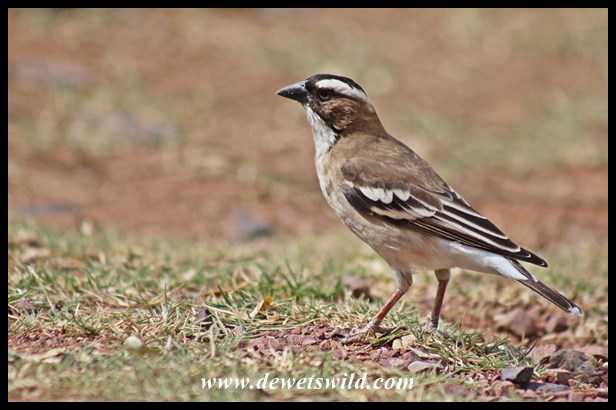
White-browed Sparrow-Weaver

Plocepasser mahali

The White-browed Sparrow Weaver is a dominant and conspicuous inhabitant of drier woodlands, thornveld, savannas and grasslands. They usually move around in small flocks of 4-10 birds, feeding on a wide variety of fruit, seeds, leaves and insects on the ground. Adults grow to 19cm in length and weigh around 50g.

White-browed Sparrow-Weavers nest in small colonies, building untidy grass nests in taller trees (including exotics) or artificial structures (like utility poles), in which they stay throughout the year. Families of White-browed Sparrow-Weavers aggressively defend their territories against intruding neighbours. Each bird in the group has its own nest, and only the dominant, monogamous, pair in the group breed. While breeding has been recorded throughout the year in response to rain, there is a definite peak in the warm summer months. Sleeping nests can be identified by having two entrances, while breeding nests have a single opening. The dominant female is responsible for incubating the clutch of 1-3 eggs for 2 weeks but the entire group assists her in the feeding of the chicks as they grow. The chicks fledge when they’re about 3 weeks old.

The IUCN describes the White-browed Sparrow-Weaver as being common to abundant and lists it is “least concern“. They occur from Ethiopia south to Angola and South Africa. In South Africa, White-browed Sparrow-Weavers are found mainly in the drier north-western parts of the country – the provinces of the Northern Cape, North West, Free State, Gauteng and Limpopo and parts of Mpumalanga and the Eastern Cape – and it would appear that they are expanding their range and increasing their numbers.

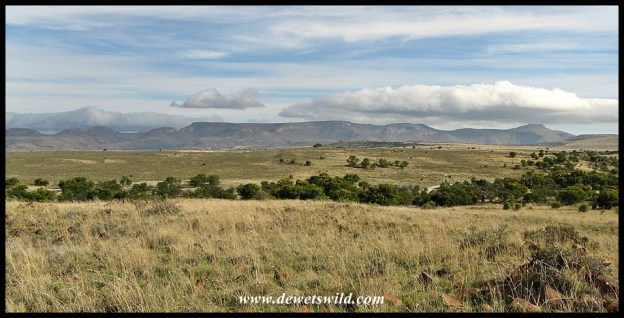
Mountain Zebra National Park

Historically, the Cape Mountain Zebra occurred widely in the mountainous areas of what today is South Africa’s Eastern, Western and Northern Cape Provinces. With the settlement of Europeans in these areas, and the consequent increase in competition for grazing with their livestock as well as uncontrolled hunting, the numbers of the zebras started plummeting. With their plight finally brought to public awareness, the National Parks Board (today SANParks) proclaimed the farm Babylons Toren in the Cradock district the Mountain Zebra National Park in 1937. At 1,432 hectares in extent, the newly established Park was hopelessly too small, and the founding herd of 5 stallions and 1 mare entirely inadequate to save the species from certain doom, and by 1950 the world population of Cape Mountain Zebra had dwindled to only 91 animals, of which only 2 were in the national park that carried their name. That same year a local farmer donated 11 zebras to the park, but it was only in 1964 that the Park was expanded to 6,536 hectares with the addition of neighbouring properties. This proved very much to the zebras’ liking, and by 1969 the Park’s herd stood at 98 head and by 1978 had grown to 200. Today, the Mountain Zebra National Park protects around 500 of these beautiful animals, and several hundred more have been reintroduced to areas in their historic distribution range.

The Mountain Zebra National Park lies at the transitional zone between the arid western Karoo-scrublands and the moister, eastern grasslands, and protects a wide variety of habitats and landscapes within its borders. Given its amazing topographical diversity it should come as no surprise that over 700 plant species occur in the Park. With the future of the Cape Mountain Zebra secured, the focus of the Park could be shifted to biodiversity conservation, and with the help of wildlife artist David Shepherd and several corporate sponsors, enough funds were collected to enlarge the Park to over 28,000 hectares, which allowed the introduction of several large game species – notably lion, cheetah, buffalo and black rhino – to their former haunts.

Sharing the Mountain Zebra National Park with its most celebrated inhabitants is 65 other kinds of mammals…

… and to date 257 bird species have been recorded in the Park.

There’s also a multitude of smaller, less noticeable animals in the Park, including 45 kinds of reptiles, 10 species of frogs, and giant 4m long earthworms!

In recent years, Mountain Zebra has become one of South Africa’s most popular national parks, and recently the number of accommodation units at the Park’s rest camp (which also boasts a small shop, restaurant and swimming pool) had to be substantially increased to cater for the demand. Doornhoek Guest House is a historic homestead restored to its former glory and now converted to luxurious overnight accommodation in a secluded corner of the Wilgerboom River valley. There’s also a terrific camping site, two picnic sites, an extensive network of game-viewing roads, three 4×4 trails, a guided hiking trail and guided game drives available to visitors. A unique attraction at Mountain Zebra is the “cheetah tracking” where guests accompany researchers and rangers to find radio-collared cheetahs in their natural habitat.

Mountain Zebra National Park was the eighth and penultimate stop on our December 2017 tour through eight of South Africa’s national parks. It is located just outside the small town of Cradock, on the R61-road to Graaff-Reinet.

Cape Bulbul

Pycnonotus capensis

The Cape Bulbul is endemic to South Africa, and specifically the Northern, Western and Eastern Cape Provinces. The IUCN lists the Cape Bulbul as being of least concern, and describes it as common to abundant. They inhabit thorny thickets in the semi-arid Karoo, fynbos, coastal scrub and dune forest, have adapted extremely well to suburban parks and gardens, and feeds mainly on fruit, supplemented with nectar, seeds and invertebrates. Adults are about 20cm long and weigh around 40g.

Cape Bulbuls are active and noisy birds, generally seen in pairs or small groups, and breed throughout the spring and summer months. The female is solely responsible for the building of the nest (a sturdy cup of plant material placed on the outer branches of a tree or shrub) and incubating the clutch of 2-5 eggs for a period of two weeks. Both parents provide food to the chicks, which leave the nest at about two weeks old, without yet being able to fly. The chicks fledge a few days later, and then become fully independent at about 7 weeks old.

Elephants, Elephants, and more Elephants!

If you thought our previous post on the Addo Elephant National Park was a bit short on elephant photo’s, you’d be right. But Addo’s star attractions really deserve a post all to themselves, wouldn’t you agree?

With the proclamation of the Addo Elephant National Park in 1931, only 11 African Elephants remained in the Addo district. Initially, the Park was not fenced to keep the elephants in and when they left the Park they were at the mercy of the “civilisation” that wanted to destroy them all, so the first Park manager made the decision to feed them with citrus and other fresh produce to keep them within his boundaries. Slowly but surely their numbers started growing, but by the time the Park was finally surrounded with an elephant-proof fence in 1954, there was still only 22 elephants at Addo. The unnatural practice of feeding the elephants, which in the end was done more for the entertainment of tourists than for the elephants’ sake, ended in 1979. By then the herd numbered about 100 animals, but Addo’s elephants have responded wonderfully to the protection they’ve been afforded since the Park’s proclamation, and today number over 600!

Addo Elephant National Park

By the early 1900’s the Eastern Cape’s wildlife was being exterminated at an alarming rate. The last lions and black rhinos in the region did not see the arrival of the year 1900, and only about 140 African Elephants remained around the Addo district, which was rapidly developing into an important agricultural area, leading to conflict with the newly established farmers. The government’s decision to intervene was not good news for the elephants. In 1919 they appointed Major P.J. Pretorius to destroy the elephants, and by 1920 he had killed 114 of them and caught 2 for a circus. Only 16 elephants remained when public sentiment swung in their favour and the wanton killing ended, and when the Addo Elephant National Park was proclaimed in 1931, only 11 elephants were left. It wasn’t until 1954 when an area of 2,270 hectares was surrounded by an elephant proof fence that the future of the Addo elephants finally looked secure. Along with the elephants, the last free-roaming herds of African (Cape) Buffalo that occurred in the then Cape Province, as well as the unique and endemic Flighless Dung Beetle, finally found a secure refuge. In subsequent years the Park’s area was expanded and species that fell into local extinction through the barrel of a gun were reintroduced.

With the Addo elephants now finally living in a safe refuge, the focus at Addo Elephant National Park is no longer on saving a single species. Today, the park’s management is concerned with the protection of the enormous diversity of landscapes, flora and fauna encompassed within its boundaries, which covers an expansive area of over 178,000 hectares stretching from beyond and across the Zuurberg range to the coastal forests and dune fields of Alexandria. The Park protects portions of no less than five of South Africa’s seven distinct terrestrial biomes, these being subtropical thicket, fynbos, forest, grassland and Nama-Karoo, not to mention the portion of marine environment protected around Algoa Bay’s St. Croix and Bird islands which is important breeding sites for endangered seabirds. Addo is the only National Park in South Africa that can claim to protect the “Big Seven” –  Elephant, Lion, Black Rhino, Buffalo, Leopard, Great White Shark, and Southern Right Whale.

Addo Elephant National Park protects a total of 95 mammals species, including all the members of the famed “Big Five“.

The Park also boasts a list of 417 bird species!

And if that isn’t enough, visitors also have a chance of spotting any of the more than 50 reptile species or 20 kinds of frogs and toads that call Addo Elephant National Park home. The Park’s most famous invertebrate inhabitant undoubtedly is the Flightless Dung Beetle (Circellium bacchus), this being only one of 5 places they are still found. These interesting insects make use of elephant, rhino, buffalo and kudu dung as food, either for themselves or rolled into brood balls in which they lay a single egg before burying it in soft sand and on which the larvae then feeds when it hatches.

The Addo Main Camp is the Addo Elephant National Park’s first and biggest tourist facility. Camping and a wide variety of accommodation (as well as a swimming pool) is available to overnight guests. There are picnic sites for day visitors, an underground hide overlooking a waterhole frequented by all the Park’s animals and floodlit at night (we even saw a brown hyena there when we visited in December), a birdwatching hide overlooking a small artificial wetland, a self-guided discovery trail, guided drives and horse rides, a fuel station, restaurant, shop and excellent interpretive centre where young and old can learn more about the Park and its inhabitants. Elsewhere in the Park guests can overnight at the luxury, full service and privately-run Gorah, Riverbend and Kuzuko-lodges, or in one of the Park’s own camps at Nyathi, Matyholweni, Kabouga Cottage, Mvubu Campsite, Narina Bushcamp, Langebos and Msintsi. Between the Main Camp and Matyholweni guests have access to an extensive and well-maintained network of all-weather game viewing roads, while other areas of the Park can be explored along hiking trails or 4×4 trails.

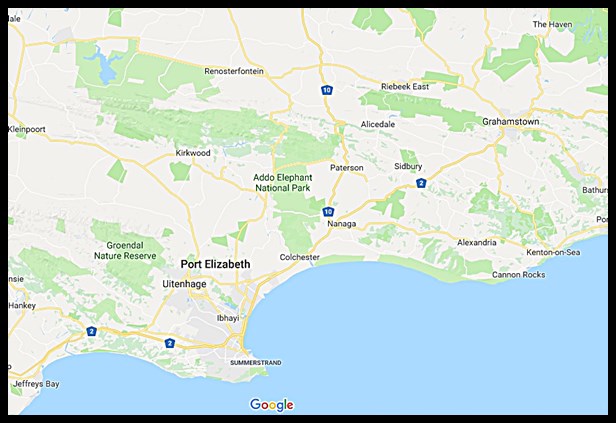
We spent three nights camping at the Addo Main Camp during our December 2017 holidays at eight of South Africa’s National Parks. The easiest way to reach the Park is along the N2 highway from Port Elizabeth, turning off to the gate at Matyholweni just before you reach the small town of Colchester on the bank of the Sundays River, about 45km from PE’s airport.
Swift Tern

Thalasseus (Sterna) bergii

The Swift Tern, or Greater Crested Tern, usually inhabits the shallow tropical and sub-tropical waters of lagoons, estuaries, bays, harbours and open beaches where it feeds mainly on fish (up to 90% of its diet) as well as squid, crustaceans and insects. Adults have a wingspan of up to 1.2m and weigh up to 430g.

These terns are gregarious birds, nesting and roosting in fairly large and dense colonies, often mixed with gulls and cormorants, usually on offshore islands, reefs or sandbanks and occasionally on top of buildings. Nests are shallow scrapes in the bare sand or on rocks and often quite exposed. The breeding season in Swift Terns stretches from late summer through winter to early spring. Pairs are monogamous. Clutches consist of 1 or 2 eggs and are incubated for around 4 weeks by both parents. Chicks fledge at a little over a month old, but don’t become fully independent until they’re about 5  months old.

The IUCN considers the Swift Tern to be of least concern, estimating the total population at around a million birds, with an enormous distribution stretching from Namibia and South Africa along the Indian Ocean coasts of Africa, the Middle East and Asia, and into the Pacific Ocean far to the north-east of Australia. They occur along the entire South African coastline, though about 80% of the local population, estimated in the region of 25,000 birds and increasing, is found in the Western Cape during the breeding season.

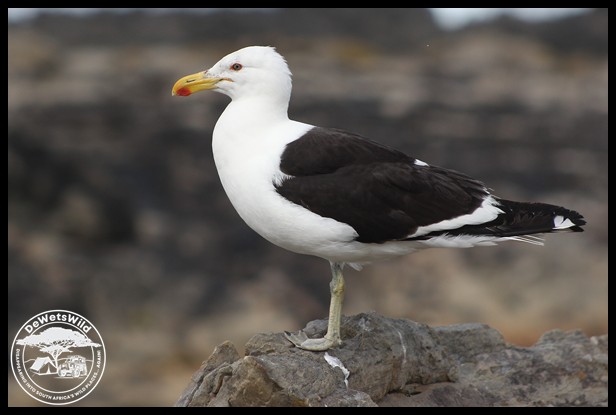
Kelp Gull

Larus dominicanus vetula

One of the most familiar seabirds in South Africa, Kelp Gulls inhabit a wide range of habitats along or near the coast, including harbours, bays, lagoons, estuaries, dams, lakes, rivers, streams and rocky and sandy beaches. They’ll also scavenge in large numbers at dump sites, food factories, abattoirs and sewerage works and have been recorded following fishing trawlers up to a 100km from the coast. Their natural diet is composed of marine invertebrates, fish, the chicks and eggs of other birds, small vertebrates, and carrion.

Adult Kelp Gulls have a wingspan of up to 1.4m, and weigh around 1kg.

Kelp Gulls are a gregarious species, occurring in large flocks throughout the year and breeding colonially during the southern spring and summer. Nesting colonies are usually located in hard to reach places, such as cliffs, rocky islands, exposed reefs, sandbanks and even on top of shipwrecks or buildings, where the bulky nest consists of dried plants, seaweed. twigs, shells, feathers and small stones. They’re very protective of their nests and will dive-bomb and defecate on any perceived threat, including humans. Pairs are monogamous and usually stay together through several breeding seasons. Clutches are usually made up of 2 to 4 eggs, which are incubated for about 4 weeks by both parents. Kelp Gull chicks fledge when they’re about two months old but stay with their parents for up to 6 months. They reach adulthood at between 3 and 4 years of age.

With an expanding population estimated at as many as 4,3-million, and a distribution range that spans much of the southern hemisphere, the IUCN considers the Kelp Gull of least concern. The race occurring in South Africa, also known as the Cape Gull, is considered to be a seperate species by some authorities and numbers at least 20,000 breeding pairs. They occur along the entire South African coastline and adjacent interior, though in lower densities along the coastline of Kwazulu-Natal than in the Eastern, Western and Northern Cape.

Knysna Turaco

Tauraco corythaix

The Knysna Turaco, or Knysna Lourie, is a very colourful bird inhabiting the evergreen montane and riverine forests of southern and eastern South Africa (from the Garden Route through the Eastern Cape and Kwazulu-Natal to the escarpment of Mpumalanga and Limpopo), extending marginally into Swaziland. Knysna Louries feed mainly on fruit, with seeds and insects making up only a small proportion of its diet. The IUCN lists it as being of least concern although it may be locally impacted by uncontrolled deforestation.

Often heard long before it is seen (its loud kok-kok-kok call being a familiar sound in the forests it inhabits), these beautiful birds are commonly encountered in the Garden Route National Park, though getting decent photographs of them in their dense and dark habitat can prove tricky! Adult Knysna Turacos grow to a length of 46cm and weigh up to 350g.

Both parents are involved in building the nest, which is little more than a flimsy platform of sticks and twigs among dense foliage, and incubating the clutch of one or two eggs for just over 3 weeks. The chicks grow quickly, start practicing to fly before they are a month old, and stay with their parents until they’re about 3 months old. Their breeding season stretches almost throughout the year, but peaks from September to December.

African Oystercatcher

Haematopus moquini 

The African Oystercatcher occurs only along the coastline of Namibia and South Africa (mainly the Cape Provinces and only sporadically into Kwazulu-Natal) where they frequent the intertidal zone on rocky and sandy beaches, estuaries, lagoons and coastal wetlands looking for molluscs (mostly mussels and limpets) and other aquatic invertebrates.

With an average weight of around 730g, females are slightly larger than males. Adults have a wingspan of about 80cm.

While non-breeding individuals can congregate in flocks of up to 200 birds, especially at roosts, breeding pairs of African Oystercatchers are territorial and monogamous and may stay together for as long as 25 years. They breed in spring and summer, with a peak over December and January, which makes them especially vulnerable to disturbance by holiday makers. Nests are located on rocky islands or beaches and is little more than a bare scrape above the high-water mark. Despite the meagre appearance of the nest the eggs are extremely well camouflaged. Both parents take turns to incubate the clutch of 1-3 eggs for between 4 and 5 weeks, with the chicks leaving the nest as soon as they are a day or so old. Chicks fledge when they are about 6 weeks old but can remain with their parents for up to 6 months.

Today, the IUCN considers the African Oystercatcher as being of least concern, with an increasing population size thanks to improved conservation measures (such as banning 4×4 driving on beaches). It is estimated that there is now around 6,700 of them, which is probably about double the number that existed in the 1970’s, and their conservation status could recently be upgraded from “near-threatened”. Birdlife South Africa has designated the African Oystercatcher as the 2018 Bird of the year – good places to see them is the Agulhas, Garden Route and Table Mountain National Parks.