

Crocuta crocuta

Spotted Hyenas roaming outside Mpila Cottage 16 in December 2018
Often depicted as cowardly villains and skulking scavengers, the truth is that the Spotted Hyena is a very efficient predator that mostly catches its own prey and dominates all other African predators with the exception of lions. Standing up to 90cm high and weighing up to 85kg, the females are considerably stronger built than the males and have very male-like genitalia, leading to a common misconception that spotted hyenas are hermaphrodites.


Spotted Hyenas have adapted to every habitat on the African continent except the tropical forests, though they prefer savannas, grasslands, woodlands and semi-deserts. They’re not dependant on drinking water but will drink when it is available and love cooling off in natural pools on hot days. Spotted Hyenas easily prey on anything from insects to giraffes and buffaloes, their diet normally reflecting which animals are most common in their area, but will also opportunistically scavenge from the kills of other carnivores (less than a third of their diet) and around rubbish dumps and human settlements. Excess food is often stored under water for later consumption. In many protected areas Spotted Hyenas have learnt that tourist camps are a reliable source of discarded food; a dangerous situation that often leads to injuries to people with lethal consequences for the hyenas.


Spotted Hyenas live in clans numbering from 3 to 80 (the size and stability of which depends on prey availability) in which a strict, female dominated, hierarchy exists. The most dominant female passes her status to her female young, and all females are dominant over all males in the clan. Males mostly join clans from other groups from which they were evicted, and it can take weeks and even months for them to be accepted into a new family. Each clan has a territory covering between 40 and 1800km² (dependent again on prey availability), that is demarcated with scent glands and communal dung middens and will be fiercely defended against interlopers. Within the territory a number of dens are established in dense vegetation, caves, between boulders or in holes in the ground (they’ll also often use human-made culverts under roads for this purpose) and used on a rotational basis. Spotted Hyenas are most active from dusk to dawn, usually hunting alone or in small parties except when going after big game, when the whole pack will join forces. When hunting they can reach speeds of up to 65km/h, but they can sustain a pace of 50km/h over a distance of up to 5km as they tire out their intended prey. They’re among the most vocal of mammals, and their well known laughing, howling and cackling is synonymous with the African night.


Females usually give birth to two cubs (though up to 4 have been recorded) at anytime of year. Cubs are kept hidden from the rest of the clan for the first two weeks of their life. More than one female in the clan may be raising cubs at the same time, but they will not take care of one another’s young. Cubs are often extremely aggressive to one another, especially of the same sex, and it is not unusual for some of the litter to die as a result of the constant fighting. The cubs are dark brown to black at birth, attaining adult colouration from the age of 2 to 3 months. Lions consider Spotted Hyenas their mortal enemies and will kill them at any opportunity, and outbreaks of rabies can decimate entire clans. Spotted Hyenas can live to the age of about 25 in the wild, and up to 40 years in captivity.


With a total population estimated between 27,000 and 47,000, the spotted hyena is one of the most numerous large carnivores on the African continent, and considered of least conservation concern by the IUCN. However, their populations are decreasing, especially outside large conservation areas, due to human pressures such as illegal hunting, poisoning and loss of habitat and prey. South Africa’s biggest population can be found in the Kruger National Park, estimated at up to 3,900 animals, and they are also a regular sighting in Addo Elephant National Park, Mapungubwe National Park, Hluhluwe-Imfolozi Park and the iSimangaliso Wetland Park.


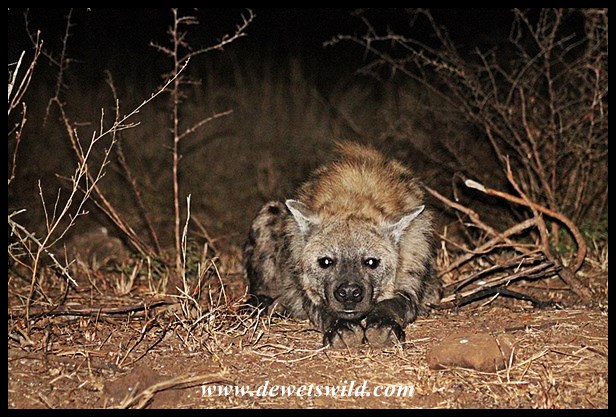
Spotted hyena
 DeWetsWild
Pingback: Just look at those teeth! | DeWetsWild
Pingback: Satara Summer 2021 – Fascinated with Spotted Hyenas | de Wets Wild
Pingback: The bloody fight that never was | de Wets Wild
Pingback: Hippopotamus | de Wets Wild
Pingback: Creatures Great and Small at uMkhuze | de Wets Wild
Vertrou daardie oë gladnie. Mens kan sommer sien hoe die verstand aan die werk is agter daar die paar oë.
Ek dink ook hulle is baie intelligent en word heeltemal onderskat deur meeste mense.
Pingback: Leopard | de Wets Wild
They are a bit scary to come across, as they can creep up so quietly!
So true, Joan! They’ve given us a few scares that same way!
Thank you so much for sharing, long back it had been fun to see them in the beautiful movie, Gods must be crazy 🙂
Must be one of the most watched South African movies that!
Moeder Natuur se mooiste kinders! NIE!! 😉
Miskien nie die mooiste nie, maar beslis van die interessantste!
Very interesting! Thanks for sharing your great photos and information about these creatures.
We love hyenas! Glad we could help show just how interesting they are!
Mooiste fotos!! Ek hoop ons kry een te sien. Of baie.
Ons sal duim vashou! Hulle is darem sulke interessante diere.
Sjoe dis mooi foto’s
Baie dankie, Tina!
Thanks for that link, I’d never heard anything except the “laugh” before. They have quite a vocal range. I’ve heard that when hyenas are waiting for lions to finish a meal it’s quite likely the hyenas made the kill in the first place and the lions took it away from them. The belief that they were scavenging from lion kills is part of what got them the bad rap. They are fascinating creatures!
Most fascinating indeed, Pat, and one of our favourite animals. And it may well be true that lions, especially the males, steal more from hyenas than the other way around.
Good info…but they still spook me out a bit!
Indeed, you wouldn’t want to encounter a hyena in the dark!
They have such a horrible reputation on the wildlife programs, but as with all of nature they play a part. Great close-ups!
It’s not only some politicians who get a bad wrap from the media! 😀
I’m off to Tanzania next week for some ‘safari-ing’ with friends of mine… I hope I’ll get a chance to take some photos as gorgeous as all of your collections!
That sounds like a brilliant adventure! I’m sure you’ll return with many beautiful photos with such beautiful models to focus on!
I remember being in a group of girls at school (middle school), where we found everything funny. There would always be one who would mock the hysterical outburst and call it “laughing like a hyena.” Soon we learned to laugh in a more lady-like manner.
Now that would be a terrible insult to any young lady!
Scary looking! But cute young! 🙂
Quite a transformation that they undergo as they grow older!
Great closeups with the eyes.
Thank you Rosemarie!
They’re not friendly-looking, but I love their ears. 🙂
janet
They do look rather menacing, don’t they Janet? Did you show this post to your daughter who loves hyenas so?
I sent her the link. 🙂
So glad you did. We’ve been promising a post about hyenas for far too long!
The babies are so cute.
Very cute, almost can’t believe they’re so vicious!
Great photos, Dries. Very interesting facts too.
Thanks very much, Sylvia!
Fascinating! Thanks for the information and the great photos–as usual.
Indeed one of our most fascinating creatures, thanks Patti!