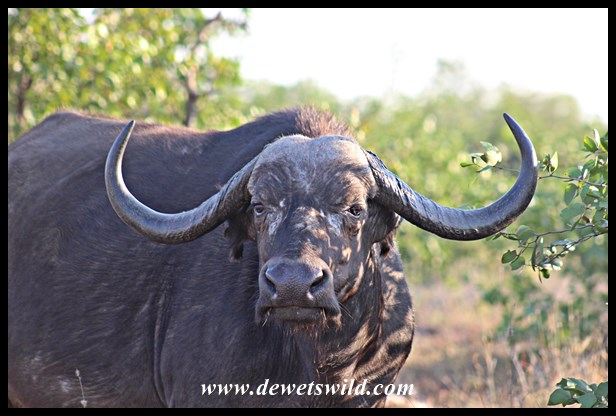
Probably due to the prevailing drought, we encountered very few buffalo in the five days we spent around Satara during our winter visit to the Kruger National Park. However, that all changed when we moved northwards to Mopani, where better winter grazing seems to have attracted even more of the huge herds of these bulky beasts than we would normally have expected to see in that region.

Crossing the road

Getting irritated by the oxpeckers

Getting irritated by the oxpeckers

Strange head ornament

Deciding to fight or flee

Not impressed with being gawked at by humans

Enjoying the first rays of sun on a cold morning

Coming to water along the Tsendze

Just look at that great posture!

Beautiful old cow
 DeWetsWild
Pingback: Herbivore Haven | de Wets Wild
I’ve always found Mopani very rewarding for Buffalo. Did you guys stay at Tsendze?
On this trip we stayed in a cottage at Mopani, Maurice, with a lovely view over the dam!
It’s a beautiful hill – love the Baobabs
Baobabs and mopane plains, quintessential Northern Kruger!
powerful animals – wouldn’t want to get in their way…
Absolutely Annette – you don’t want to tangle with a buffalo!
Oh my goodness…that face!
Beautiful old cow, isn’t she Kathy? 😀
We once drove through Wood Buffalo National Park in Northern Alberta, kept my eyes strained the whole way…never saw a one!! Until I became a Chef and cooked one up for a burger! lol…
You had to go to some horrible lengths to see a buffalo then, Teresa! 😀
It was actually only parts of it… quite good ! Not much different then Beef…. sorry! they raise them like cattle now and they are just so docile, it doesn’t seem right does it? I feed my dog Venison…poor Bambi! I was raised on wild game like Moose and Venison… Oh, Moose gives you the farts so if you ever try it so be forewarned! lol… 🙂
Perhaps luckily, we seldom have the opportunity to dine on moose, Teresa! Sounds like a real hoot! 😀
Baie mooi foto’s,veral waar die renostervoëltjie die buffel so pla!
Baie dankie Dina! Daardie voeltjie was besonders irriterend!
Fantasiese foto’s
Baie dankie, Toortsie!
Not the sort we see in the western US. 😉
janet
Do you know whether “buffalo” or “bison” was the original name for your version of wild cattle, Janet, and when and why the other name then came into use?
Here’s what I found in an article on Mental Floss:
No buffalo have ever lived in North America, according to MacPhee, so how come we call bison by that name? According to the National Park Service, when early explorers came to North America—at which point there may have been as many as 60 million bison on the continent—they thought the animals resembled old world buffalo, and so they called them that. The word comes from the Portuguese bufalo, or “water buffalo,” from the Latin word bufalus, a variant of bubalus, which meant “wild ox.”
Sounds good to me! 😉
janet
Thank you so much Janet! That certainly is a clear explanation!
Wow! What a face he has. Those ox-peckers really take their job seriously. 🙂
Absolutely Sylvia! They just do not seem to get the hint!
😅
Those little birds are persistent, aren’t they?
There isn’t a nook or a cranny on any herbivorous animal that they won’t go crawling into, Lois!
Ha! That made me laugh! That is so strange.
They go after the ticks that hide in all the dark places!
These guys are so adorable… well in a big horned kind of way 😉
I still find it funny folks here in the US call our bison, buffalo. 🐂🐃
They’re very adorable – at more than an arms length! 😀
I’ve often wondered which name was used first – bison or buffalo? Was “buffalo” a word that came over from Europe? But there, they have the European Bison, or Wisent, which looks so much like the American Bison so why not use that name rather? Was “Bison” the indigenous name for them? Could be an interesting study topic!