Monthly Archives: July 2015

Inspiration

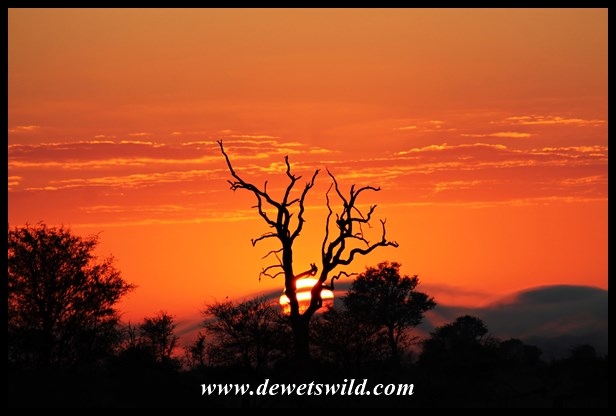
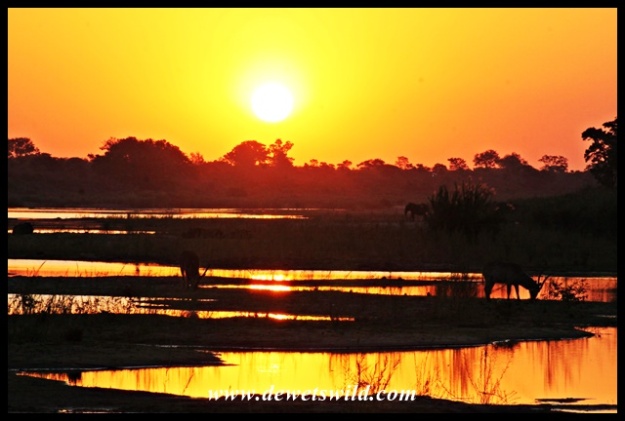
It probably comes as no surprise that we’re inspired by the beauty of a tranquil South African sunset, like this one over the Sabie River near Lower Sabie Rest Camp, in the Kruger National Park.

Inspiration

Inspiration” is the theme for this week’s WordPress Photo Challenge

World Ranger Day

The 31st of July is set aside as World Ranger Day, a day to appreciate the work these dedicated people perform on behalf of humanity, to celebrate their successes and commemorate those that laid down their lives in the line of duty.

Ranger Day

Having just spent three days with two exemplary rangers on the Sweni Wilderness Trail in the Kruger National Park, it became as clear as ever just what an incredible debt of gratitude we owe the men and women protecting our natural heritage.

Ranger Day 2

Imfolozi, in the middle of a dry spell

In the 20 years that I’ve been visiting the Hluhluwe-Imfolozi Park, I’ve never seen the Black Umfolozi River bone-dry at the bridge on the way to Mpila Camp. That changed when we visited in July 2015. A drought has the north of Kwazulu-Natal Province in its firm grasp and it is evident that the Park is unfortunately not escaping its ravages.

Travelling south-west after entering at Memorial Gate, through the Hluhluwe-section of the Park, we couldn’t help noticing how parched even this normally lush area has become, a marked contrast from when we visited in December 2014. Game-viewing was easy going, as animals were congregating in their numbers around the remaining water sources and the denuded vegetation provided little cover. After checking in at Mpila, we headed for Sontuli Loop, our favourite drive in the reserve.

The next morning saw us out exploring Imfolozi at the break of dawn. The animal population seems to be coping well with the harsh conditions and we had good sightings of several species of birds, mammals and reptiles. Unseasonably hot weather, in the low 30’s Celsius, saw us return to Mpila for a siesta during the midday heat before taking our afternoon drive to Ubhejane Hide .

Overnight a cold front accompanied by strong gusts of wind passed over the Park, seeing temperatures drop to less than half of what they were the previous day and overcast conditions prevailing throughout. This allowed us to stay out exploring for most of the day, visiting the Centenary Centre for lunch (we can highly recommend the ostrich burgers sold at the take-away kiosk!). A drive out to the extreme south-west corner of the reserve that afternoon put our minds at ease with the knowledge that the White Umfolozi River, that runs through the Park’s wilderness area, is still flowing, albeit only a trickle compared to the normal situation.

More of the same wintery weather greeted us as we woke on our last full day in the Park, and the hot cup of coffee and rusks we enjoyed that morning at Ubhejane Hide was indeed very welcome. By now we knew the few remaining pools at the viewpoint over the Black Umfolozi (near point 17 on the Park map) was like a magnet to wildlife, and finding three big male lions there guarding one of them was no surprise. The band of brothers remained in the same spot all day, doing what lions do best – sleeping! As for the de Wets, we headed for Sontuli Picnic Site for a lovely braai (South African barbeque) and then enjoyed our traditional last slow drive along Sontuli Loop at dusk before heading back to camp.

It’s unbelievable how quickly time passes when enjoying South Africa’s wild places. Leaving the Park on the morning of the 15th of July, we were concerned about the effects a prolonged drought would have on the Park’s vegetation and wildlife. Recent news about good rains falling in the area therefore was extremely welcome. It might not break the drought, but it will replenish the waterholes and hopefully carry the wildlife through to summer when (hopefully) more rain should come.

HIP 15Jul2015

————————————————————————————————————————————–

For our July 2015 visit, we opted to enter and exit the Hluhluwe-Imfolozi Park at Memorial Gate, in the north of the reserve (a 7-hour, with stops, 570km drive from our home in Pretoria), and spent four nights at wonderfully wild Mpila Camp in the Imfolozi-section of the reserve.

The route from Pretoria to Memorial Gate  (drawn with Google Maps)

The route from Pretoria to Memorial Gate
(drawn with Google Maps)

Sadly the Hluhluwe-Imfolozi Park is under threat; if a proposed coal mine on the southern border of the reserve gets given the go-ahead it will mean the end of the reserve’s renowned wilderness area and much of its, and the Isimangaliso Wetland Park’s, ecological integrity. Visit “Save our Imfolozi Wilderness” if you’d like to add your voice in opposition to this unnecessary and unwelcome development.
Close Up

This toad was waiting for us at the back door of our cottage in Mantuma Rest Camp at uMkhuze Game Reserve, in the iSimangaliso Wetland Park, when we visited in December 2014.

Close Up

Close Up” is the theme for this week’s WordPress Photo Challenge.

Back from the Wilderness

I’ve just returned from an amazing three days on the Sweni Wilderness Trail in the Kruger National Park, preceded by two nights at Lower Sabie Rest Camp. It was an experience I will never forget, for so many reasons, and I’ll be telling you all about it in upcoming editions of de Wets Wild.

Sweni sunrise

Symbol

It is the winter school holidays in South Africa and we spent the last five days in the Hluhluwe-Imfolozi Park, where the authorities go to great lengths to ensure visitors enjoy the Park safely and responsibly. Naturally, we’ll be telling you all about our visit in upcoming editions of de Wets Wild.

Symbol

Symbol” is the theme for this week’s WordPress Photo Challenge.

Natal Red Duiker

Cephalophus natalensis

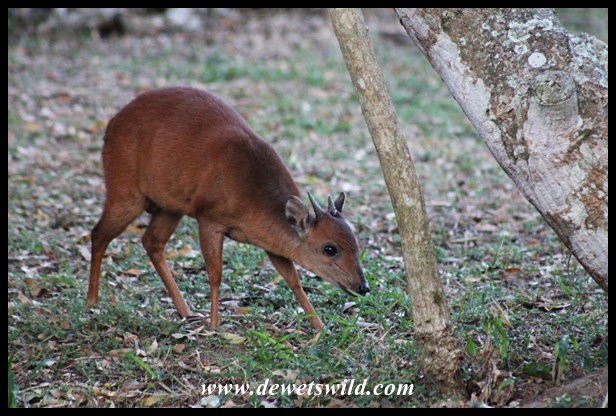
The Red Duiker is a small antelope found in indigenous forests and other densely vegetated habitats on the wetter eastern side of South Africa. Despite their richly coloured coats, these diminutive antelope blend in perfectly with their dappled forest habitat, where they feed mostly on leaves, shoots, fruits and berries.

Red Duiker (10)

Adult red duikers stand only between 35cm and 48cm at the shoulder, and weigh between 10 and 18kg. Both sexes carry short horns, often obscured by a tuft of hair on the crown.

Red Duiker (9)

Red duikers are mostly encountered alone or in pairs consisting of either a ram and ewe, or a ewe with her lamb. Single lambs are born at any time of year, weighing less than 1kg at birth. They are very shy and rush away quickly at the slightest indication of danger, unfortunately mostly along well-worn paths which makes them vulnerable to ambush predators like pythons and leopards, as well as poachers. Their natural life expectancy is 8 to 12 years.

Although the IUCN estimates that wild populations of the red duiker are declining, they are considered to be safe from extinction as the species finds protection in several well managed Parks and reserves. In our opinion the best place to get a glimpse of this beautiful little antelope is at Cape Vidal and Mission Rocks in the iSimangaliso Wetland Park and at Umlalazi Nature Reserve, though we’ve also seen them at uMkhuze Game Reserve, Tembe Elephant Park, in the Hluhluwe-Imfolozi Park and at Ithala Game Reserve.

Red Duiker (8)

A winter exploration of St. Lucia’s Eastern Shores

iSimangaliso Wetland Park, South Africa’s first World Heritage Site, is named after the isiZulu word meaning “Miracle” and “Wonder”. Our recent visit to the Park just reminded us again what an appropriate name that is.

Having visited the Western Shores in December last year, we focused our attention during our June visit on the Eastern Shores section of the Park, a diverse area lying between the Indian Ocean in the east, Lake Saint Lucia in the west, St. Lucia town and the lake’s estuary to the south and incorporating the popular destinations of Mission Rocks and Cape Vidal, where we stayed for three nights. The sunrises and sunsets alone made the trip worthwhile!

As always, the game and bird-viewing on the Eastern Shores could only be described as splendid, but the Park is clearly not escaping the ravages of the drought that has Kwazulu-Natal Province in a firm choke hold, and none of the pans close to the roads held any water. Indeed a stark contrast to the lush oases of reeds and waterlilies these waterholes normally are, complete with hippos, crocodiles and wading birds in residence. Even the Mfazana Pans, where there’s a brilliant photographic hide, was little more than an almost-dry puddle of mud.

We seem to have extraordinary luck with finding leopards here and this trip was no exception, with no less than four sightings of these beautiful cats. A late afternoon sighting of a serval, a much smaller but also spotted cat, being chased by a group of lapwings as it crossed a burnt field, was a very pleasant surprise. Unfortunately we didn’t see anything more than a footprint of iSimangaliso’s spotted hyenas during this visit. On the other side of the scale, a tiny snake, the variegated slug eater, was a first-ever encounter for us and one we’ll remember just as long as any of the leopard sightings.

We can never spend enough time at this wonderful place, and you’ll understand that we were not at all pleased that our long weekend flew past in the blink of an eye. Time to start making plans for the next visit then…

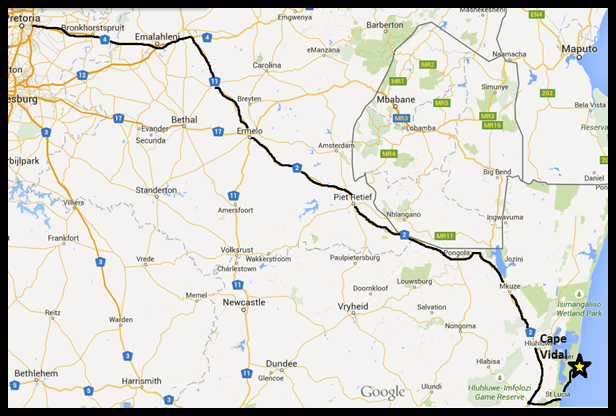
The Bhangazi gate into the Eastern Shores of Lake Saint Lucia lies roughly 640km South-East of Pretoria. (Drawn using Google Maps)

The Bhangazi gate into the Eastern Shores of Lake Saint Lucia lies roughly 640km South-East of Pretoria.
(Drawn using Google Maps)

Cape Vidal, the most beautiful beach

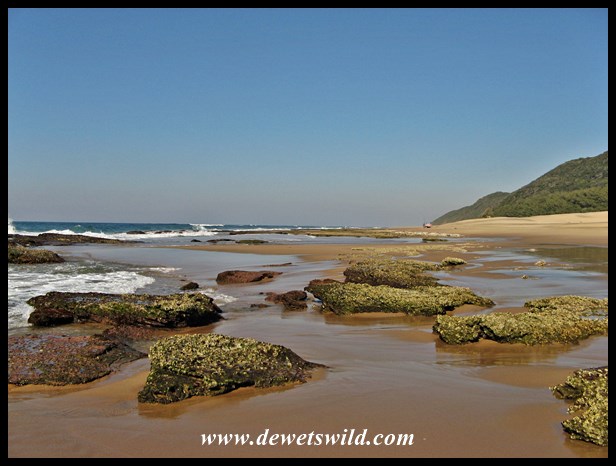
To us, there is no more beautiful a beach in this country than Cape Vidal. Miles of sand stretching as far as the eye can see, lined between densely forested dunes and the warm blue water of the Indian Ocean (in the waves of which dolphins and whales can often be seen), with rock pools harbouring fascinating marine life exposed at low tide.

Cape Vidal is named after Alexander Thomas Emeric Vidal, captain of the British surveying ship HMS Leven, that mapped this coastline in 1822. Today, this pristine area falls within the iSimangaliso Wetland Park, is one of the most popular destinations in the reserve and an excellent base from which to explore the Eastern Shores of Lake Saint Lucia. The accommodation and campsite is managed by Ezemvelo KZN Wildlife and often booked out months in advance. There’s a fuel station and a small shop selling only basic essentials, so it is best to stock-up on your groceries at St. Lucia town before entering through Bhangazi Gate 35km to the south of Cape Vidal. Apart from all the activities that the beach caters for, Cape Vidal is also one of the best spots in the country to easily see a wide variety of otherwise very shy forest birds and animals (like Samango Monkeys and Red Duiker).

Door

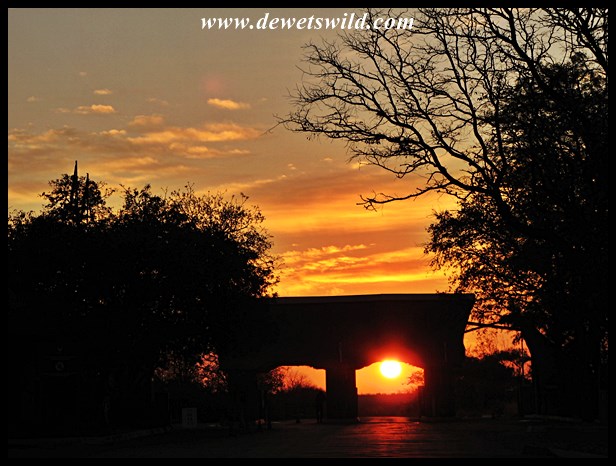
Early morning at Phalaborwa Gate, one of the gateways into the Kruger National Park.

Door

Door” is the theme for this week’s WordPress Photo Challenge