Monthly Archives: June 2015

Cruising Lake St. Lucia

Participating in a guided launch tour of Lake St. Lucia is one of the most memorable experiences to be had in the iSimangaliso Wetland Park. Several operators offer tours lasting about two hours and departing at different times of the day. In this time the cruisers move about 8km up into the lake from the jetties in St. Lucia town, bringing visitors close to a variety of aquatic life and giving an interesting glimpse into the ecology of the lake system.

During our recent visit to iSimangaliso, we enjoyed a tour on the 80-seater Santa Lucia, a joint operation between Ezemvelo KZN Wildlife and Thompsons Tours. A cashbar on board sells drinks and snacks while a guide gives detailed explanations of the surroundings and wildlife encountered along the way. We passed several pods of hippos (witnessing one naughty youngster chewing on another tourboat), a few crocodiles, numerous birds, wildlife on the shore, got a chance to view the mangrove marshes and even saw a shark’s dorsal fin briefly break the water’s surface.

This gallery should give you some idea of what you can look forward to on a guided launch tour of Lake Saint Lucia!

Ian Player on the African Wilderness

We’ve got three million years of Africa imprinted on our psyche…to see how people are gripped by the spirit of Africa, particularly at night when they sleep on the red earth, that very ancient earth, and they dream their dreams. There is a connection that is evoked from the depths of the collective unconsciousness that has drawn us all together. And also when they hear the leopard at night. That rasping call. It sparks something inside…It is an experience that has awakened thousands of people to the value of African wilderness, and the understanding that it was once their home. And it inspires them to protect it, because it is the landscape of the human soul.

(The late Dr. Ian Player in an address to the eighth World Wilderness Congress.)

Ian Player

Ineke, who blogs at “I scrap 2“, kindly invited us to join in the “3 days, 3 quotes challenge”. We in turn extend an open invitation to all de Wets Wild’s friends to join in, and we look forward to the wise words you have to share!

Robert McCammon on Africa’s elephants

“They say that somewhere in Africa the elephants have a secret grave where they go to lie down, unburden their wrinkled grey bodies, and soar away, light spirits at the end.”

Robert McCammon

Robert McCammon

Ineke, who blogs at “I scrap 2“, kindly invited us to join in the “3 days, 3 quotes challenge”. We in turn extend an open invitation to all de Wets Wild’s friends to join in, and we look forward to the wise words you have to share!

Muse

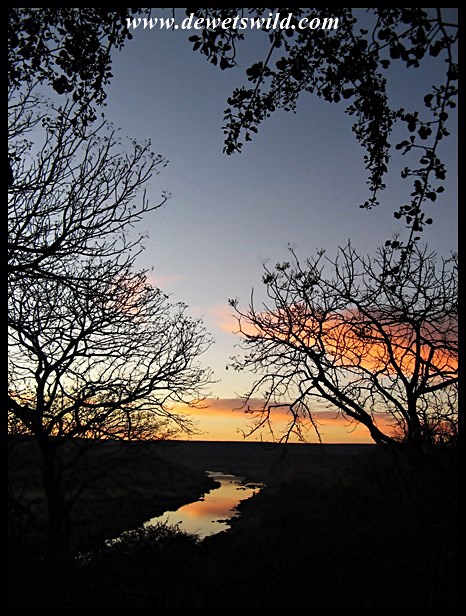
Out in South Africa’s wild places it’s very difficult not to be enamoured with our magnificent sunrises and sunsets. This photograph was taken at Lake Panic, near Skukuza in the Kruger National Park.

Muse

Muse” is the theme for this week’s WordPress Photo Challenge

Richard Mullin on Africa

“The only man I envy is the man who has not yet been to Africa; for he has so much to look forward to.”

Richard Mullin.

Richard Mullin

Ineke, who blogs at “I scrap 2“, kindly invited us to join in the “3 days, 3 quotes challenge”. We in turn extend an open invitation to all de Wets Wild’s friends to join in, and we look forward to the wise words you have to share!

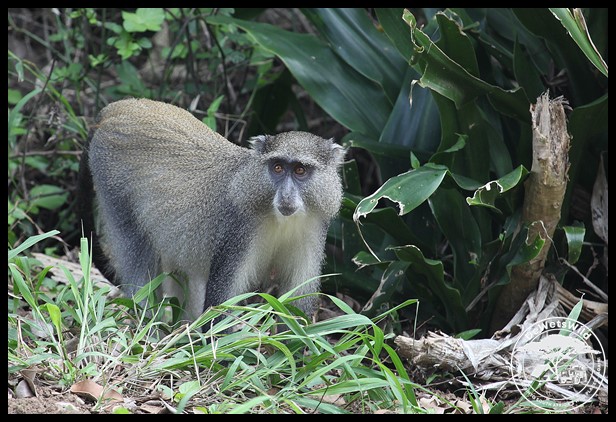
Samango Monkey

Cercopithecus mitis

The Samango Monkey is one of South Africa’s less well-known primates, being restricted to the densely vegetated habitats along the coast and adjacent hinterland of the Eastern Cape and Kwazulu-Natal and the escarpment forests of Mpumalanga and Limpopo provinces.

Samango Monkey (5)

Males are considerably stronger built than females, and weigh up to 11kg.

Samango Monkeys are to be found only in indigenous forests and on their edges, where they feed on fruits, flowers, leaves, seeds, insects, bark, eggs, nestlings and small mammals and reptiles. Troops number up to 70 individuals, though usually far fewer with 20 being the average, and are lead by between one and five adult males. They are strictly diurnal and much more arboreal than the vervet monkey, their better known and more widely distributed South African cousin. Single babies are born in the summer months. Forest predators, like leopards, crowned eagles and pythons, are their biggest natural enemies.

Known elsewhere in Africa as the Sykes’ or Blue Monkey, with several recognised subspecies, the race of Samango Monkey occurring in South Africa is considered “vulnerable” by the IUCN, as they occur mostly in small numbers in highly fragmented habitats, with little genetic exchange between subpopulations. We’ve encountered Samango Monkeys in the Hluhluwe-Imfolozi Park, Tembe Elephant Park and in the Oribi Gorge, but it is only at Cape Vidal in the iSimangaliso Wetland Park that you’d be virtually guaranteed to see this special species as they’ve become quite habituated to the human presence and boldly raid even the best protected picnic basket…

These are all camera trap photos of samango monkeys at Cape Vidal

Variegated Slug Eater

Duberria variegata

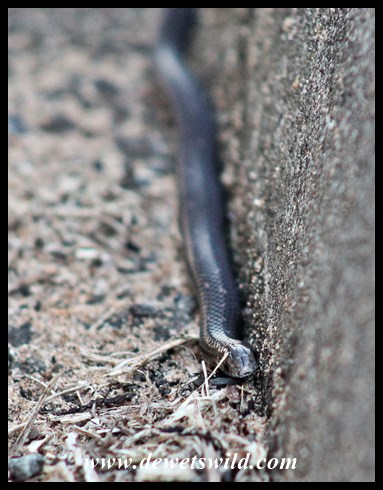
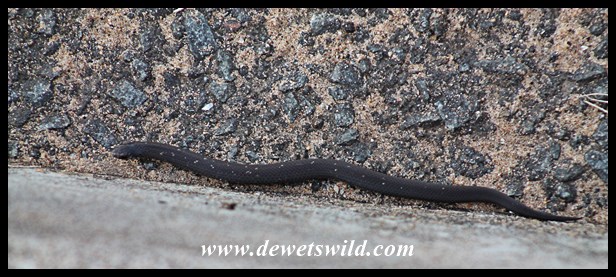
While visiting the iSimangaliso Wetland Park recently, we came across this tiny snake at  the Amazibu Hide between St. Lucia Town and Cape Vidal.

Variegated Slugeater (2) Variegated Slugeater (4)

Referring to our copy of the Field Guide to Snakes and Other Reptiles of Southern Africa (Bill Branch, Third Edition 1998), Marilize suspected it to be a Variegated or Spotted Slug Eater, an identification confirmed with the assistance of the helpful people at the SA Reptiles Forum.

These snakes are endemic to a very small piece of South Africa’s north-eastern and Mozambique’s southern coastline, occurring in dune forests and grasslands (habitat in abundance at iSimangaliso). It burrows in leaf litter and sandy substrates and, as its name suggests, feeds on slugs and snails. Females give birth to between 7 and 20 live young, about 10cm in length, in late summer, which would mean the 12cm-long specimen we encountered was still quite young (Adults grow to between 22cm and 34cm).

Just goes to show that no matter how much time you spend in natural environments, there’s always something new to discover and interesting to learn!


Seven colours make a rainbow

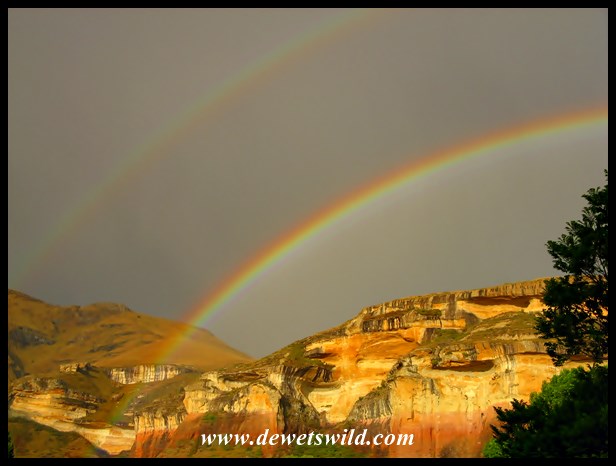
A beautiful double rainbow following on a magnificent thunderstorm at Glen Reenen, in the Golden Gate Highlands National Park.

ROYGBIV

ROY G. BIV” is the theme for this week’s WordPress Photo Challenge

Hungry Hungry Hippo!

Just when you thought it was safe to go back into the water…

Well, when it’s Lake Saint Lucia you’re talking about then it is never safe to go into the water, thanks to the hippos, crocodiles and sharks that populate this aquatic environment. Better to be safe ON the water then? Only if you don’t encounter this playful young hippo, seemingly intent on making a meal of the tourist launch!

Luckily for the tourists on the boat, mom intercedes and calls him to order, dispensing quick discipline hippo-style with a bite and a roll on top of the little delinquent.

This delightful scene played out while we were enjoying a guided launch-tour of Lake Saint Lucia aboard the Santa Lucia, during our recent visit to the iSimangaliso Wetland Park. We’ll share more photos and memories from the cruise in an upcoming edition of de Wets Wild.

At the end of a wonderful long weekend…

Our long weekend at the iSimangaliso Wetland Park has come to an end, but please “stay tuned” in the weeks to come as we’ll share some of our latest experiences from this spectacular world heritage site.

iSimangaliso Sunrise