
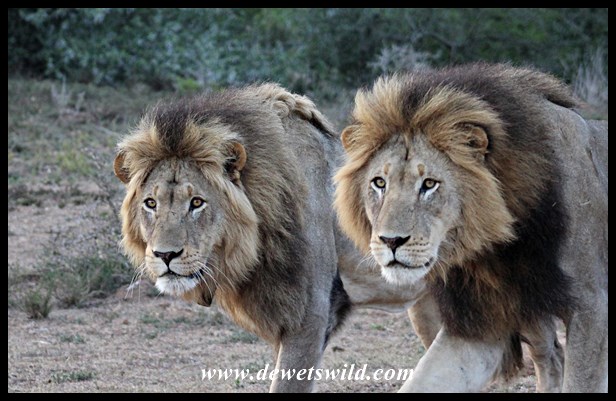
Panthera leo
The lion. Such a short name for such a magnificent creature.
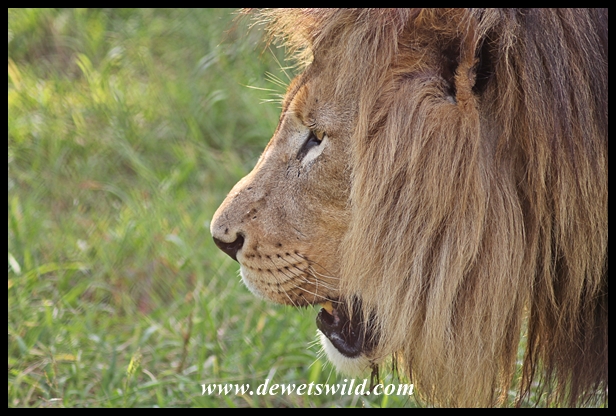
If there’s one animal that draws people from all over the world to our country’s wild places more than any other, it has to be the “King of the jungle”.


The lion is Africa’s biggest cat; males weighing over 200kg and standing up to 1.2m high at the shoulder.


They’re very adaptable creatures, inhabiting almost any habitat where there’s enough prey to sustain them. They’ll prey on anything from insects to crocodiles, buffaloes, rhinos, hippos and even elephants, and can consume up to 40kg of meat in a single sitting. And despite their association with royalty, they’re not above stealing carcasses from other predators, or taking carrion. They’ll drink regularly if water is available, but otherwise can go without it for extended periods.


It is well known that lions are the most sociable of cats, living in prides that can number over 30 animals where food is abundant. These prides are controlled by single or coalitions of up to 6 adult males, defending territories in which the core of the pride, the adult females, can safely raise their cubs. The strength of the pride lies in the defending of territory, hunting of large prey animals, and communal care of the cubs. Depending on the availability of food, the territories can cover areas as large as 2000 square kilometres, scentmarked by animals of both sexes and loudly proclaimed by their distinctive roaring. Neighbouring prides will get involved in serious fights over territory, and when new males take over a pride it is seldom a bloodless affair, more often than not killing the cubs sired by the ousted males (who themselves are lucky if they escape alive). All in all, the life of a lion is not an easy one, and their lifespan is limited to only 12 to 15 years in the wild, if they reach adulthood at all.


Today, despite all the reverence afforded to it through the ages as a symbol of nobility and bravery, the lion is a species under threat. Ever increasing human populations, and their accompanying livestock, is shrinking the habitat and prey available to these powerful cats by the day. They are being persecuted as livestock killers. They’re being poached for their skin and heads as trophies, and for their bones, used in traditional Asian “medicine”, “tiger wine” and “love potions”. There’s many so-called “captive-breeding facilities” where lions are exploited for the same purposes. To top it off, the dwindling populations are susceptible to disease and inbreeding. Though estimates range widely, there’s probably no more than 30,000 wild lions remaining in Africa (maybe as few as 10,000), and perhaps 400 in India. In South Africa, there’s sizable populations finding protection in the Kruger National Park and the Kgalagadi Transfrontier Park, with smaller numbers in several other reserves, including Pilanesberg, Hluhluwe-Imfolozi, iSimangaliso, Tembe, Mapungubwe, Marakele, Addo, Karoo and Mountain Zebra.


The 10th of August has been designated World Lion Day; “An independent campaign working to highlight the importance of the lion globally and to raise lion conservation awareness worldwide“


 DeWetsWild
Pingback: Come along on a game drive through Botswana’s Chobe National Park | DeWetsWild
Pingback: Autumn Adventure – Boys will be boys, even if they’re lions | de Wets Wild
Pingback: Satara Summer 2021 – Big Cat Royalty: Lions! | de Wets Wild
Pingback: Waiting hours for a glimpse at a White Lion | de Wets Wild
Pingback: Black-backed Jackal | de Wets Wild
Pingback: Hippopotamus | de Wets Wild
Pingback: Alone time with the King of Beasts | de Wets Wild
Pingback: Pilanesberg National Park: 10 – 13 May 2012 | de Wets Wild
Pingback: Leopard | de Wets Wild
Pingback: Spotted Hyena | de Wets Wild
Pingback: African Wild Dog | de Wets Wild
Pingback: Dinokeng Game Reserve | de Wets Wild
Pingback: Common Ostrich | de Wets Wild
Pingback: A dry Kruger is a predator’s paradise | de Wets Wild
Pingback: Beautiful Bontle | de Wets Wild
Pingback: Cheetah | de Wets Wild
Excellent post with fantastic photos. Abhorrent practice is poaching for whatever reason hunters do it. That disgusting American dentist that shot that beautiful lion for ‘fun’ was dreadful.
Infuriating just how little regard humans have for nature’s treasures, isn’t it Sue.
Yes 100% correct.
Pingback: Sweni Wilderness Trail | de Wets Wild
Pingback: World Lion Day | de Wets Wild
Pingback: Hluhluwe-Imfolozi’s tree climbing lions | de Wets Wild
Enjoyed your post. Excellent pictures!
Thank you Kathy, and welcome to de Wets Wild!
Mens raak sommer siek om te dink dat daar nog mense is wat glo dat leeubene medisyne is.Dis die probleem met meeste bedreigde diere…die mens se stommiteit oor onwetenskaplike snert!Jou foto’s is besonders!
Ja nee, dis absoluut verbysterend dat in die 21ste eeu daar nog mense rondloop, in hul honderde miljoene, vir wie dit niks vreemds is om ons wildlewe vir sulke strooi uit te buit nie.
Dankie nogmaals vir die gawe kompliment op ons fotos, Dina!
Amazing photos! I hope we wake up before it’s too late and they are no more.
We agree Linda. Don’t humans ever learn?
Love the photos. I will be on a walking safari in Kruger shortly so this serves as a good source of inspiration.
Now that’s something to look forward to! Which trail will you be participating on Rob?
Happy World Lion Day 🙂 I commemorated it too 😀
They’re special creatures, hey Paula?
It’s great to see the close-up details in your pix, they are truly magnificent creatures; and also for raising awareness to their dwindling numbers. The figures are alarming! One wonders what it will take to force the countries driving the demand to stop the trade before they drive species into total extinction? While designating a world day to highlight their plight, I can’t but help wondering whether the target countries even pay heed to such a campaign?
We certainly share your sentiments! What would it take to bring an end to the centuries-old traditions and beliefs of over a billion people, threatening our wildlife in so many ways…
nice kitteh
That they are, but these kitties don’t like being stroked 😀
🙂
I just love the Lions, I showed them to my hubby and he said you guys cheat! (because you have such the array of neat animals!) he says this even when he gets to see Black Bears on the shore of the river and running across the road to the corn field almost every evening comming home from work! but he never get’s a picture!!
Keep up the Good Work!!
Thank you so much! And how lucky he is to see bears on his commute from work to home!
Pingback: World Lion Day | MARGARET-ROSE STRINGER
I shall do a referral post to this one, guys – I’m horrified to learn that the King of Beasts is endangered – but one can scarcely be surprised.
If there’s one thing I would like to have NEVER OCCURRED it is Chinese medicine.
Thank you for sharing our post with your friends and followers Margaret-Rose; spreading the word about the plight of the lion might just make one or two people change their mind about further exploiting these beautiful animals.
I think it’s a case of preaching to the converted, in terms of our group … 🙂
Let’s hope, just maybe, that Google dishes up our posts to someone out there to who it may make a difference.
And of course, you are right: we never know all the places our posts end up ! 🙂
As has already been said, very informative article. I love all the photos, but especially the last close-up of the male’s eyes. Quite breathtaking.
Thank you very much 🙂
Amazing captures. How did you take these shots, in a car?
Thank you for sharing the information.
Thanks Amy! Yes, these were all taken from the safety of a vehicle.
What a great article and many wonderful photos! Did you really shoot those lion photos? 😉 Just kidding. Were you safe – I guess that was my question? I have never been to Africa. I can’t even imagine. Helen
Thanks Helen! Perfectly safe in our vehicle at all times 😉
such beautiful photos. somehow even if I took the perfect photo of a squirrel (abundant in my backyard), it just can’t compare to a lion. 🙂
They are powerful, majestic animals for sure!
I came over to comment almost exactly what Loisajay said. So consider it said!
🙂 Thanks Barbara!
“..if they reach adulthood at all…” I had no idea. They are magnificent creatures and your photos, as always, are beautiful.
Thank you Lois!
Thanks for the great photos and all the information. Awareness is the first step to making changes. I would have guessed their numbers were dwindling but I did not not have any specifics. Such a tragedy that these majestic cats are in danger.
Terribly sad Patti, and as always only due to pressure humans are placing on them.