Tag Archives: wildlife

Surprise Weekend at Marakele; Saturday 12 June 2021

Round about 04:45am on Saturday, the territorial rasping of a leopard really close lured Joubert and me out of our cosy tent into the cold winter morning air at Tlopi Tented Camp. Try as we might using our spotlight and headlamps the big cat remained unseen, so we warmed ourselves with hot drinks, waiting for the first rays of sunshine to appear. It was the morning of Marilize’s milestone birthday, and unfortunately this coincided with South Africa experiencing a “third wave” of Covid-19 infections precluding any big commemoration with the extended family and friends. It was up to me and Joubert to make the event memorable, so we surprised Marilize with a weekend breakaway to Marakele National Park

First light made an appearance around 06:20 and a stream of birds started arriving at the dam – first a few double-banded sandgrouse, then a hadeda and a pair of egyptian geese, waking up the arrow-marked babblers in the tree shading our tent. It was only at 08:10 that the sun first peaked over the cliffs of the Waterberg towering over Tlopi and started heating up the crisp air. Somewhere in between Marilize joined us on the deck of our safari tent.

Marakele_Jun21_D-PS (7)

One of the most active actors on the dam stage was a pied kingfisher that regularly made attempts at dive-bombing fish in the shallow water, and was very successful at it too, providing us excellent views and photographic opportunities from very early on in the day.

There appears to be a very healthy population of bushbuck in the thickets around Tlopi. They regularly ventured out into the open to drink and feed in and around the dam.

Throughout the day a family of tawny-flanked prinias put in regular appearances:

The vervet monkeys had us laughing. As soon as they spotted anything on our deck that appeared to be food they could steal – and seeing as we were celebrating a birthday it must have seemed like a feast to them – they’d arrive from all corners, including from across the dam, to come and try their luck, in vain.

There truly is no need to venture out of Tlopi Tented Camp to go and look for Marakele’s wild inhabitants – there is a constant queue of animals and birds arriving at the dam in front of the camp, and around your tented accommodation, that would keep any nature lover enthralled all day long.

From about 14:00 in the afternoon, two herds of elephants made their way past the camp to the dam. They spent quite a while enjoying the water and the greenery around the dam, allowing us to take photographs of them to our hearts’ content. The little ones were especially endearing. Be sure to catch our next post to see what drama erupted next to the dam thanks to the elephants!

At the end of a beautiful and happy day, with the sun setting to the west of Tlopi while the smoke from our evening braai (barbeque) wafted on the slight breeze, Joubert set up his camera for a few night shots after it went dark.

To be continued…
Surprise Weekend at Marakele; Friday 11 June 2021

This past weekend Marilize celebrated a milestone birthday, and unfortunately this coincided with South Africa experiencing a “third wave” of Covid-19 infections precluding any big commemoration with the extended family and friends. It was up to me and Joubert to make the event memorable, so we surprised Marilize with a weekend breakaway to Marakele National Park. We left Pretoria just after 1pm on Friday, routing through Bela-Bela (Warmbad) and Thabazimbi, and arrived at Marakele’s gate just before 4pm.

After performing all the requisite formalities, which these days include a questionnaire on the recent medical history of the entire family, we set off on the 17km drive to Tlopi Tented Camp in the golden glow of the bushveld sunset.

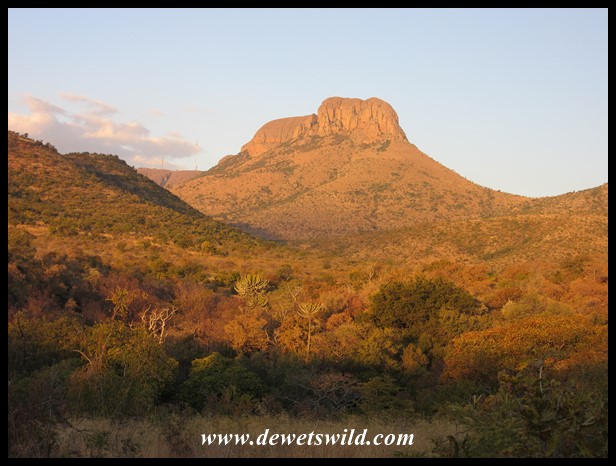
In our estimation Tlopi Tented Camp is Marakele’s most beautifully situated accommodation option, and we were very lucky to be allocated unit 10, “Loerie”, right at the far end of the camp. Tlopi looks out over a dam frequented by a large number of birds and mammals, and the mountains of the Waterberg beyond.

To be continued…

Rufous-eared Warbler

Malcorus pectoralis

The Rufous-eared Warbler is eminently at home in semi-desert scrublands and grasslands and, despite the sparse vegetation of its chosen habitat, can be frustratingly difficult to get a clear view of. It is shy and feeds close to or at ground-level, being very rodent-like in its movements, and subsisting mainly on invertebrates with seeds and small berries making up only a small portion of its diet.

Rufous-eared Warblers are seen singly, in monogamous pairs or in small family groups. They may breed throughout the year, though there is a peak in nesting activity after the first rainfall in their arid haunts. Their nests are untidy oval-shaped balls built in thorny shrubs just slightly above the ground. Clutches usually contain 2-4 eggs, but sometimes as many as 7, and are incubated for 2 weeks. The chicks grow quickly, being fed by both parents, and leave the nest two weeks after hatching. Adults have a total length of about 15cm and weigh only about 10g.

This delightful little bird occurs in South Africa’s drier western half and can be found widely in the Eastern, Northern and Western Cape and Free State Provinces. Beside South Africa, the Rufous-eared Warbler is also found in Botswana and Namibia, and the IUCN considers it to be of least concern.

Denham’s Bustard

Neotis denhami

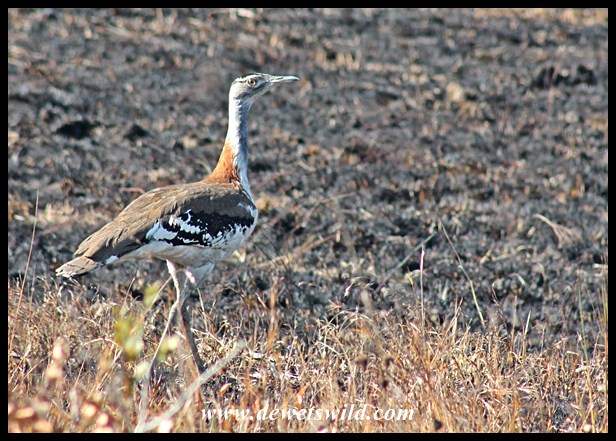
Denham’s Bustard is a large bird inhabiting open high-rainfall grasslands and heathland where it feeds on plant material (fruit, grass, flowers, seeds, etc), invertebrates and small vertebrates (snakes, frogs, rodents, chicks of ground-nesting birds, etc). They’re attracted to recently burnt areas for the easy pickings available. Adult males weigh around 8kg, females approximately half that. Their wingspan may measure as much as 2m. They’re usually seen singly or in small groups but occasionally congregate in flocks numbering a few dozen.

The breeding season for Denham’s Bustards stretch through the months of spring and summer. Males breed with as many females as they can, and play no parental role. Females lay only 1 or 2 eggs which are incubated for almost 4 weeks. The eggs are laid on bare ground surrounded by concealing vegetation. Newly hatched chicks are precocial and, while initially fed by their mother will soon start pecking up their own food. The chicks can fly when they’re about 2 months old, but remain with their mother for an extended period of time.

Numbers of Denham’s Bustard are declining throughout its range and it is considered to be near-threatened, despite its wide distribution across sub-Saharan Africa. This is mostly due to hunting and loss of habitat, and collisions with vehicles, power lines and fences also take a toll locally. In South Africa, where the subspecies known as Stanley’s Bustard (N. d. stanleyi) is endemic, the biggest populations are to be found in the Eastern and Western Cape, though they’re also found in lower numbers in Kwazulu-Natal, extreme eastern Free State, Mpumalanga and Limpopo, with a total population size for our country probably lower than 5,000 mature individuals.

Natal Rock Crab

Grapsus tenuicrustatus

The Natal Rock Crab occurs along the tropical coastlines of the Indian and Pacific Oceans, stretching from South Africa to Polynesia and Hawaii.

Adults Natal Rock Crabs are carnivorous and live in the intertidal zone on rocky shores where they scavenge for food, living or dead. While they may occur in large numbers on the rocks, these crabs are actually quite solitary and any “social” interaction with others of their kind revolves only around mating. They’re very fast and agile and not even heavy pounding by the surf will easily dislodge them from the rocks.

Natal Rock Crabs breed throughout the year and males in their breeding prime are distinguished by their bright colours. Females carry their eggs in a “purse” beneath their bodies and drop their larvae, numbering up to 100, into calm water when they hatch, about 3 weeks after being fertilised. The larvae are free-swimming in shallow offshore waters and feed on phytoplankton, moving back to the rocks when they metamorphose into miniature adult form. Adults have a carapace up to 8cm wide. They grow continuously throughout their lives, molting as they go, and can regenerate lost limbs.

Dark-backed Weaver

Ploceus bicolor

The Afrikaans name for the Dark-backed Weaver is Bosmusikant – “Bush musician” – and a most descriptive moniker that is given its melodious whistling tune, often delivered in duet. This bird has an extremely patchy distribution over the southern half of Africa. Locally they’re found in evergreen forests and dense riverine woodland along our coastline and a bit further inland from Port Elizabeth in the Eastern Cape through Kwazulu-Natal to the border with Mozambique.

Dark-backed Weavers are omnivores, feeding on invertebrates, fruit, flowers and nectar. While they often associate in mixed flocks with other insectivorous birds they never seem to mix with other kinds of weavers. They form permanent, territorial pairs that breed in spring and summer. Weaving the nest at the tip of a thin, bare branch, using vines, creepers and slender leaves, is mostly performed by the male but sometimes the female will help. The clutch of 2-4 eggs are incubated for a little longer than 2 weeks, with the chicks fledging when they’re about 3 weeks old but remaining with their parents for almost two months after leaving the nest. Adults weigh 35g and measure 15cm in length.

The IUCN considers the Dark-backed Weaver to be of least concern.

Hinged Tortoises

Genus Kinixys

Africa is home to 6 species of Hinged Tortoise, four of which are found in South Africa. These tortoises are unique in that their carapace has a hinge that allows the rear of their shell to close around their back legs and tail when retracted.

Perhaps surprisingly for tortoises, they are omnivorous and include a wide variety of vegetation and invertebrates, including snails and millipedes, and even tadpoles, in their diet.

Females lay small clutches of around 2-10 eggs, usually at the end of summer, with the hatchlings emerging in early spring.

All species are exploited by collection from the wild as food and for the international pet trade, while two species endemic to southern Africa further has to contend with habitat destruction throughout their limited distribution.

Bell’s Hinged Tortoise (K. belliana)

Bell’s Hinged Tortoise inhabits moist habitats ranging from savannas to dune forest, and in South Africa is restricted to the north of Kwazulu-Natal, though they occur much more widely in suitable habitat through the rest of the continent. Adults grow to about 22cm in length.

Lobatse Hinged Tortoise (K. lobatsiana)

The Lobatse Hinged Tortoise is found in South Africa’s Gauteng, Limpopo, Mpumalanga and North West Provinces, as well as in a small portion of bordering Botswana. It inhabits rocky outcrops and hills in dry, thorny savannas and the IUCN considers it to be vulnerable, owing to a declining population size brought on by habitat pressure and harvesting. Adults grow to 20cm in length.

Natal Hinged Tortoise (K. natalensis)

The smallest of South Africa’s Hinged Tortoises, the Natal Hinged Tortoise grows to only about 15cm in length. It inhabits rocky savanna habitat and, with a limited distribution in the provinces of Kwazulu-Natal and Mpumalanga, the IUCN considers to be vulnerable due to threats to its habitat and collection from the wild.

Speke’s Hinged Tortoise (K. spekii)

Adult Speke’s Hinged Tortoises measure about 18cm in length. Their flattened carapaces allow them to hide in crevices or under logs when they aestivate during our cool and dry winters. This species too inhabits savanna habitats and, in South Africa, is found in Mpumalanga and Limpopo.

Olive Woodpecker

Dendropicos griseocephalus

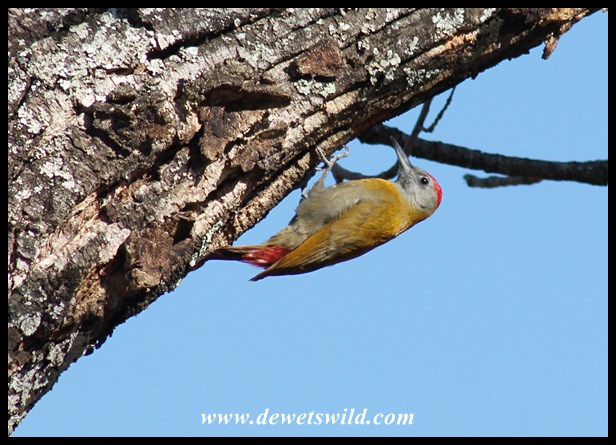
Despite being a common bird in its preferred montane forest habitat, the Olive Woodpecker is secretive and doesn’t spend much time in the open, preferring to forage in dense leaf cover in the canopies of the forest trees. They feed mainly on insects and other invertebrates discovered while pecking behind bark and probing inside crevices in the wood.

Olive Woodpeckers are usually seen in pairs or family groups and may nest at any time of year, though there’s a distinct breeding peak in the spring and summer months. Their nests are chiseled and carved out of soft wood on the trunk and branches of tall, usually decaying, trees by both parents and usually used for only a single season. The clutch of 2 or 3 eggs are incubated by both parents for around two weeks and once hatched, both the male and female look after the chicks at the nest until they fledge at about 4 weeks of age. The family moves around together and often returns to the nest hole to roost until the chicks become independent when they’re 4 months old. Pairs are mostly permanent and usually remain in the same territory year-round. Fully grown, Olive Woodpeckers weigh about 45g and measure 20cm in length.

The Olive Woodpecker has two separate centres of distribution – one stretching from Angola to Tanzania through central Africa, and the other in South Africa, extending from the Soutpansberg in Limpopo in the north southwards along the escarpment through Mpumalanga and into most of Kwazulu-Natal, through the Eastern Cape and along the mountains of the Western Cape to the Cederberg range in the southwest. In our experience the Royal Natal National Park and Giant’s Castle Game Reserve are reliable places to see this bird. It is considered to be of least concern in conservation terms.

Boisduval’s Tree Nymph

Sevenia boisduvali

Boisduval’s Tree Nymph is the most commonly encountered member, and with a wingspan of about 4cm also the smallest, of the butterfly genus Sevenia. They inhabit coastal and montane forests and dense woodlands and are usually seen gliding through the shadows or basking in the sun against a branch or trunk. Boisduval’s Tree Nymphs may swarm in their thousands at the end of summer, though adults may be found throughout the year. Adults are attracted to leaking tree sap and rotting fruit while the gregarious larvae feed on plants from the Euphorbiaceae-family.

In South Africa, Boisduval’s Tree Nymph occurs from the Eastern Cape northwards along the Indian Ocean coast and adjacent interior through Kwazulu-Natal and into the lowveld of Mpumalanga and Limpopo. Beyond our borders their distribution extends to Ethiopia in the north-east and Sierra Leone in the west.

Scimitar-horned Oryx

Oryx dammah

The 21st of May 2021 is observed as Endangered Species Day, and to mark the occasion we’re featuring a very special antelope, the Scimitar-horned Oryx, which is officially classified as extinct in the wild.

Naturally the Scimitar-horned Oryx occurred in a band across the Sahel and Sahara from Senegal and Mauritania in the west to Sudan in the east, and also in the countries along Africa’s Mediterranean coast from Morocco to Egypt. Sadly however, these beautiful antelope were driven to extinction in their native haunts by overhunting and competition with livestock and haven’t been seen in the wild since the early 1990’s. That we have any left today is thanks to zoos and game farms all over the world, including here in South Africa – it is estimated that there are at least 15,000 oryx in these collections stemming from a captive breeding programme initiated in the 1960’s. Most excitingly, attempts are currently being made to reintroduce the species to reserves in Chad, Morocco, Senegal and Tunisia sourcing animals from these facilities.

In their natural distribution range Scimitar-horned Oryx lived nomadically in herds usually numbering between 12 and 70, though larger congregations were not unheard of. They inhabited the semi-desert ecotone surrounding the Sahara, moving into the true desert only when periods of exceptional rainfall resulted in good grass cover there. They’re predominantly grazers but also feed on herbs and leaves, and are independent of open water for drinking, being very well adapted to hot and dry environments. Cows give birth to single calves at any time of year, following an 8 month gestation. Adults stand about 1.2m high at the shoulder, with their graceful horns growing to that same length! At up to 210kg, bulls are bulkier than the cows which weigh up to 140kg.