Tag Archives: wildlife

Spotted Hyena

Crocuta crocuta

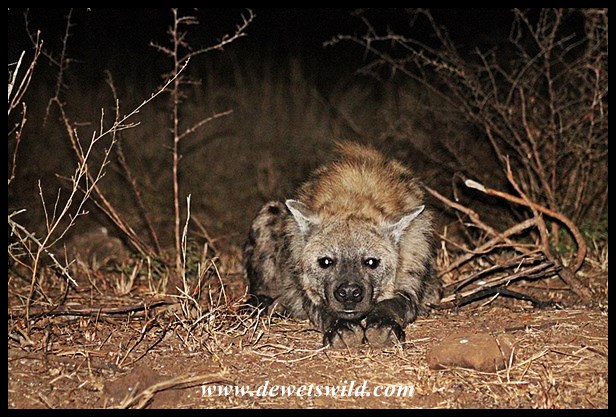
Spotted Hyenas roaming outside Mpila Cottage 16 in December 2018

Often depicted as cowardly villains and skulking scavengers, the truth is that the Spotted Hyena is a very efficient predator that mostly catches its own prey and dominates all other African predators with the exception of lions. Standing up to 90cm high and weighing up to 85kg, the females are considerably stronger built than the males and have very male-like genitalia, leading to a common misconception that spotted hyenas are hermaphrodites.

Spotted Hyenas have adapted to every habitat on the African continent except the tropical forests, though they prefer savannas, grasslands, woodlands and semi-deserts. They’re not dependant on drinking water but will drink when it is available and love cooling off in natural pools on hot days. Spotted Hyenas easily prey on anything from insects to giraffes and buffaloes, their diet normally reflecting which animals are most common in their area, but will also opportunistically scavenge from the kills of other carnivores (less than a third of their diet) and around rubbish dumps and human settlements. Excess food is often stored under water for later consumption. In many protected areas Spotted Hyenas have learnt that tourist camps are a reliable source of discarded food; a dangerous situation that often leads to injuries to people with lethal consequences for the hyenas.

Spotted Hyenas live in clans numbering from 3 to 80 (the size and stability of which depends on prey availability) in which a strict, female dominated, hierarchy exists. The most dominant female passes her status to her female young, and all females are dominant over all males in the clan. Males mostly join clans from other groups from which they were evicted, and it can take weeks and even months for them to be accepted into a new family. Each clan has a territory covering between 40 and 1800km² (dependent again on prey availability), that is demarcated with scent glands and communal dung middens and will be fiercely defended against interlopers. Within the territory a number of dens are established in dense vegetation, caves, between boulders or in holes in the ground (they’ll also often use human-made culverts under roads for this purpose) and used on a rotational basis. Spotted Hyenas are most active from dusk to dawn, usually hunting alone or in small parties except when going after big game, when the whole pack will join forces. When hunting they can reach speeds of up to 65km/h, but they can sustain a pace of 50km/h over a distance of up to 5km as they tire out their intended prey. They’re among the most vocal of mammals, and their well known laughing, howling and cackling is synonymous with the African night.

Females usually give birth to two cubs (though up to 4 have been recorded) at anytime of year. Cubs are kept hidden from the rest of the clan for the first two weeks of their life. More than one female in the clan may be raising cubs at the same time, but they will not take care of one another’s young. Cubs are often extremely aggressive to one another, especially of the same sex, and it is not unusual for some of the litter to die as a result of the constant fighting. The cubs are dark brown to black at birth, attaining adult colouration from the age of 2 to 3 months. Lions consider Spotted Hyenas their mortal enemies and will kill them at any opportunity, and outbreaks of rabies can decimate entire clans. Spotted Hyenas can live to the age of about 25 in the wild, and up to 40 years in captivity.

With a total population estimated between 27,000 and 47,000, the spotted hyena is one of the most numerous large carnivores on the African continent, and considered of least conservation concern by the IUCN. However, their populations are decreasing, especially outside large conservation areas, due to human pressures such as illegal hunting, poisoning and loss of habitat and prey. South Africa’s biggest population can be found in the Kruger National Park, estimated at up to 3,900 animals, and they are also a regular sighting in Addo Elephant National Park, Mapungubwe National ParkHluhluwe-Imfolozi Park and the iSimangaliso Wetland Park.

Spotted hyena

Spotted hyena

African Wild Dog

Lycaon pictus

African Wild Dogs are large canids, standing between 60 and 80cm high at the shoulder and weighing up to 36kg. Their blotched coats have patterns as unique to each individual as our fingerprints are. Perhaps “Painted Wolves” would be a more accurate name for these enigmatic carnivores, one of Africa’s rarest species.

African Wild Dogs inhabit grasslands, marshes, savannas, woodlands and semi-deserts, where they hunt mammals ranging in size from rodents to buffaloes, though their main prey is medium-sized antelope like the impala, springbok, bushbuck, nyala and reedbuck. These dogs have great stamina, and tire out their prey by chasing it at speeds of up to 60km/h for distances of up to 6km. They are among the most successful of predators, with between 70 and 90% of their hunting attempts resulting in a kill. They kill their prey by disembowelment, and although it appears cruel is actually a much quicker death than the suffocation employed by lions and other big cats. They feed extremely quickly; a pack of nine dogs can completely devour a 100kg antelope within 15 minutes. African Wild Dogs are not dependent on the availability of drinking water, but will drink regularly if it is available.

African Wild Dogs live in closely-knit packs numbering from 2 to 50 and occupying vast home ranges. Within the pack a strict hierarchy is maintained, with only the dominant pair allowed to breed. Often all the animals of the same sex within a pack are related as new packs are formed by groups of the same sex leaving their maternal packs when they become adult at about two years of age and joining up with unrelated animals of the opposite sex. Wild Dogs hunt mostly in the early morning and late afternoon, and also on moonlit nights, and rest up in the shade during the heat of the day.

The alpha female gives birth to between 2 and 21 tiny pups annually, mostly during the dry season when prey is easier to come by. The pups are born in holes in the ground, usually abandoned aardvark or warthog burrows. All the pack members take excellent care of the pups in the pack, bringing food back to the den for small puppies and allowing older puppies to feed first at a kill. Wild Dogs are susceptible to a wide variety of infectious diseases, often causing entire packs to be wiped out, but it is bigger and stronger predators – lions, hyenas and leopards – that are the biggest natural threat to both adult and juvenile Wild Dogs. Their life expectancy in the wild is only about 10 years.

The African Wild Dog is considered endangered with their population estimated at most around 6,600 and still declining due to disease and human pressures. Centuries of persecution by hunters and farmers have decimated their numbers, eradicating them from most of their former range. Today African Wild Dogs occur in only a few scattered pockets across the continent. In total South Africa is home to only about 400 – 500 African Wild Dogs, of which roughly half occurs in and around the Kruger National Park, with smaller populations in a handful of other public and private conservation areas, including Hluhluwe-Imfolozi Park, iSimangaliso Wetland Park, Tembe Elephant Park and Pilanesberg National Park.

Rhino Social Media

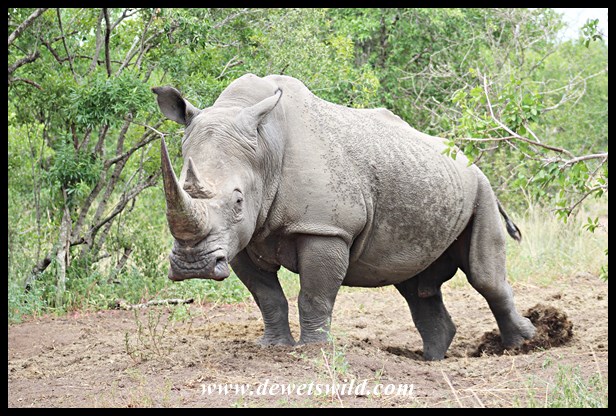
White rhino bulls use dung middens to communicate their presence and demarcate their territories. They’ll also kick around in the middens to transfer the scent onto their feet and then spread it throughout their stomping grounds, communicating their ownership to interlopers.


Hluhluwe-Imfolozi’s Giants

Hluhluwe-Imfolozi Park is home to giants; behemoths that can cause the earth to tremble with every step. And they’re not shy about showing themselves either, as we found out again during our visit in December.

Buffaloes were in evidence throughout the Park, whether as lone bulls, in small bachelor groups or in huge herds.

We could never tire of seeing elephants!

The curious giraffes tower over everything else in Hluhluwe-Imfolozi, except the magnificent scenery…

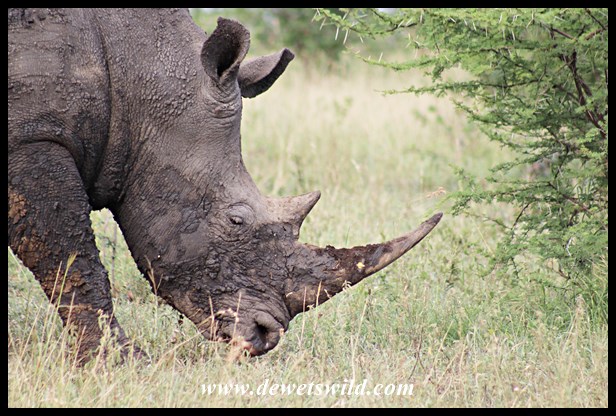
It is thanks to Hluhluwe Imfolozi that we can still see the Southern White Rhino in the wild today.

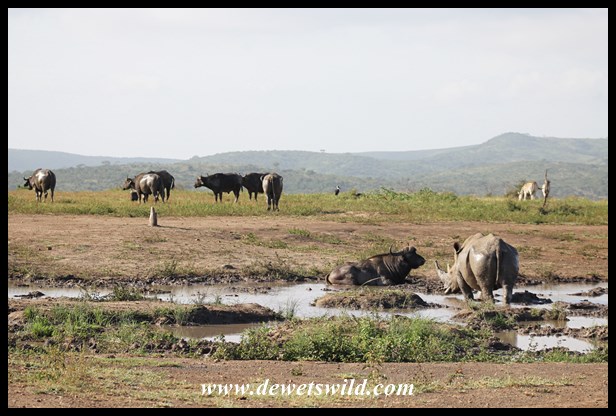
We didn’t get to see the hippos on this trip, and only managed two quick sightings of black rhinos that were too fleeting for photos, but still, these galleries should be proof enough that giants still roam Hluhluwe-Imfolozi Park.

hip-white-rhino-and-buffaloes

The staple diet…

A selection of five common herbivore species form the base diet of most of Hluhluwe-Imfolozi Park’s predators. Apart from the warthogs we showed you yesterday, the majority of their menu is mostly made up of impalas, nyalas, plains zebras and blue wildebeests with the more “exotic” fare consisting of primates (like the samango monkey), kudu, waterbuck, buffaloes and giraffes (we’ll share some pictures of the latter two tomorrow).

Looking at the excellent condition of the game following good rains just before our December visit, you’d be forgiven though for thinking that it is an easy life for a herbivore in Hluhluwe-Imfolozi!

These little piggies

During our visit to Hluhluwe-Imfolozi Park in December we found that at least two warthog sows decided that Mpila Camp would make an excellent nursery for their tiny piglets.

Aren’t they adorable!?

Encounters with Cheetahs at Imfolozi

Many of our friends here at de Wets Wild are great fans of cheetahs, so they especially would be thrilled to know that we had three wonderful encounters with these lithe cats during our December visit to Hluhluwe-Imfolozi Park.


Monkey Cuteness

This tiny vervet monkey, playing with his toes and being amazed by the things he sees around him in the Hluhluwe-Imfolozi Park’s Hilltop Camp, must be one of the cutest things I’ve seen in a long time!

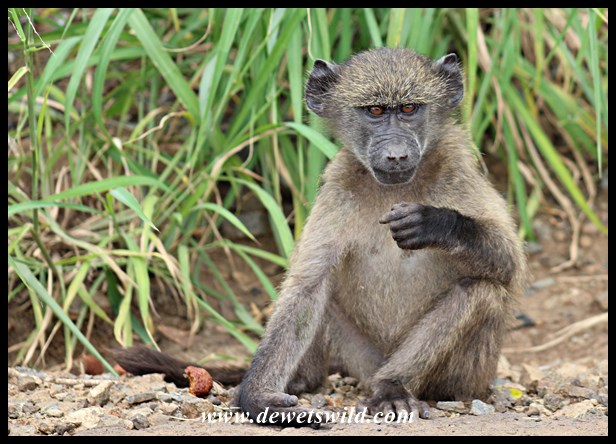
This baboon youngster on the other hand reminds me of that evil doll Chucky

evil-looking-baboon

Bird Watching in Hluhluwe-Imfolozi

Hluhluwe-Imfolozi is blessed with a rich diversity of avifauna – this gallery shows just a small selection of the 104 bird species we identified during our visit in December.

Nest Building Secretarybirds

A pair of Secretarybirds had just started building their platform-nest on top of a small tree near the Hluhluwe-Imfolozi Park’s Cengeni Gate when we visited in December. It was quite interesting to watch them searching the surrounding area for sticks and twigs to use in the construction.