Tag Archives: wildlife

Cape Bulbul

Pycnonotus capensis

The Cape Bulbul is endemic to South Africa, and specifically the Northern, Western and Eastern Cape Provinces. The IUCN lists the Cape Bulbul as being of least concern, and describes it as common to abundant. They inhabit thorny thickets in the semi-arid Karoo, fynbos, coastal scrub and dune forest, have adapted extremely well to suburban parks and gardens, and feeds mainly on fruit, supplemented with nectar, seeds and invertebrates. Adults are about 20cm long and weigh around 40g.

Cape Bulbuls are active and noisy birds, generally seen in pairs or small groups, and breed throughout the spring and summer months. The female is solely responsible for the building of the nest (a sturdy cup of plant material placed on the outer branches of a tree or shrub) and incubating the clutch of 2-5 eggs for a period of two weeks. Both parents provide food to the chicks, which leave the nest at about two weeks old, without yet being able to fly. The chicks fledge a few days later, and then become fully independent at about 7 weeks old.

Elephants, Elephants, and more Elephants!

If you thought our previous post on the Addo Elephant National Park was a bit short on elephant photo’s, you’d be right. But Addo’s star attractions really deserve a post all to themselves, wouldn’t you agree?

With the proclamation of the Addo Elephant National Park in 1931, only 11 African Elephants remained in the Addo district. Initially, the Park was not fenced to keep the elephants in and when they left the Park they were at the mercy of the “civilisation” that wanted to destroy them all, so the first Park manager made the decision to feed them with citrus and other fresh produce to keep them within his boundaries. Slowly but surely their numbers started growing, but by the time the Park was finally surrounded with an elephant-proof fence in 1954, there was still only 22 elephants at Addo. The unnatural practice of feeding the elephants, which in the end was done more for the entertainment of tourists than for the elephants’ sake, ended in 1979. By then the herd numbered about 100 animals, but Addo’s elephants have responded wonderfully to the protection they’ve been afforded since the Park’s proclamation, and today number over 600!

Addo Elephant National Park

By the early 1900’s the Eastern Cape’s wildlife was being exterminated at an alarming rate. The last lions and black rhinos in the region did not see the arrival of the year 1900, and only about 140 African Elephants remained around the Addo district, which was rapidly developing into an important agricultural area, leading to conflict with the newly established farmers. The government’s decision to intervene was not good news for the elephants. In 1919 they appointed Major P.J. Pretorius to destroy the elephants, and by 1920 he had killed 114 of them and caught 2 for a circus. Only 16 elephants remained when public sentiment swung in their favour and the wanton killing ended, and when the Addo Elephant National Park was proclaimed in 1931, only 11 elephants were left. It wasn’t until 1954 when an area of 2,270 hectares was surrounded by an elephant proof fence that the future of the Addo elephants finally looked secure. Along with the elephants, the last free-roaming herds of African (Cape) Buffalo that occurred in the then Cape Province, as well as the unique and endemic Flighless Dung Beetle, finally found a secure refuge. In subsequent years the Park’s area was expanded and species that fell into local extinction through the barrel of a gun were reintroduced.

With the Addo elephants now finally living in a safe refuge, the focus at Addo Elephant National Park is no longer on saving a single species. Today, the park’s management is concerned with the protection of the enormous diversity of landscapes, flora and fauna encompassed within its boundaries, which covers an expansive area of over 178,000 hectares stretching from beyond and across the Zuurberg range to the coastal forests and dune fields of Alexandria. The Park protects portions of no less than five of South Africa’s seven distinct terrestrial biomes, these being subtropical thicket, fynbos, forest, grassland and Nama-Karoo, not to mention the portion of marine environment protected around Algoa Bay’s St. Croix and Bird islands which is important breeding sites for endangered seabirds. Addo is the only National Park in South Africa that can claim to protect the “Big Seven” –  Elephant, Lion, Black Rhino, Buffalo, Leopard, Great White Shark, and Southern Right Whale.

Addo Elephant National Park protects a total of 95 mammals species, including all the members of the famed “Big Five“.

The Park also boasts a list of 417 bird species!

And if that isn’t enough, visitors also have a chance of spotting any of the more than 50 reptile species or 20 kinds of frogs and toads that call Addo Elephant National Park home. The Park’s most famous invertebrate inhabitant undoubtedly is the Flightless Dung Beetle (Circellium bacchus), this being only one of 5 places they are still found. These interesting insects make use of elephant, rhino, buffalo and kudu dung as food, either for themselves or rolled into brood balls in which they lay a single egg before burying it in soft sand and on which the larvae then feeds when it hatches.

The Addo Main Camp is the Addo Elephant National Park’s first and biggest tourist facility. Camping and a wide variety of accommodation (as well as a swimming pool) is available to overnight guests. There are picnic sites for day visitors, an underground hide overlooking a waterhole frequented by all the Park’s animals and floodlit at night (we even saw a brown hyena there when we visited in December), a birdwatching hide overlooking a small artificial wetland, a self-guided discovery trail, guided drives and horse rides, a fuel station, restaurant, shop and excellent interpretive centre where young and old can learn more about the Park and its inhabitants. Elsewhere in the Park guests can overnight at the luxury, full service and privately-run Gorah, Riverbend and Kuzuko-lodges, or in one of the Park’s own camps at Nyathi, Matyholweni, Kabouga Cottage, Mvubu Campsite, Narina Bushcamp, Langebos and Msintsi. Between the Main Camp and Matyholweni guests have access to an extensive and well-maintained network of all-weather game viewing roads, while other areas of the Park can be explored along hiking trails or 4×4 trails.

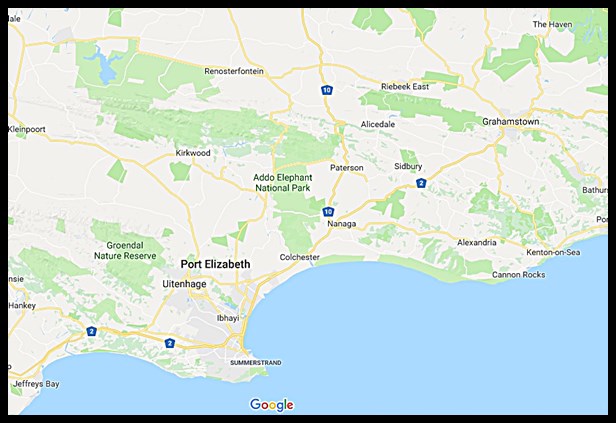
We spent three nights camping at the Addo Main Camp during our December 2017 holidays at eight of South Africa’s National Parks. The easiest way to reach the Park is along the N2 highway from Port Elizabeth, turning off to the gate at Matyholweni just before you reach the small town of Colchester on the bank of the Sundays River, about 45km from PE’s airport.
Swift Tern

Thalasseus (Sterna) bergii

The Swift Tern, or Greater Crested Tern, usually inhabits the shallow tropical and sub-tropical waters of lagoons, estuaries, bays, harbours and open beaches where it feeds mainly on fish (up to 90% of its diet) as well as squid, crustaceans and insects. Adults have a wingspan of up to 1.2m and weigh up to 430g.

These terns are gregarious birds, nesting and roosting in fairly large and dense colonies, often mixed with gulls and cormorants, usually on offshore islands, reefs or sandbanks and occasionally on top of buildings. Nests are shallow scrapes in the bare sand or on rocks and often quite exposed. The breeding season in Swift Terns stretches from late summer through winter to early spring. Pairs are monogamous. Clutches consist of 1 or 2 eggs and are incubated for around 4 weeks by both parents. Chicks fledge at a little over a month old, but don’t become fully independent until they’re about 5  months old.

The IUCN considers the Swift Tern to be of least concern, estimating the total population at around a million birds, with an enormous distribution stretching from Namibia and South Africa along the Indian Ocean coasts of Africa, the Middle East and Asia, and into the Pacific Ocean far to the north-east of Australia. They occur along the entire South African coastline, though about 80% of the local population, estimated in the region of 25,000 birds and increasing, is found in the Western Cape during the breeding season.

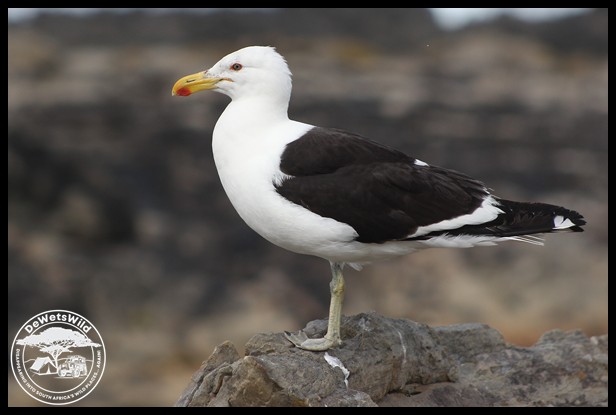
Kelp Gull

Larus dominicanus vetula

One of the most familiar seabirds in South Africa, Kelp Gulls inhabit a wide range of habitats along or near the coast, including harbours, bays, lagoons, estuaries, dams, lakes, rivers, streams and rocky and sandy beaches. They’ll also scavenge in large numbers at dump sites, food factories, abattoirs and sewerage works and have been recorded following fishing trawlers up to a 100km from the coast. Their natural diet is composed of marine invertebrates, fish, the chicks and eggs of other birds, small vertebrates, and carrion.

Adult Kelp Gulls have a wingspan of up to 1.4m, and weigh around 1kg.

Kelp Gulls are a gregarious species, occurring in large flocks throughout the year and breeding colonially during the southern spring and summer. Nesting colonies are usually located in hard to reach places, such as cliffs, rocky islands, exposed reefs, sandbanks and even on top of shipwrecks or buildings, where the bulky nest consists of dried plants, seaweed. twigs, shells, feathers and small stones. They’re very protective of their nests and will dive-bomb and defecate on any perceived threat, including humans. Pairs are monogamous and usually stay together through several breeding seasons. Clutches are usually made up of 2 to 4 eggs, which are incubated for about 4 weeks by both parents. Kelp Gull chicks fledge when they’re about two months old but stay with their parents for up to 6 months. They reach adulthood at between 3 and 4 years of age.

With an expanding population estimated at as many as 4,3-million, and a distribution range that spans much of the southern hemisphere, the IUCN considers the Kelp Gull of least concern. The race occurring in South Africa, also known as the Cape Gull, is considered to be a seperate species by some authorities and numbers at least 20,000 breeding pairs. They occur along the entire South African coastline and adjacent interior, though in lower densities along the coastline of Kwazulu-Natal than in the Eastern, Western and Northern Cape.

Knysna Turaco

Tauraco corythaix

The Knysna Turaco, or Knysna Lourie, is a very colourful bird inhabiting the evergreen montane and riverine forests of southern and eastern South Africa (from the Garden Route through the Eastern Cape and Kwazulu-Natal to the escarpment of Mpumalanga and Limpopo), extending marginally into Swaziland. Knysna Louries feed mainly on fruit, with seeds and insects making up only a small proportion of its diet. The IUCN lists it as being of least concern although it may be locally impacted by uncontrolled deforestation.

Often heard long before it is seen (its loud kok-kok-kok call being a familiar sound in the forests it inhabits), these beautiful birds are commonly encountered in the Garden Route National Park, though getting decent photographs of them in their dense and dark habitat can prove tricky! Adult Knysna Turacos grow to a length of 46cm and weigh up to 350g.

Both parents are involved in building the nest, which is little more than a flimsy platform of sticks and twigs among dense foliage, and incubating the clutch of one or two eggs for just over 3 weeks. The chicks grow quickly, start practicing to fly before they are a month old, and stay with their parents until they’re about 3 months old. Their breeding season stretches almost throughout the year, but peaks from September to December.

African Oystercatcher

Haematopus moquini 

The African Oystercatcher occurs only along the coastline of Namibia and South Africa (mainly the Cape Provinces and only sporadically into Kwazulu-Natal) where they frequent the intertidal zone on rocky and sandy beaches, estuaries, lagoons and coastal wetlands looking for molluscs (mostly mussels and limpets) and other aquatic invertebrates.

With an average weight of around 730g, females are slightly larger than males. Adults have a wingspan of about 80cm.

While non-breeding individuals can congregate in flocks of up to 200 birds, especially at roosts, breeding pairs of African Oystercatchers are territorial and monogamous and may stay together for as long as 25 years. They breed in spring and summer, with a peak over December and January, which makes them especially vulnerable to disturbance by holiday makers. Nests are located on rocky islands or beaches and is little more than a bare scrape above the high-water mark. Despite the meagre appearance of the nest the eggs are extremely well camouflaged. Both parents take turns to incubate the clutch of 1-3 eggs for between 4 and 5 weeks, with the chicks leaving the nest as soon as they are a day or so old. Chicks fledge when they are about 6 weeks old but can remain with their parents for up to 6 months.

Today, the IUCN considers the African Oystercatcher as being of least concern, with an increasing population size thanks to improved conservation measures (such as banning 4×4 driving on beaches). It is estimated that there is now around 6,700 of them, which is probably about double the number that existed in the 1970’s, and their conservation status could recently be upgraded from “near-threatened”. Birdlife South Africa has designated the African Oystercatcher as the 2018 Bird of the year – good places to see them is the Agulhas, Garden Route and Table Mountain National Parks.

Tsitsikamma (Garden Route National Park)

When it was proclaimed in 1964, Tsitsikamma was the first marine national park in Africa. Since then it was progressively enlarged as more areas on land and sea was added to the Park, and by the time it was incorporated into the Garden Route National Park alongside Wilderness National Park, Knysna National Lake Area, and extensive tracts of state forests in between in 2009, the Tsitsikamma section covered an 80km stretch of coastline, extending on average 5km out to sea.

The name “Tsitsikamma” is a Khoekhoen word meaning “place of much water”, which is very apt as the region receives on average around 1,200mm of rain annually. This is a rugged but exceptionally beautiful area, with forested slopes, shear cliffs tumbling into the sea, deep ravines cut into the mountains by dark rivers over millennia, and enormous waves pounding unrelentingly onto the rocky shore.

The easy trail leading to the suspension bridges at the river mouth, about a kilometre from Storms River Mouth Rest Camp, the Tsitsikamma’s main tourst facility, really gives the visitor an excellent introduction to the Tsitsikamma-area; bringing you into contact with the beach, ocean, forest and river, and many of the creatures that find a home there.

Notably, Tsitsikamma’s list of recorded mammals is dominated by marine animals rather than the large terrestrial game species normally associated with a national park in Africa. That being said, visitors should count themselves lucky to see one of the seven whale or five dolphin species that ply these waters – we were fortunate to see a pod of Indian Ocean Bottlenose Dolphins in the surf and a handful of Humpback Whales breaching far into the sea. On land however the Chacma Baboons and Rock Dassies are ubiquitous inhabitants of the camp. And with almost 300 bird species recorded, many of which closely associated with the ocean and rocky beaches, the Tsitsikamma section is a birdwatcher’s delight. Most of the Garden Route National Park’s 25 species of snakes are seldomly seen, so we were thrilled to witness an altercation between a deadly venomous Boomslang and Southern Boubou while walking around one morning.

Walking around after dark, and seeing the healthy population of frogs and toads at Storms River Mouth, we realised how grossly inadequate our old guidebook on South Africa’s amphibians was to identify the 24 species that’s been recorded in the Garden Route National Park. We remedied that soon after we got back home!

As already mentioned, Storms River Mouth Rest Camp is the Tsitsikamma section’s main visitors facility and understandably one of the Garden Route’s top attractions. Here, wedged between mountain and sea, overnight visitors have a choice of spectacularly located accommodation and camping sites, serviced by a restaurant and shop that stocks basic food items and curios. There are picnic sites for day visitors and a small swimming beach. Guided boat tours and more adventurous activities up the Storms River gorge can be undertaken daily. Unique snorkeling and scuba trails allow visitors a glimpse into the underwater world of the Tsitsikamma, and on land several walking trails lead deep into the forest. At the eastern side of the Tsitsikamma section lies the more rustic Nature’s Valley Rest Camp, just outside the small holiday town of the same name. The renowned Otter Trail, covering a distance of almost 50km between Storms River Mouth and Nature’s Valley over 5 days, is rated as one of the best and most scenic hiking routes on the planet.

Storms River Mouth was the sixth destination on our December itinerary through eight of South Africa’s national parks. It is easily accessible along a good tarred road that turns off the N2 highway between Plettenberg Bay and Port Elizabeth.

Diepwalle (Garden Route National Park)

Originally, most of South Africa’s Garden Route between the mountains and the sea was covered by dense forests. Unfortunately these forests have been exploited on an industrial scale for wood and ivory since the 1760’s and the town of Knysna owns its existence to the lucrative trade that required access to a harbour for exporting. At various times attempts were made to protect pockets of forest from harvesting, but it is not until the 1880s, when a professional forester was appointed as superintendent by the colonial government, that any real effort went into the protection and sustainable use of what remained. Today only about a third of the indigenous forests remain, with a large proportion of it being protected in the Garden Route National Park, proclaimed in 2009 when several state forests were amalgamated with the Wilderness and Tsitsikamma National Parks and the Knysna National Lake Area.

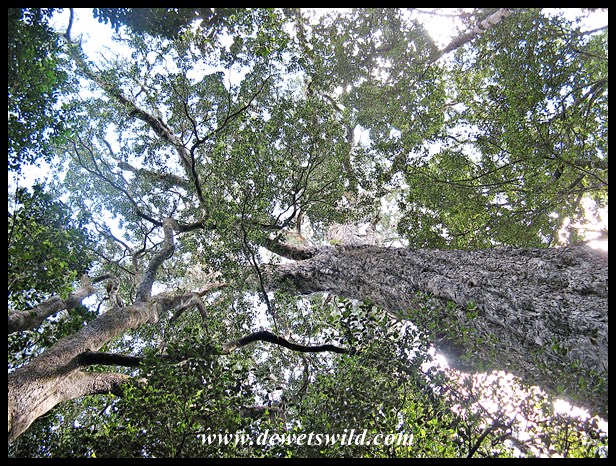
North of Knysna, the Diepwalle State Forest was one of those pockets of forest afforded protection. One of the main attractions here is the enormous King Edward VII-tree, an Outeniqua Yellowwood tree estimated to be over 600 years old, towering almost 40m above the forest floor and so named by a group of British officials who were entertained to a picnic here in 1924. Diepwalle is also known to be part of the range of the last few remaining Knysna Elephants. In the 1880s it was estimated that between 400 and 600 elephants still roamed the Garden Route, yet today, a little over 100 years later, there may be only one lone cow remaining (even elephant researchers and park staff differ on exactly how many are left). Unless they are exceptionally lucky, the only contact visitors are likely to have with a Knysna Elephant is not along the Elephant Walk trail through the forest, but rather with the skeleton of one that is on display at the Forest Legends Museum at Diepwalle.

Diepwalle is easily accessible from Knysna, a short drive along the gravel R339 (Prince Albert’s Pass) leading to Uniondale. We spent a morning in the area while on our December holidays visiting eight of South Africa’s national parks. Guests can stay a night or two here on the unique camping decks set among the trees in the deep forest shade. Apart from the fascinating museum, there’s also picnic sites and a community-run tea garden serving delicious treats.


Wilderness (Garden Route National Park)

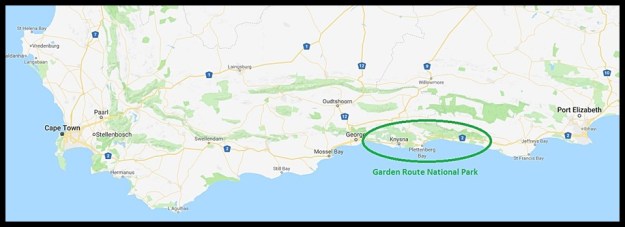
South Africa’s Garden Route is a 300km stretch of diverse and exceptionally scenic coastline between Mossel Bay in the west and the Storms River in the east, sandwiched between the Outeniqua and Tsitsikamma mountains and the Indian Ocean. The process of protecting the Garden Route from exploitation and human encroachment has been a long one, and is still ongoing. From the 1960’s various small pieces of the area east of the small holiday town of Wilderness received formal protection, culminating in these being amalgamated into the newly proclaimed Wilderness National Park in 1987 and the years thereafter. In March 2009, the erstwhile Wilderness National Park became an integral part of the expanded Garden Route National Park (covering a total of over 1,500km²), when it was joined with the Knysna National Lake Area and Tsitsikamma National Park through the proclamation of enormous tracts of state-owned land joining them.

The Wilderness section of the Garden Route National Park is centered on South Africa’s very own “Lakes District”. The original area encompassed by the Park straddles six lakes (Groenvlei, Bo-Langvlei, Langvlei, Rondevlei, Swartvlei and Island Lake), the Wilderness Lagoon, Serpentine and Touw Rivers, indigenous forests, and both rocky and sandy beaches along the coastline.

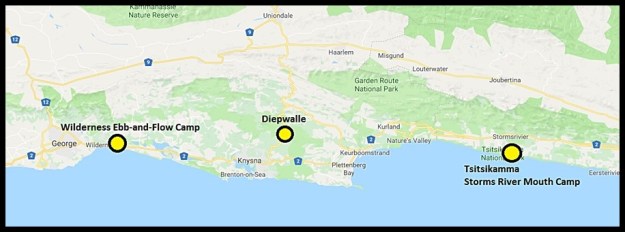
Before the Wilderness National Park was proclaimed, the area where the Garden Route National Park’s Ebb-and-Flow Rest Camp is situated today was the Ebb-and-Flow Nature Reserve (administered by the George municipality and today Ebb-and-Flow North) and the private Siesta Caravan Park (today Ebb-and-Flow South).

Birdwatchers and photographers are in for a treat when visiting any of the three hides next to the lakes in the Wilderness section of the Garden Route National Parks. We had time to visit two of them in December – Malachite (on Langvlei) and Rondevlei, and could easily have spent all day at either.

Given the amazing diversity of habitats in the park, it is no surprise that the Wilderness section of the Garden Route National Park abounds with a wide variety of birdspecies, and while the area doesn’t support much in the way of large mammals apart from shy bushbuck, bushpigs and very seldomly seen leopards, it does give visitors the opportunity to walk around unhindered looking for the smaller fry.

Ebb-and-Flow Rest Camp is the Wilderness section’s main visitor node. Here there are accommodation and two expansive camping areas for overnight guests, a newly opened picnic area for day visitors, and canoes for hire to explore the Touw and Serpentine Rivers. A network of walking trails of varying length traverse the area, many of them starting at or near Ebb-and-Flow. The Park also has several beaches for sun-seekers and bathers. Privately-run accommodation establishments and camping sites, shops, restaurants, fuel stations and more are available in the nearby towns of Wilderness and Sedgefield.

The Wilderness section of the Garden Route National Park is easily accessible along the N2 highway running from Cape Town to Port Elizabeth, and is just a few minutes’ drive from the airport at George. We recently spent three nights camping in the lovely Ebb-and-Flow North camp, the fifth stop on our 2017 summer holidays in eight of South Africa’s national parks.