Tag Archives: wildlife

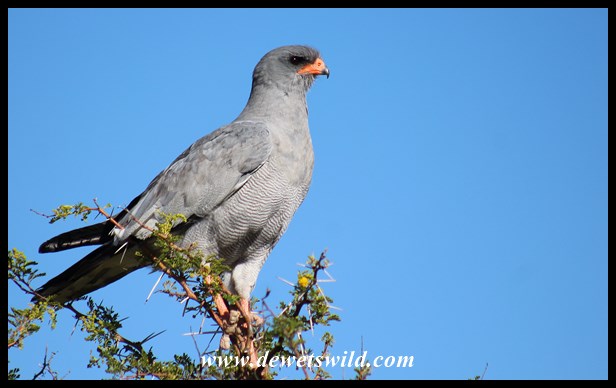
Pale Chanting Goshawk

Melierax canorus

The Pale Chanting Goshawk is one of the most commonly encountered birds of prey in its arid habitats, occupying dry savanna, semi-desert and Karoo scrubland in which there’s ample open ground and perches to hunt from. Small mammals, birds and reptiles make up the bulk of their prey, though they will also take insects and other invertebrates. Adults can weigh as much as 1.4kg, with a wingspan of up to 1.1m. As to the “chanting” in its name, after listening to this recording it will be perfectly clear to you.

Pale Chanting Goshawks are usually seen singly or in pairs but sometimes in family groups of five or more birds, sitting conspicuously on an elevated vantage point (such as a tree top or utility pole) from where they attack their prey. It is well documented that Pale Chanting Goshawks follow predators around, like the black-backed jackal or honey badger, in the hope that it can snatch any small prey the carnivore flushes from its hiding place.

While breeding attempts have been recorded almost throughout the year, there’s a noticable peak in nesting activity in the spring season. Nests are platforms of sticks lined with a wide variety of natural and man-made materials, placed on trees or artificial structures. Pairs are monogamous (though sometimes assisted by a third, usually male, individual) and males may fight to the death defending their territory. Both parents incubate the small clutch of 1 to 3 eggs for a period of about 5 weeks, with the hatchlings leaving the nest when they’re about 7 weeks old. While the youngsters are independent by 3 months old they will remain in their parents territory for up to a year.

The Pale Chanting Goshawk is common, even in farming areas, in southern Angola, Namibia, Botswana and western Zimbabwe and South Africa (everywhere except the eastern half of the Eastern Cape, Kwazulu-Natal and the lowveld of Limpopo and Mpumalanga) and listed as being of least concern by the IUCN.

Swallow-tailed Bee-eater

Merops hirundineus

The beautiful Swallow-tailed Bee-eater is a highly nomadic bird, especially outside of the breeding season, and inhabits a wide-range of habitats, although they’re mostly associated with arid and semi-arid savannas and woodlands and especially riparian vegetation in these parts. They mostly feed on flying insects, especially bees and wasps, caught on the wing by making short dashes from an open perch. They are quite adept at disarming the stings of their prey by beating and rubbing it against the perch before consuming it. Adults grow to about 21cm in length and 23g in weight.

Swallow-tailed Bee-eaters are usually found in pairs or small flocks. Outside the breeding seaon, which spans spring and summer, they sleep communally, in tightly packed rows on their favourite perches. Pairs are monogamous and make solitary nest tunnels in earth walls, riverbanks or inside mammal burrows. Broods of 2-4 chicks are cared for by both parents.

Swallow-tailed Bee-eaters are distributed widely over the Sahel and Africa south of the equator, and the IUCN considers the species to be of least concern. In South Africa, Swallow-tailed Bee-eaters are mainly found in the Northern Cape, North West, Free State and west of the Limpopo Province, occasionally venturing into other parts of the country.

Camel Thorn

Vachellia (Acacia) erioloba

The Camel Thorn is an iconic tree of many arid Southern African landscapes. These trees grow in deep, dry, sandy soils in South Africa (Northern Cape, North West, Free State, Gauteng, Limpopo), Namibia, Botswana, Zimbabwe and parts of Angola and Zambia.

Camel Thorns can grow to 18 meters high, with a widely spreading crown and a tap root that can grow up to 60m deep in order to reach underground water (young trees grow very slowly above ground until their roots reach a reliable supply of ground water). The thorns are paired, often swollen and up to 6cm long. Flowers (clumps of small, yellow balls) are borne from late winter through summer. Camel Thorns are estimated to live to around 250-300 years old.

The wood of Camel Thorns is highly regarded both for lumber and as firewood but as it is a slow-growing species it has been declared a protected species in South Africa in order to prevent it being exploited to extinction. The seeds can be roasted and make a reasonable substitute for coffee. Various parts of the tree is used in traditional medicine to treat ailments ranging from head, ear- and toothache to tuberculosis and gonorrhea, even rabies in dogs. The English name of this tree derives from its Afrikaans name, Kameeldoring, in reference to the leaves and seedpods being a favoured food source for the giraffe (kameelperd), as it is for many other herbivores, both wild and domesticated. Humans also prepare the pods as a porridge.

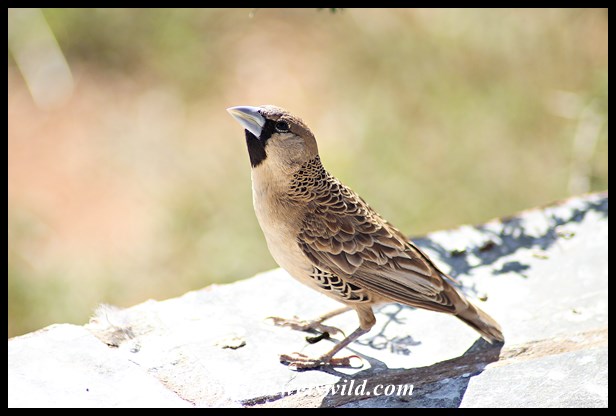
Sociable Weaver

Philetairus socius

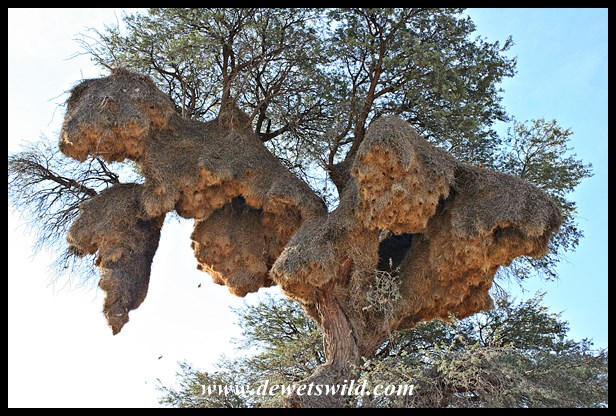
You’d probably expect that the bird that is responsible for building the largest nests on earth must be a massive winged behemoth, but you’d be wrong. Meet the Sociable Weaver. Their enormous communal nests, constructed of thorny sticks and dry grass in large, indigenous trees or artificial structures like windpumps and utility poles, house up to 500 adults birds and their chicks and are used for generations – some nests are over a 100 years old and weigh over a tonne! The nests provide excellent insulation from the outside weather, never getting colder than 15°C in winter nor warmer than 30°C in summer. These nests are often also utilised and shared by other kinds of birds and animals.

This Sociable Weaver nest near Twee Rivieren in the Kgalagadi Transfrontier Park may well be one of the biggest constructions by birds on the planet!

The Sociable Weaver is a small (30g, 14cm) sparrow-like bird endemic to parts of Namibia, Botswana and South Africa’s Free State, Northern Cape and North West Provinces, where they inhabit arid Kalahari savanna and feed on seeds and small insects.

Sociable Weavers don’t breed until after it has rained, which in their distinctly arid range is very unpredictable. While they may not breed at all during severe droughts, in years of good rainfall the monogamous pairs, assisted by chicks from previous broods, may attempt to raise from 4 to as many as 9 clutches of 2-6 chicks each! The youngsters fledge at about 3 weeks old and remain dependent on their parents and their helpers for another 45 days or so after leaving the nest.

As a common species with a stable population, the IUCN considers the Sociable Weaver to be of least concern.

Carnivorous Ground Squirrels!?

While exploring with his camera in Mata Mata Rest Camp in the Kgalagadi Transfrontier Park, Joubert came across something really remarkable, if somewhat gruesome: Southern African Ground Squirrels feeding on the carcass of a Cape Turtle Dove. While it is doubtful the squirrels killed the dove and it isn’t clear how the dove succumbed (probably attacked by a raptor), Joubert captured some really fascinating behaviour, as none of the literature we consulted give any indication at all that ground squirrels will eat meat (other than an occasional hapless insect).

These photos were all taken by Joubert (who turns nine soon).

(Edit 08/08/2018 – The WILD Magazine also did a short piece about Joubert and these photos, have a read here)

(Edit 17/08/2018 – Joubert’s school shared his photos and Wild article on their facebook page:
https://www.facebook.com/plugins/post.php?href=https%3A%2F%2Fwww.facebook.com%2Flaerskoolgarsies%2Fposts%2F1830709550376081&width=500 )
 

Kgalagadi Transfrontier Park – Wildlife

For such an arid area – average rainfall measures around 200mm per annum – the Kgalagadi Transfrontier Park is home to an astonishing variety of wildlife. Apart from a wide variety of desert-adapted plants and invertebrates, the Park’s lists boast 62 kinds of mammals, 274 species of bird (of which 78 are resident throughout the year), 48 sorts of reptiles (including 17 snake species) and seven kinds of frogs.

There’s three kinds of plants that really are characteristic of the Kalahari. The first is the Camel Thorns – huge trees growing in the beds of the Auob and Nossob River and about which we’ll be sharing more soon. Then, there’s the Gemsbok Cucumbers and Tsamma Melons; the fruits of which are made up of around 90%+ of water and both an invaluable source of moisture to all kinds of wildlife (including some carnivores).

At the one end of the scale there’s a multitude of invertebrates and small reptiles and mammals taking up their respective positions in the food pyramid. The Kgalagadi Transfrontier Park allows a glimpse into their natural cycles and behaviours uniquely adapted to their arid environs.

The Kalahari might best be known for the grand variety of raptors that soar its airways, but birdwatchers will not be disappointed by the variety of other, less fearsome but equally fascinating, feathered fauna that find a home here.

The Rest Camps of the Kgalagadi Transfrontier Park are excellent places to look for owls, by day or night!

Predators, both large and small, abound in the Kalahari. Africa’s three species of big cat are often seen (though the leopard eluded us when we visited in June 2018), and is one of the main reasons people undertake the long journey to visit here.

The Gemsbok is so iconic of the Kalahari that both parks that today make up the Kgalagadi Transfrontier Park (Botswana’s Gemsbok National Park and South Africa’s Kalahari Gemsbok National Park) was named after it. These beautiful animals are of the most commonly encountered large mammals in the Park.

And while there may not be as great diversity among the large herbivores in the Kgalagadi Transfrontier Park as in some of Africa’s other great conservation areas, the antelope, giraffe and warthogs occur in such numbers that it belies the harshness of their environment.

We’ll dedicate the next few posts on our blog to discover some of the Kalahari’s residents in more detail.


Kgalagadi Transfrontier Park – History and Tourism

Wedged into a remote corner of South Africa’s Northern Cape, between Namibia and Botswana, lies a very special piece of the Kalahari Desert. Here a wilderness of dunes, pans and dry, sandy river beds is a safe refuge to a rich variety of natural life, and one of the last fully functional ecosystems remaining on earth. The beds of the Auob and Nossob Rivers very rarely boast flowing water – the Auob perhaps once in ten years, the Nossob only once or twice in a century.

When the First World War broke out over a 100 years ago, the British Colonial government of the Union of South Africa and British Bechuanaland considered the beds of the Auob and Nossob Rivers a strategic access into German South West Africa and started sinking boreholes in the rivers to supply advancing troops. After the war, the area was divided into farms by a Scotsman, Roger Jackson, explaining how many of the waterholes today carry very Scottish-sounding names. The newly settled farmers however found it tough going – the fascinating museum at Auchterlonie providing a glimpse into this hard life – and had to turn their rifles on the herds of game moving through the area in order to make a living.

With the game population falling drastically, and shortly after South Africa’s first national park was proclaimed (the Kruger in the then Transvaal) two influential men from the region invited then Minister of Lands, Piet Grobler, on a “hunting trip” in the Kalahari and deliberately took him to an area denuded of wildlife. So disturbed was the minister by the lack of game that he immediately set about the process of proclaiming the area between the Auob and Nossob Rivers South Africa’s second national park – the Kalahari Gemsbok National Park coming into official existence on 31 July 1931. Soon more land to the southwest of the Auob and its confluence with the Nossob were added, bringing the size of the Park to 9,600km². Then, in 1938 the government in neighbouring Bechuanaland (today Botswana) proclaimed an even bigger piece of land on the other side of the Nossob (the unfenced international boundary between the two countries) the Gemsbok National Park. Informally the two conservation areas were managed as a single unit ever since, but it wasn’t until 1999 when the leaders of the two countries signed a treaty to formalise the arrangement. The Kgalagadi Transfrontier Park, covering over 34,500km², was officially opened on 12 May 2000 and is one of the biggest, and most unspoiled, conservation areas on the planet.

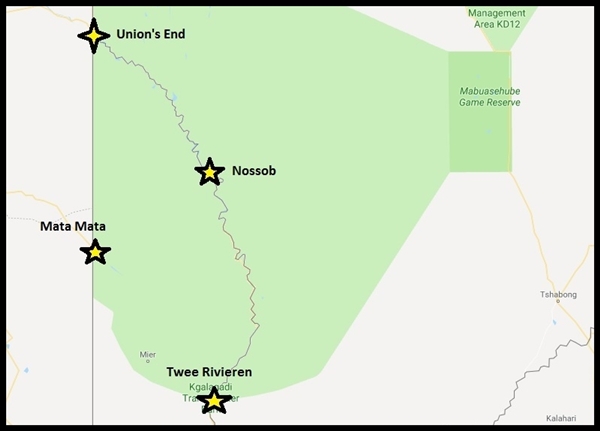
On the South African side of the Kgalagadi Transfrontier Park guests have a choice of three “traditional” rest camps offering basic amenities like accommodation, camping, a shop, fuel station, swimming pools, and guided walks and drives. Twee Rivieren is the main entrance, biggest camp and administrative centre of the Park (it also has a restaurant and border control) and offered the first tourist accommodation in the Park in 1940, while Mata Mata (on the Auob River, opened 1955) and Nossob (on the Nossob River, opened 1966) lie deeper into the Park, about 120m and 160km away from Twee Rivieren respectively. Union’s End marks the point where the borders of South Africa, Botswana and Namibia meet and is one of 6 rustic picnic sites available on the South African side of the Park. Six smaller Wilderness Camps are also spread throughout the Park – these offer only accommodation to overnight visitors. Between Twee Rivieren and Mata Mata lie the Kalahari Tent Camp, Urikaruus and Kieliekrankie, between Nossob and Mata Mata is located Bitterpan while Gharagab and Grootkolk is located north of Nossob on the way to Union’s End. While there’s around 500km of prepared roads (very sandy and corrugated in places, not recommended for sedans) to explore the Park in relative comfort, there is also a selection of guided and self-guided 4×4 trails available.

Relative locations of Twee Rivieren, Mata Mata, Nossob and Union’s End in the Kgalagadi Transfrontier Park

The Kgalagadi Transfrontier Park must be one of South Africa’s most out-of-the-way tourist attractions, lying about 1060km from Pretoria and 1040km from Cape Town. The nearest major airport with daily flights is at Upington, about 250km away from Twee Rivieren.

The location of the Kgalagadi Transfrontier Park

In the next installment, we’ll be showing you the marvelous wildlife spectacle the Kgalagadi Transfrontier Park has to offer.


Western Rock Skink

Trachylepis sulcata sulcata

Western Rock Skinks inhabit rocky outcrops in the Karoo and semi-deserts of the Northern Cape and Namibia, where they hunt by day for their principally insect prey. They are usually seen in pairs and hide in cracks and crevices at night or when danger threatens. Females may give birth to 2 broods of between 3 and 5 young in the summer months. Western Rock Skinks grow to 8cm long (excluding their tail, which can be shed to escape predators). These very active lizards are commonly seen along the trails in the Augrabies Falls National Park.

Namaqua Porkbush

Ceraria namaquensis

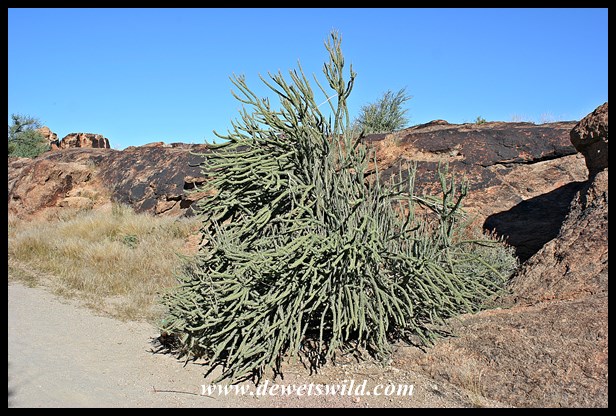
The Namaqua Porkbush is a hardy, slow growing, succulent shrub that grows up to 6 feet tall, excellently adapted to the extremely harsh semi-desert environment of rocky hills where it grows on the border of Namibia and South Africa’s Northern Cape. The bark of young shoots of the Namaqua Porkbush can be used to make a kind of elastic rope. The Augrabies Falls National Park is a wonderful place to see these tenacious plants, which seems to be able to grow in even the most meagre of substrate.

Pririt Batis

Batis pririt

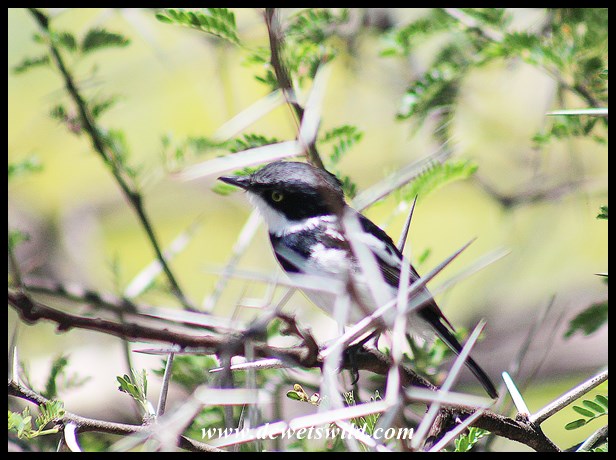
Common in dry savanna habitats, especially those dominated by thorn trees, and along wooded drainage lines in more arid areas, the tiny Pririt Batis (10g in weight, 12cm long) follows an entirely insectivorous diet.

It is mostly the female’s responsibility to build the delicate cup-shaped nest using spiderweb and fine plant material inside the foliage of a tree or shrub. Breeding in this species has been recorded almost throughout the year (though there seems to be a spring peak), with clutches of 1-4 eggs incubated by the female for a little over 2 weeks. Both parents look after the chicks once hatched. The chicks leave the nest when they’re two weeks old but may remain with their parents for up to 6 weeks more. These little birds normally move around in pairs or small groups, often together with similarly sized birds of other species.

The Pririt Batis is distributed from southern Angola through Botswana and Namibia to South Africa‘s arid western provinces (Free State, North West, Eastern, Western and Northern Cape). The IUCN lists it as being of least concern.