Tag Archives: wildlife

Red-necked Spurfowl

Pternistis afer

A denizen of dense habitats, such as mountain forests and riverine thickets, as well as adjacent clearings in which they will forage for seeds, fruits, berries and insects, the Red-necked Spurfowl (or Francolin) is one of our most attractive game birds. Adults measure up to 40cm in length and weigh between 400 and 800g.

Red-necked Francolins are usually encountered in pairs or family groups, and often associates with the closely related Swainson’s Spurfowl with which it has been known to interbreed. Their breeding season stretches from summer to mid-winter, with nests being bare scrapes on the ground in which clutches of 3-9 eggs are laid.

The Red-necked Spurfowl is considered to be of least concern by the IUCN, though they are prone to habitat modification and destruction. They occur widely throughout central Africa, extending southwards along the Indian Ocean coast and adjacent interior to South Africa, where they have been recorded on the Mpumalanga escarpment, in the Drakensberg range and from southern Kwazulu-Natal to the Garden Route.

Spur-winged Goose

Plectropterus gambensis

The Spur-winged Goose is the largest member of the duck family occurring in Africa, with adults weighing up to 7kg with a wingspan of up to 2 meters (males are considerably larger than females). They are found in association with rivers, swamps, marshes and lakes, usually near stretches of open grassland where they feed mainly on grasses and grains, and will migrate over short distances should local conditions become unsuitable. They are often found associating with Egyptian Geese and feed mainly at dusk and dawn, resting on or next to the water by day.

Spur-winged Geese are gregarious, usually encountered in groups of up to 50 individuals but at times congregating in enormous flocks numbering into the thousands, especially during the 2-month winter moulting period following the breeding season, which stretches through spring and summer.  They use a variety of sites for their nests, ranging from aardvark burrows to the large disused nests of eagles and hamerkops, though they prefer to utilise hollows in large trees or dense vegetation for the purpose. Pairs are monogamous and usually nests well away from others of their kind, with there usually being between 6 and 14 goslings in a clutch. The female takes most, if not all, of the responsibility for incubation (± 7 weeks) and rearing the young, which fledge by the time they’re about 3 months old.

The IUCN considers the Spur-winged Goose to be of least concern, and despite being hunted for meat their populations seem to be growing. They occur over almost all of sub-Saharan Africa, and in South Africa can be found in every province, being absent only from the driest parts of the Northern Cape.

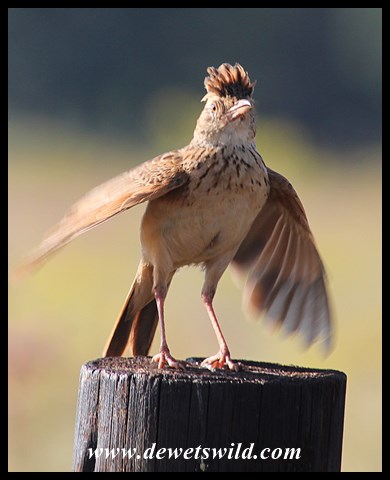
Rufous-naped Lark

Mirafra africana

The Rufous-naped Lark is a common and conspicuous inhabitant of agricultural fields, open grasslands and savannas, where males display prominently atop perches like tree stumps, fence-posts and termite mounds. They follow a mixed diet of insects and seeds. Adult Rufous-naped Larks measure around 17cm in length and weigh about 44g.

Rufous-naped Larks are usually found singly or in pairs, being territorial and monogamous. Their nests are domed structures built of dry grass at the base of a bush or tuft of grass. They breed almost throughout the year, though there’s a distinct peak in the summer months. Clutches of 2-4 eggs are incubated for 2 weeks, with the female taking most of the parental responsibility after the eggs have hatched. The chicks leave the nest before they’re 2 weeks old and before they can fly.

The IUCN lists the Rufous-naped Lark as being of least concern, though it does mention a probably declining and fragmenting population in the north of the species’ range. In South Africa they occur in the Eastern Cape, Free State, Northwest, Gauteng, Kwazulu-Natal, Mpumalanga and Limpopo, and north of our borders they’re distributed patchily over much of sub-Saharan Africa.


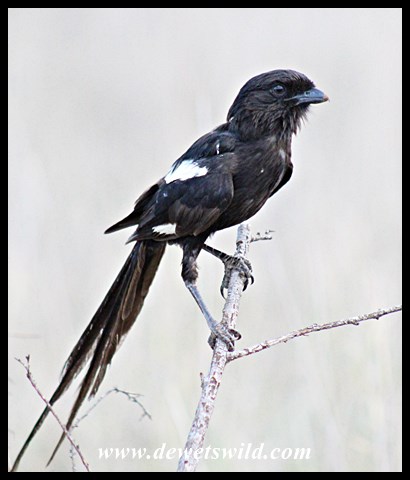
Magpie Shrike

Urolestes melanoleucus

The unmistakable Magpie, or Long-tailed, Shrike inhabits open savanna habitats, typically where thorn trees dominate, and feed on invertebrates, lizards, small mammals, carrion and occasionally fruit. They generally avoid man-altered habitats and human habitation.

Adult Magpie Shrikes measure up to 50cm long and weigh around 85g.

Magpie Shrikes are gregarious and territorial, with groups numbering 3-12 occupying home ranges of up to 70 hectares in size (though much smaller while nesting). Their nesting season spans spring and summer. The dominant pair is monogamous and usually assisted by other group members in raising the chicks.

In South Africa, Magpie Shrikes are found mainly in Limpopo and Mpumalanga, extending marginally into Gauteng, Free State, Northwest, Northern Cape and Kwazulu-Natal. They also occur patchily through the rest of southern and eastern Africa. The IUCN indicates that the overall population of the Magpie Shrike is decreasing, possibly due to habitat loss, but still lists it as being of least concern at the moment.

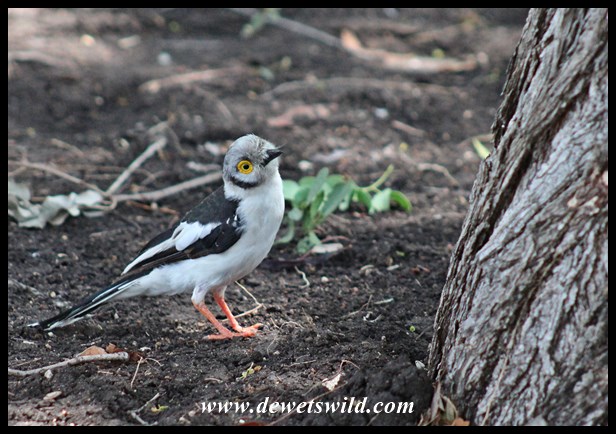
White-crested Helmetshrike

Prionops plumatus

The very active and gregarious White-crested Helmetshrike occurs commonly in savanna and woodland habitats from northern Kwazulu-Natal through Mpumalanga and Limpopo to Gauteng and North West, and north of our borders can be found throughout central, east and west Africa. It is listed as being of least concern by the IUCN.

White-crested Helmetshrikes breed in territorial groups numbering 3-10 individuals, their peak egg-laying season being spring and early summer. There is a strict hierarchy within the group, and all members assist in the rearing of the 2-5 chicks, though the dominant pair takes care of the construction of the nest, which is a compact cup made of plant material and spider web. The eggs are incubated for 3 weeks and the chicks leave the nest about the same period of time after hatching, though group members will keep feeding them until they’re over two months old. Outside the breeding season groups often join up to form larger flocks of 20 or more, and often join mixed bird parties as they move quickly from tree to tree.

Adult White-crested Helmetshrikes grow to about 18cm in length and weigh around 34g. They feed primariliy on insects, other invertebrates and small reptiles, but will also consume fruits in season.

Green Milkweed Locust

Phymateus viridipes

The Green Milkweed Locust, or African Bush Grasshopper, is a large – up to 9cm long – poisonous locust that can congregate in enormous numbers (as we experienced on Sunday at the Walter Sisulu National Botanical Garden, apparently an annual occurrence there in September and October), and may migrate over great distances, flying strong and high. They feed on toxic plants and are rather sluggish on the ground, preferring to stay in trees and bushes and flying between them. When feeling threatened they will raise and rustle their wings and exude a noxious foam (poisonous if ingested) from their bodies as defense. Eggs are laid in the ground and the nymphs (also called “hoppers”) are highly gregarious, moving around in tight clusters until they are almost fully grown.

And yes, they scare me. Terribly.

Swinging into spring at the Botanical Gardens

With the spring season now in glorious swing here in South Africa we headed to the Walter Sisulu National Botanical Garden again for a jolly day out in nature this past Sunday. The recently fledged Verreaux’s Eagle chick and its parents were the stars of the show, as always, and yet again we were amazed at the variety of wildlife finding a home here in suburban Johannesburg. The gardens are hugely popular with the citizens of South Africa’s biggest city, and not without reason, as we hope these photos will convince.

Have a look here for all our posts on the Walter Sisulu National Botanical Garden if you’d like to learn more about this fantastic place.

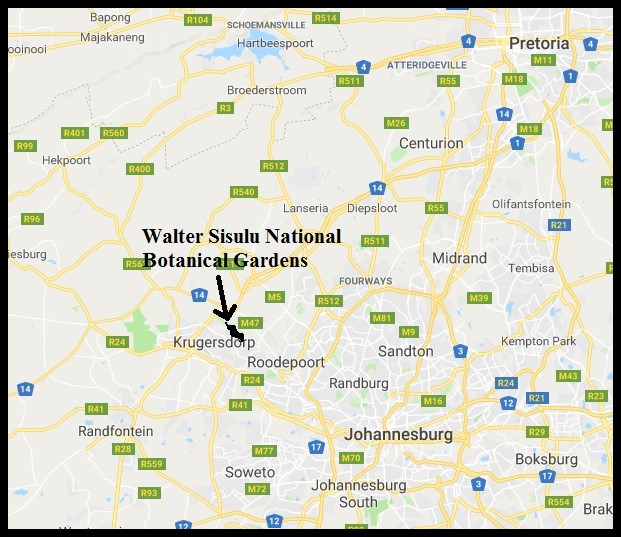
Walter Sisulu National Botanical Gardens is located on the outskirts of Johannesburg on the borders of Krugersdorp and Roodepoort

Collared Sunbird

Hedydipna collaris

Primarily a bird of forest and riparian habitats where it feeds on nectar, fruit and insects, the tiny (8g, 10cm) Collared Sunbird has exquisite, iridescent plumage, especially in the male of the species.

Collared Sunbirds breed mainly during spring and summer, when the female uses dry grass and other fine plant material to position an untidy oval nest with a side entrance in the outer branches of a tree or shrub, often near the hives of bees or wasps. The female is also solely responsible for the incubation of the clutch of 1-4 eggs over a two week period. The male doesn’t take an active role in the feeding of the chicks, which become independent at around 4 weeks old, either.

The Collared Sunbird is listed as being of least concern by the IUCN, although the loss of coastal forest habitats to development is cause for concern. It occurs widely over the more densely vegetated areas of sub-Saharan Africa, and in South Africa occurs along the coast and adjacent interior of the Eastern Cape and Kwazulu-Natal through to the Lowveld and Escarpment of Mpumalanga and Limpopo.

Laughing Dove family tragedies…

During September (2018) we had the opportunity to watch a pair of Laughing Doves incubate a clutch of two eggs and raise their squabs in our backyard.

They started incubating the eggs on the 8th of September, and 12 days later the hatchlings emerged. Sadly one of the chicks only lived for six days, the reason for its demise being unclear, and Marilize had to watch as its mother unceremoniously pushed its body out of the nest.

Five days later even more tragedy struck as both parents abandoned the remaining chick when it was only eleven days old and still incapable of fending for itself. We had no idea what happened to the parents, who up to that point seemed very devoted, and therefore we first opted not to interfere at the nest in the hope that they’d return soon enough to resume caring for their youngster before it got too weak.

Yesterday, with more than 24 hours elapsed since the last time the adults visited the nest and still no sign of them, Marilize and Joubert took the little one to a local veterinarian who will take care of it until it is big enough to release.

Edit: 14 November 2018

Our tragic laughing dove pair were in the family way again. Late in October we saw them cooing around each other at the nest where they tried raising their first family in September. On the 28th of October, we noticed the first egg in the nest and on the morning of the 31st the clutch was complete with a second egg and they started incubating, facing some harsh weather (heat and rain) in the process. The first hatchling made its appearance on the 11th of November, and by the 12th the pair had discarded the second, unhatched, egg. Sadly, on the afternoon of the 13th of November, the little chick also died – it might have choked as we watched it being fed by the mother not long before. Unceremoniously the hen kicked the little body from the nest and flew off.

We sure hope that this Laughing Dove pair will try again and hopefully be successful with their next attempt at rearing a family.

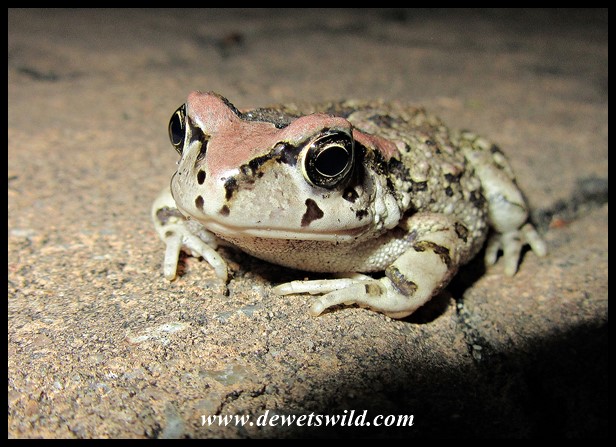
Raucous Toad

Sclerophrys capensis (prev. Bufo rangeri)

The Raucous Toad is a regular inhabitant of South African gardens, especially those with running water fountains, and its duck-like “quacks” will be familiar to many people. Its natural habitat preference is for permanent ponds, wetlands, streams and rivers in fynbos, grasslands, savanna areas and coastal forests, where they feed mainly on insects and other invertebrates. Adults grow to 11cm in length. Raucous Toads breed in the summer months, with males calling repeatedly in groups from the vegetated margins of their watery abodes to attract and mate with the females. The eggs are laid in long strings among aquatic vegetation, and may number over 10,000 per female! Tadpoles take 2 to 3 months from hatching to complete their metamorphosis.

The IUCN considers the Raucous Toad to be of Least Concern. It is a common species but may be declining in parts of its range, which covers much of South Africa, Lesotho and Swaziland.