This was the scene we enjoyed our first cup of coffee, rusks and biscuits with this morning, here in Hluhluwe-Imfolozi Park.
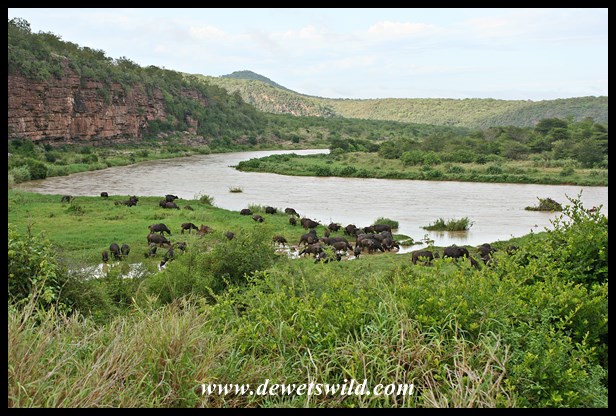
This was the scene we enjoyed our first cup of coffee, rusks and biscuits with this morning, here in Hluhluwe-Imfolozi Park.

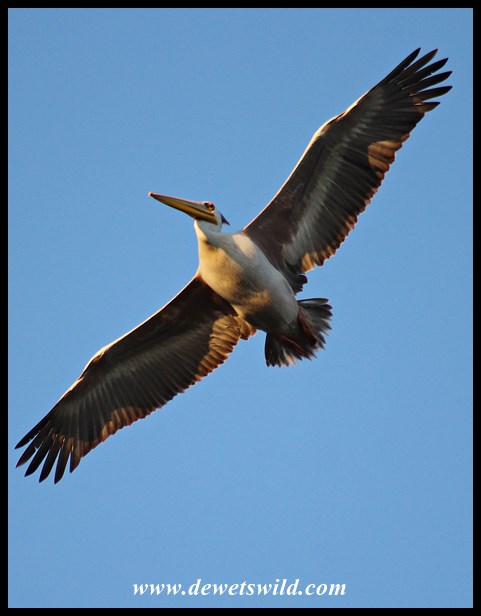
While exploring the mangrove swamps here at Umlalazi Nature Reserve this morning, this Pink-backed Pelican treated us to a low-level flypast.
Today was our last day here at Umlalazi. Tomorrow, we head for the Hluhluwe-Imfolozi Park. If we have a good enough connection well try to post a daily update from there as well.

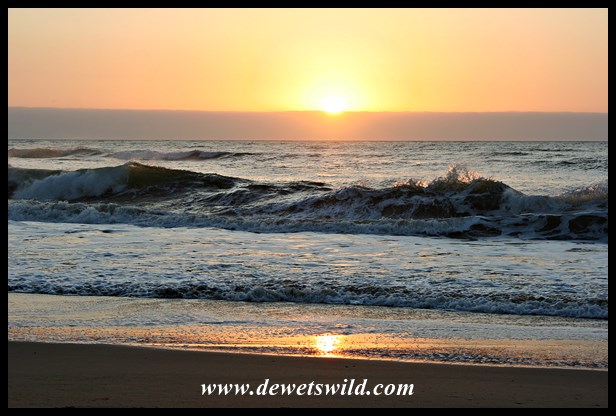
We were out the door at 04:20 this morning to take in this spectacular sunrise over the Indian Ocean. We then spent a couple of hours playing on the beach before going back to our cabin for a delicious brunch. Wish every day could start this way…
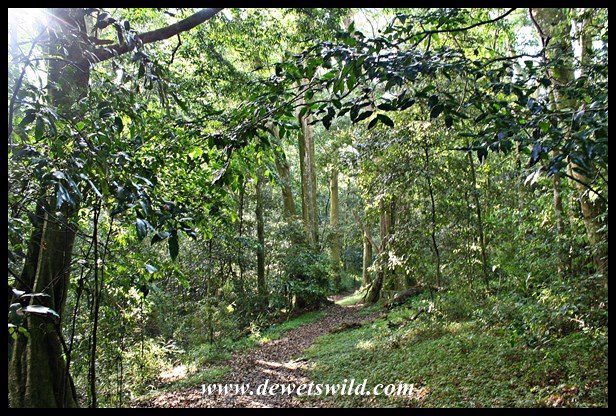
We spent the morning exploring the beautiful Dlinza Forest Nature Reserve in the town of Eshowe. This panoramic view awaits you at the top of the aerial boardwalk at Dlinza – an excellent way to experience the middle and upper stories of the forest that one doesn’t normally have access to – click on the image for a larger view. Of course we’ll share more about Dlinza when we’re back from holiday!

View from the Dlinza Reserve’s Aerial Boardwalk
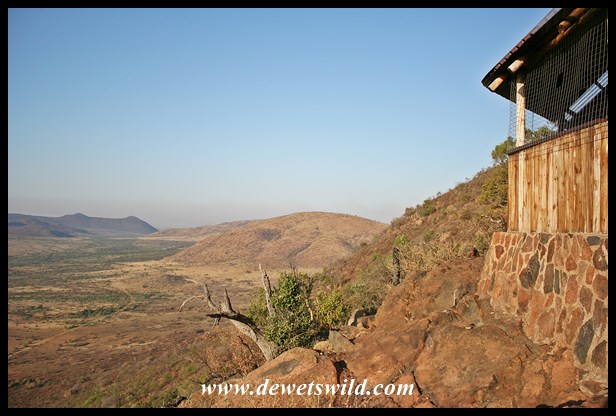
Early on this past Saturday morning Joubert and I headed for the Pilanesberg National Park’s Kwa Maritane Gate. Our plan was to spend all of Saturday, most of Sunday morning and the night between in one of South Africa’s most easily accessible wildlife destinations, enjoying a bit of father-son company and shared hobbies in the beautiful surroundings far from the city’s distractions. When the Gate opened at 05:30 we set off, enjoying some thrilling encounters with the Park’s wildlife right from the start.


While we were enjoying the Pilanesberg’s sights and sounds from the coolness of the photographic hide at Makorwane Dam, Joubert suggested that we head for Bakgatla Resort to go setup camp before the day got any hotter.


With our tent pitched and our camping chairs unpacked, we could enjoy our lunch, a few glasses of cold drink and an ice-cream treat surrounded by a selection of Bakgatla’s permanent residents of the feathered variety.


The first stop on our afternoon drive was Rathlogo Hide, just a few kilometers from Bakgatla.


At Tilodi Dam we laughed at the antics of a male African Black Duck that was most impressed with himself for having chased off a White-faced Whistling Duck from “his” shoreline.


There was much more wildlife to be seen as we traveled through the southeastern portions of the Park.


At Lengau Dam a group of baboon youngsters were having great fun roughhousing in a dead tree and occasionally dropping into the water below – no doubt enjoying great relief from the oppressive heat but I was surprised that they weren’t more afraid of the crocodiles!


With the sun setting it was time to head towards Bakgatla.


On Sunday morning we packed up our camp and headed for the Lenong Viewpoint to enjoy our morning tea and rusks from a beautiful vantage point high on top of one of Pilanesberg’s mountains. The rest of the morning we spent visiting more of our favourite spots in the Park, until the day started getting really hot again. We enjoyed a quick lunch at Fish Eagle Picnic Spot and then headed for Kwa Maritane Gate and home…


Pilanesberg National Park is an easy 160km drive from our home in Pretoria.

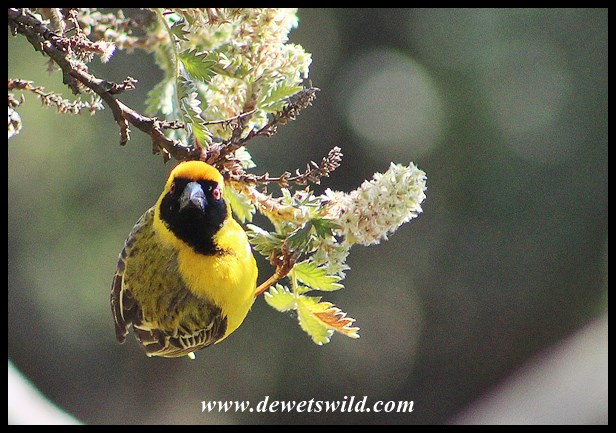
With the spring season now in glorious swing here in South Africa we headed to the Walter Sisulu National Botanical Garden again for a jolly day out in nature this past Sunday. The recently fledged Verreaux’s Eagle chick and its parents were the stars of the show, as always, and yet again we were amazed at the variety of wildlife finding a home here in suburban Johannesburg. The gardens are hugely popular with the citizens of South Africa’s biggest city, and not without reason, as we hope these photos will convince.


Have a look here for all our posts on the Walter Sisulu National Botanical Garden if you’d like to learn more about this fantastic place.
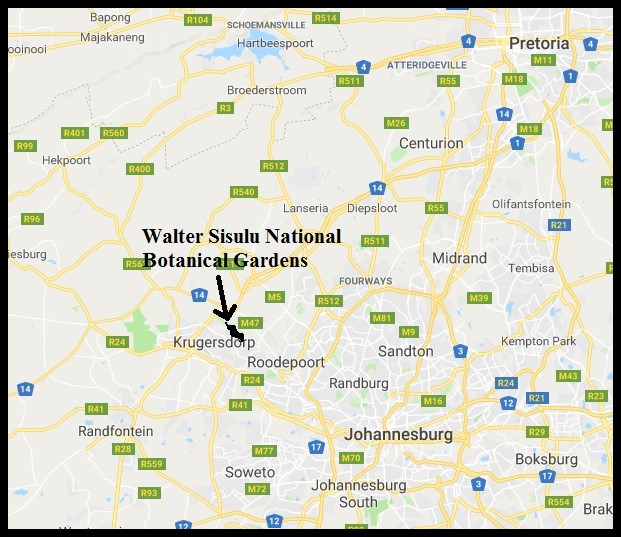
Walter Sisulu National Botanical Gardens is located on the outskirts of Johannesburg on the borders of Krugersdorp and Roodepoort

This past Women’s Day long weekend afforded us the opportunity to make a long overdue return visit to one of our favourite South African wild places – the Ithala Game Reserve in northern Kwazulu-Natal. We’ve been singing the praises of this little known yet exceptionally scenic reserve for as long as this blog’s been running and if you’d like to see all our posts about Ithala and learn more about it please follow this link.
While the weekend’s weather ranged from cold, wet and blustery to glorious sunshine, that didn’t curtail our explorations in the least. How could it, when the majestic scenery is so rewarding!?


And, when the sun came out, so did the butterflies and various kinds of reptiles!


Ithala has a rich variety of bird species and many of them are easily seen and photographed in Ntshondwe, the reserve’s main camp.


And of course, what would a “game reserve” be without a rich assortment of large animals? Ithala never disappoints in its variety of mammals, and especially the giraffes (Ithala’s emblem) were out in force!


We spent three nights at Ithala, staying in comfort in Ntshondwe’s chalet #20. Ithala’s a relaxed 6 hour drive on good tarred roads from our home in Pretoria.
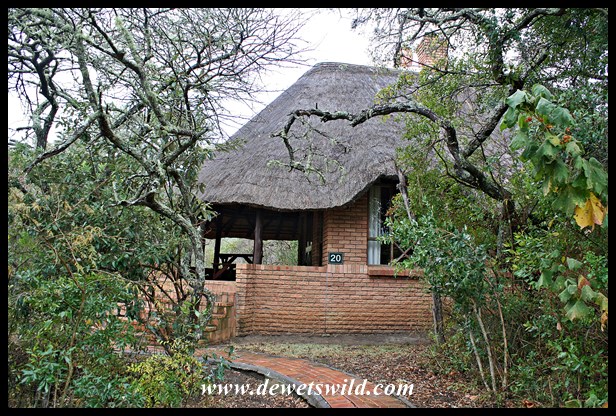
Ntshondwe Chalet #20, Ithala Game Reserve, August 2018
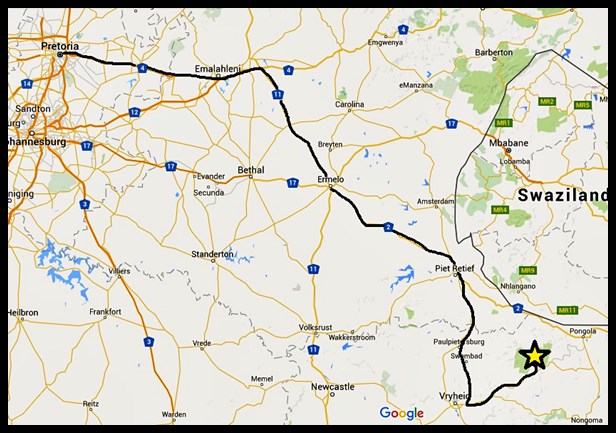
Pretoria to Ithala
(drawn with Google Maps)
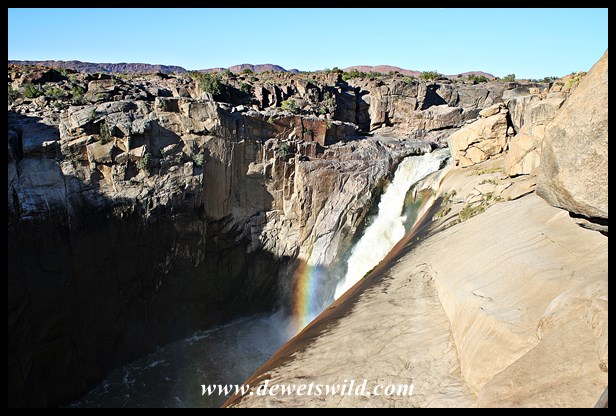
The Orange River, South Africa’s biggest and longest (running 2,200km from its source in Lesotho to its mouth at the Atlantic Ocean) is, for the most part, a lazy, slow-flowing waterway. That changes however when it is forced through a narrow granitic channel in the arid Northern Cape, plunges 56m over the impressive Augrabies Falls and continues through a dramatic gorge for another 18km before again returning to its more placid ways.
After years of political wrangling, a small 5,400 hectare area around the Falls was proclaimed the Augrabies Falls National Park in August 1966. Subsequently surrounding areas have been incorporated, and today the Park covers over 51,000 hectares.
Visitors can enjoy the best views of the Falls from several vantage points connected by easily negotiated boardwalks.
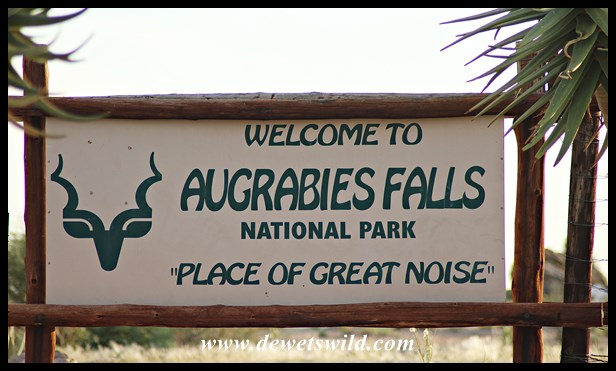
Consider that these photos taken during our visit in June 2018 saw the river flowing at a below average 38 cubic meters per second, and then imagine what it must look like when a flood of approximately 7,800 cumec, as happened in 1988, thunders down the Falls, to understand exactly why the Khoi named this place “Aukoerebis“, meaning “the place of great noise“!


Although the Falls is a worthy focal point of the National Park, there’s still lots more to see further afield when exploring this arid rocky desert landscape (the Park receives only about 120mm of rain annually). Places like Oranjekom, Ararat, Echo Corner and the Moon Rock are well worth the visit for spectacular views and fascinating geology. Quiver Trees and Namaqua Porkbush, both of which we’ll feature in more detail soon, are conspicuous plants and brilliantly adapted to life in this harsh environment. Rocky hills and arid plains where animals and birds abound add to the attraction.


Among the fauna finding protection in the Augrabies Falls National Park counts 49 species of mammal, 181 recorded bird species, around 50 species of reptile, 6 kinds of frog and 12 species of indigenous fish.


Guests can be accommodated overnight in the rest camp’s chalets or the very neat camping area, all within easy walking distance from the Falls (illuminated until 10pm each evening). At the camp there’s four swimming pools (including one for day visitors), a shop, restaurant, fuel station and a little bird-watching hide. The Oranjekom Gorge Cottage is located about 10km from the main camp, and offers privacy and magnificent views over the ravine and river. Provision is also made for day visitors with picnic sites in the camp and along the game viewing loop. Visitors are welcome to explore the Park’s roads in their own vehicle (some roads are only accessible to 4×4 vehicles) or on mountain bikes, and there’s several hiking trails to choose from ranging in length from 2 to 33km (the latter being the Klipspringer Trail which includes two overnight stops). Guided drives (both day and night) in open vehicles can be booked at reception.


The Augrabies Falls National Park is in one of the remotest corners of South Africa’s Northern Cape Province; roughly 930km from Pretoria and 870km from Cape Town. The nearest major airport with daily flights is at Upington, about 125km away. We enjoyed a wonderful two-night visit to Augrabies at the end of June 2018, during which all these photos were taken.
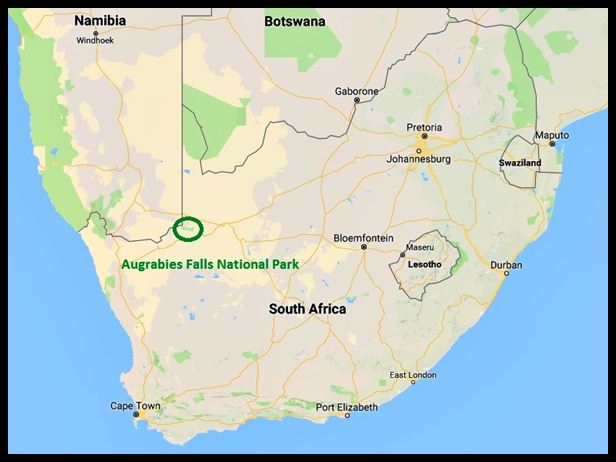
Location of Augrabies Falls National Park
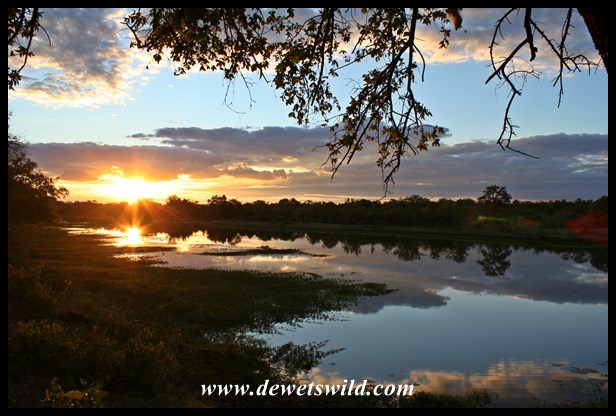
Fresh back from a self-made long weekend in the Kruger National Park again. Lots more photos coming your way in the days to follow!

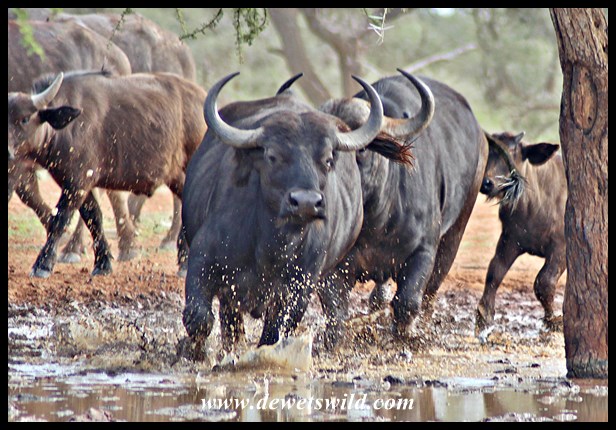
“Dries se Gat” is one of our favourite waterholes in Mokala National Park, not only because I share a name with it but also because there always seem to be something interesting happening there.
During our latest visit to Mokala we arrived at the waterhole just as a big herd of 100+ buffaloes were making their way to the water, and could spend quite a bit of time watching the animals interact with each other while slaking their thirst and enjoying a mud bath.


If you’d like to learn more about Mokala National Park, why not have a read through the detailed post we did about the Park in 2016.
 DeWetsWild