Tag Archives: travel

Red-billed Quelea

Quelea quelea

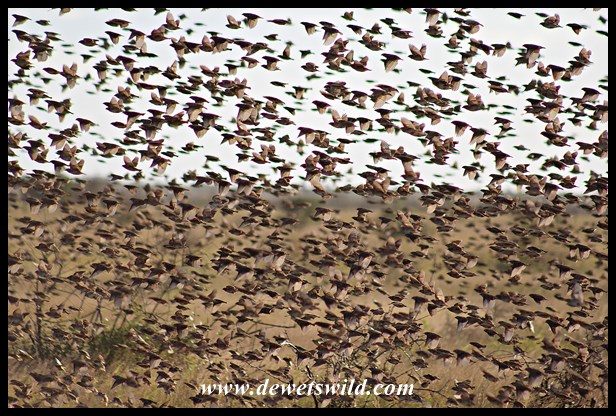
Some of the most impressive sights of our recent visit to the Satara area of the Kruger National Park was the enormous flocks of Red-billed Quelea occupying the grasslands of the central plains. Following the good rains that bought respite from an awful drought, the savannas are heavy with a rich harvest of seeding grasses, and literally millions of the little birds are making the most of the abundant foodsource. When their population reaches a peak, as it currently has, there could be as many as 33-million Red-billed Queleas swirling in cloudy swarms over the Park!

The Red-billed Quelea is a small (20g) seed-eating sparrow-like nomad inhabiting grasslands and grainfields (causing enormous losses to farming communities). Swarms that could number in the millions descend on watering holes at least twice daily. While feeding they “roll” over the grasslands in a wave-like motion, most impressive to witness! While seeds make up the vast majority of their diet they do catch small insects as well, especially when raising chicks.

Nesting occurs communally in the rainy months and hundreds, even thousands, of nests are woven per tree (prefers thorn trees) by the males. Breeding colonies could consist of more than 2 million monogamous pairs, and is a magnet for every imaginable predatory bird, reptile and mammal that is large enough to take adults and chicks. Clutches normally number three eggs and the female incubates them for only 12 days, whereafter the chicks fledge within another two weeks!

The Red-billed Quelea may well be the most abundant bird on the planet, with an estimated population as large as ten billion, and as such is considered as being of least concern by the IUCN. It occurs widely in the savannas of Sub-Saharan Africa and can be found in every one of South Africa’s provinces, where it must number in the hundreds of millions.

(The photos in the following gallery were taken on visits to the Kruger Park and elsewhere)

de Wets Wild turns five!

We’re fresh back from a wonderful breakaway in the Kruger National Park, and of course have lots to share with you from our latest trip to the bush, so stay tuned!

Today also marks the fifth birthday of de Wets Wild – Thank you to everyone who has supported and encouraged us along the way!

Sunset at Satara


A special time at the Giant’s Castle

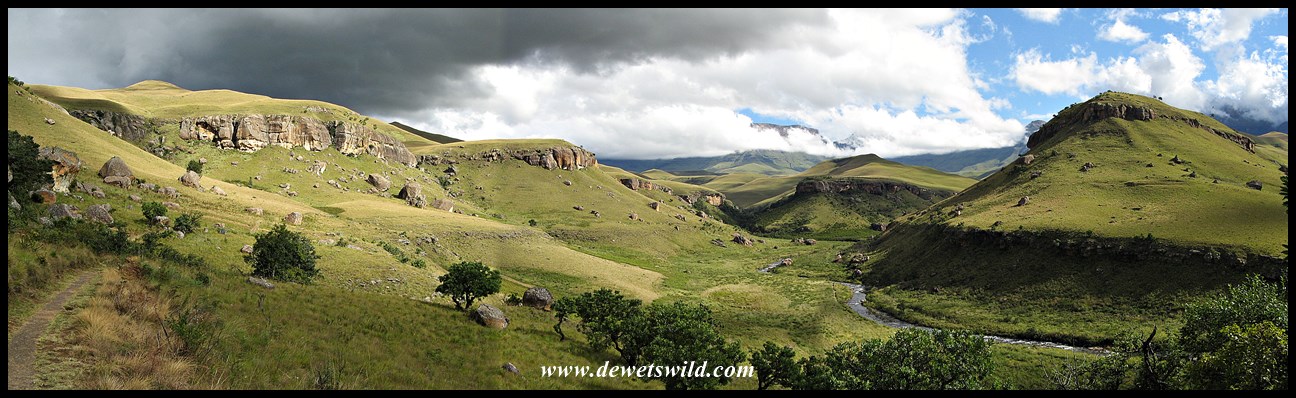
Spending Easter in a beautiful natural location is almost a given for the de Wets. Our original plans for this particular long weekend was to visit the uKhahlamba Drakensberg Park, and specifically the Cathedral Peak area, but a last minute change in reservations had us heading for the Giant’s Castle area of the Park instead. A special place to celebrate a special holiday!

While we had only three days to spend at Giant’s Castle, the weather made sure we experienced almost every climatic experience the Drakensberg mountain range can conjure (with the exception of snowfall). Dark thunder clouds one day gave way to heavy fog and a constant drenching drizzle the next, followed in turn by a day of glorious sunshine! Giant’s Castle must be one of the scenically most spectacular parts of the entire Drakensberg range, and you cannot help but stand in awe at the shear majesty of the landscape surrounding you.

Whether it rains or shines, Giant’s Castle’s grandiose scenery will keep your jaw dropping every so often. When that happens, and you bend down to pick it back up, take a moment to enjoy the magnificent juxtaposition of tiny beauties – pretty flowers, exquisite butterflies, delightful droplets, ornamental moss and lichens, and dainty insects – all around you!

It goes without saying that such a scenically attractive piece of earth wouldn’t be complete without a myriad of wildlife to round off the picture, even if, as at Giant’s Castle, they have to be content with taking a back seat to the surrounding landscape.

Giant’s Castle is one of our favourite destinations in the uKhahlamba Drakensberg Park, and we can’t imagine that we’d ever get enough of it (our previous visit was also over Easter, in 2014). Excellent amenities in the camp (managed by Ezemvelo KZN Wildlife) and a terrific network of short and longer walking trails ensures that every visit is a pleasant and fulfilling experience, one we can highly recommend!

Giant’s Castle Chalet #4, uKhahlamba Drakensberg Park, April 2017

Sitting pretty in the ‘Berg

Well, maybe not so much pretty as comfortably…

Wintry weather in the ‘Berg

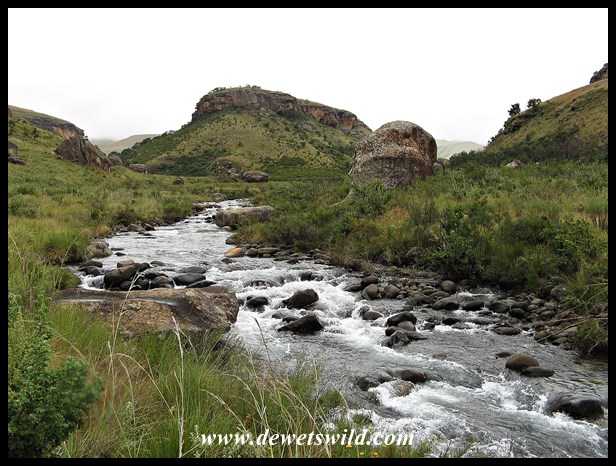
A cold, overcast and rainy day at Giant’s Castle allowed just a short walk along the Bushmans River this morning

Easter in the ‘Berg

We’re wishing you a blessed Easter from spectacular Giant’s Castle Game Reserve in the Drakensberg Mountains!

(Click on the image for a larger view)

Creatures Great and Small at uMkhuze

Despite the lush greenery making it a little more difficult than normal, we were treated to some amazing game-viewing at uMkhuze Game Reserve when we visited in March, and what better way to conclude our trip reports than with some photos of the “hairies and scaries” we encountered along the way?

With so many habitats, uMkhuze is home to an astounding variety of invertebrates, amphibians, reptiles and mammals (not forgetting the birds we showed you earlier), and the galleries to follow should give you some idea of what you could expect to see when visiting this wonderful place!

One would think that the bigger the animals the easier they are to see? Please go tell that to uMkhuze’s elephants, rhinos and lions that kept so well hidden during our visit!? Jokes aside though, we reveled in some wonderful encounters with plains zebra, nyala, kudu, impala, hippos, grey duiker, baboons, vervet monkeys, spotted hyenas, buffaloes, blue wildebeest and giraffe.

The arrival of autumn heralds the start of the rutting season for many antelope, and it was hard not to notice the testosterone flowing strongly in many male nyalas and impalas as they established their place in the hierarchy and started herding together their harems!

uMkhuze Game Reserve has so much to offer, and with every visit we’re given only a little taste of it, just enough to keep us going back for more!

uMkhuze Birding

With a list of over 400 recorded bird species, the uMkhuze Game Reserve (part of the iSimangaliso Wetland Park) is one of South Africa’s most highly-rated birdwatching destinations. The reserve is home to many commonly seen and well-known species, both residents and summer migrants, but also hosts several species rarely encountered in South Africa – we, for instance, had our first ever sighting of the African Pygmy Goose at uMkhuze’s Nsumo Pan when we visited the reserve in March, though we sadly didn’t manage a photograph of it. This gallery however shows just some of the almost 100 species we managed to find during our three day visit!


Celebrating nature’s resilience at uMkhuze

Not long ago, much of South Africa was in the grip of one of the most severe droughts in recorded history, and some parts of the country still are. Recent good rains in the north and east of the country has however had a positive impact, and while the effects of the drought will probably take some time to be reversed, seeing uMkhuze Game Reserve covered in swathes of lush, green vegetation and enjoying the spectacle of a full Nsumo Pan, one couldn’t help but feel optimistic!

Baboon antics at Kumasinga

Joubert and I had great fun with the jolly baboons at uMkhuze Game Reserve‘s Kumasinga Hide – their fun and games kept us entertained for hours! Just confirmation again of why Kumasinga is one of the best and most popular photographic hides in the country.