Tag Archives: Satara Rest Camp

Satara Summer 2021 – Jaunting with Jackals

The plains around Satara is usually one of the best regions of the Kruger National Park for regular encounters with Black-backed Jackals, and that certainly was the case again when we visited in December 2021.

In the first few days after we arrived at Satara we were lucky to spend some time with a pair of Black-backed Jackals and their small puppies that were using a den just outside the camp’s north-west corner. The parents must have moved their den later because we didn’t get to see the family again later in our stay.

Another pair of baby jackals were to be seen on the H6 road and these lively puppies were responsible for lots of smiles. One morning we found them playing with every kind of dung that was lying on the road near them – I wondered what their parents thought of their smelly breath and fur!

Black-backed Jackals are great at making the most of every opportunity. We found this jackal scrounging around for grubs in elephant dung one morning on the S90.

While Black-backed Jackals are commonly encountered around Satara, the other kind of jackal that occurs in the Kruger National Park – the Side-striped Jackal – is a much rarer find. We only had one fleeting glimpse of one individual during our three week trip to Satara.

Side-striped Jackal


Satara Summer 2021 – Mingling with Antelope

The Kruger National Park is home to 21 different kinds of antelope – more than any other protected area in our country. Along with zebras and warthogs they form the staple prey for the majority of the large predators in the Park.

The Satara area of the park, which we visited in December 2021, hosts the largest concentrations of Blue Wildebeest in Kruger. Most Wildebeest calves are born at this time of the year, when the summer rains bring a flush of green fodder for the lactating cows.

Bushbuck aren’t seen around Satara all that often; the veld is generally too open for their liking in this part of the Park and any sightings are likely to be along the stream courses where the riverine vegetation provides the cover and browse they need.

The S36 road linking Satara and Orpen to the picnic spots at Muzandzeni and Nhlanguleni is usually reliable for finding Common Duikers, and if you are lucky these shy little antelope may stand still for a second or two so you can take a picture.

It is a real pity that the Impala is so numerous in Kruger that most visitors seem to not even spare them a second glance. They are actually really athletic and beautiful antelope.

Joubert got these photographs of two impala rams sparring.

The birth of Impala lambs are timed to occur en masse at the end of November and into early December. The lambs congregate into a “creche” within the herd when they’re at rest, but can often be seen running and chasing each other around – seems they have boundless energy.

In the evening of the 31st of December, along the Sweni Road (S126), we encountered a huge herd of Impalas. They were on the move, relinquishing the open plain where they were feeding for denser bush in which to spend the night. We spent several minutes with the herd as they walked off until the whole plain was abandoned.

Owing to the general scarcity of suitable rocky habitats around Satara, our only Klipspringer sighting of the entire 3 weeks we spent in that part of the Kruger Park was at an outcrop to the south of Tshokwane.

Three Klipspringers near Tshokwane

The open, thorny savanna around Satara supports a high density of the magnificent Greater Kudu and they can easily be seen along any of the roads that radiate from the camp.

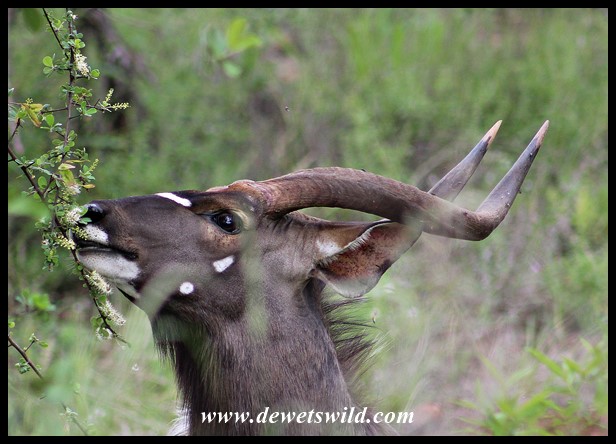
By contrast, the Nyala is rarely encountered in this part of the Park and while they’re sometimes seen along the course of the Nwaswitsontso River south of Satara we had to go north to the banks of the Olifants River this time around to see this impressive bull.

Nyala bull

The Steenbok is the small antelope seen most often around Satara – they find the open grasslands perfectly to their liking.

The less I say about the expression on these Steenbokkies’ faces after mating, the better probably…

The Tsessebe is one of the rarest antelope in the Kruger National Park, and is not found near Satara. We undertook a day’s outing north to the Mopani area of the Park specifically to go looking for them, and luckily did not return to Satara with nothing to show for our effort.

Another large antelope you would defnitely encounter when visiting Satara is the Waterbuck. They’re quite numerous along the courses of the Nwanetsi and Gudzani streams to the east of the camp.

Satara Summer 2021 – Raptors Rule The Skies

Protected places like the Kruger National Park is becoming the last strongholds for many birds-of-prey, the undeniable masters of the skies. Any visit to the Kruger is sure to provide regular encounters with a wide variety of meat-eating birds, and in summer even more so as many species migrate here to escape from the winter in the northern hemisphere.

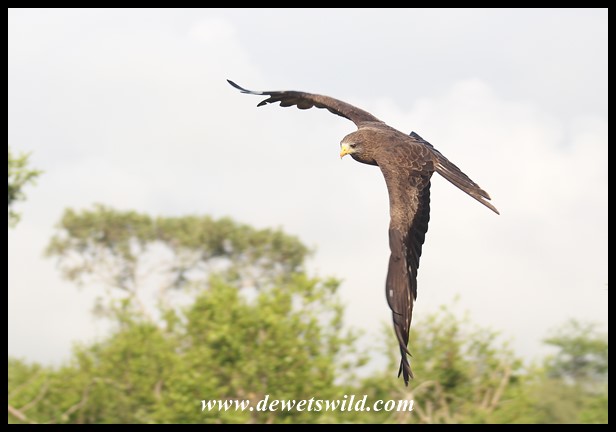
Not all birds-of-prey boast the size and muscle of the big Eagles. Some, like the Falcons, Kestrels, Kites and Harriers make up for what they lack in brawn by being exceedingly fast, nimble and stealthy.

Of course no one’s going to deny the absolute majesty of the Eagles. No wonder they’ve been featured in religion, folklore and heraldry for centuries.

If the Eagles rule the sky during the day then it belongs to the Owls at night. Of course this makes them much harder to see, and photograph, but we were lucky on a few occasions.

Vultures fulfill a vital role in the ecosystem, efficiently cleaning away any leftovers remaining after the large predators have had their fill of a carcass, and in a place like Kruger National Park with healthy populations of all Africa’s large carnivores there’s certainly lots of work for the Vultures. Sadly these birds are all highly endangered outside our country’s large protected areas.


Black-crowned Night Heron

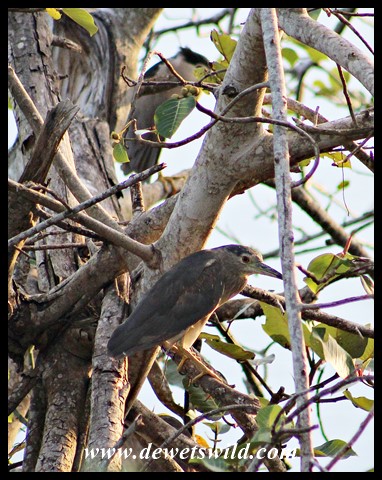
The Black-crowned Night Heron isn’t necessarily a rare bird, but because it is so shy and retiring, and nocturnal, is not seen very often and not very obliging for photographs. During our December 2021 visit to the Kruger National Park, we found a juvenile where the S41-road crosses the Nwanetsi stream. In the early morning it was often quite willing to sit in the open for a photo or two, and one one occasion we even got to see one of its parents flying back home on an overcast morning.

Nycticorax nycticorax

The Black-crowned Night Heron is a nocturnal bird whose habitat requirements are closely linked to slow-moving water with lush growth of emergent vegetation. As these habitats are often fleeting in this part of the world many of our local populations are nomadic in response to rainfall patterns through the region. Their prey ranges from insects and other invertebrates to fish and amphibians and even small reptiles, birds and mammals. As their name suggests these herons are active from dusk to dawn, hiding in dense vegetation by day.

Black-crowned Night Herons often breed colonially, with others of their kind or even other species of water birds. Adults form monogamous pairs with both partners participating in the nest building, incubating the clutch of 2-8 eggs (that take between 3 and 4 weeks to hatch) and rearing the chicks, who fledge at around 7 weeks of age. Breeding can take place at any time of year but reaches a peak in our wetter summer months. Fully grown they measure around 56cm in length and weigh approximately 630g.

Occurring widely but sparsely all over South Africa where there is suitable habitat, the Black-crowned Night Heron’s distribution stretches far beyond our borders to every other continent except Antarctica and Australia. The IUCN considers it to be of least concern.

During a visit to the iSimangaliso Wetland Park in March 2022 we found a slightly older Black-crowned Night Heron and its parents near Cape Vidal.

Black-crowned Night Herons

Another special sighting of this bird was one we saw flying over De Hoop Vlei during broad daylight during a visit to De Hoop Nature Reserve in December 2022.

Southern Carmine Bee-eaters

The Southern Carmine Bee-eater is a regular summer visitor to South Africa, so they are not entirely unfamiliar to us. We have however not seen them in such numbers before as we have during our December 2021 visit to the Kruger National Park.

Merops nubicoides

The beautiful Southern Carmine Bee-eater is a bird that lives in open woodland and savannah habitats, often found near open water, and that feeds exclusively on insects, most of which they catch in flight and usually much bigger than the fare enjoyed by most other bee-eaters. They’re often seen hunting near to large mammals and ground birds – often using them as a perch – catching the insects these bigger animals disturb into flying. They’re attracted to veld fires for similar reasons.

Southern Carmine Bee-eaters breed in huge colonies numbering up to a thousand pairs, where each monogamous pair excavates a nest-tunnel up to 3.5m deep into earthen banks, usually along rivers and gullies. The clutch of 1-6 eggs take 2 weeks to hatch and the chicks then leave the nest when they’re around 3 weeks old. When not breeding they are less gregarious and more dispersed. Southern Carmine Bee-eaters are the largest of the family occurring in Africa, measuring around 25cm in length (excluding the elongated tail feathers) with a weight of about 62g.

In South Africa, Southern Carmine Bee-eaters are found mainly in the provinces of Mpumalanga and Limpopo, and marginally into Gauteng and North West, with most birds arriving locally by December and departing again by March. Interestingly the majority of birds arrive to breed in our northern neighbours Zambia, Zimbabwe and the Okavango region of Botswana from August to November, with the chicks already fledged by the time they then move further southwards to other parts of Botswana and South Africa’s northern provinces. At the onset of our autumn season they then return northwards to countries as far afield as the DRC and Tanzania. Only in a very narrow band crossing parts of Angola, Zambia, Malawi and Mozambique are they resident throughout the year. The IUCN lists the Southern Carmine Bee-eater as being of least concern.

Satara Summer 2021 – Summer Birding

We were fortunate to see and identify at least 202 bird species during our December 2021 visit to the Satara area of the Kruger National Park. This gallery features many of them. Over the course of the next few days we’ll be looking more closely at four very special species that made this trip even more memorable, and then on Friday we will showcase the magnificent birds-of-prey that rule the skies of Kruger.

In most browsers you should be able to click on the first image and then work your way through the carousel of pictures:

Satara Summer 2021 – Squirrels, Rats and Bats

Bats and rodents are not everyone’s cup of tea, but in South Africa’s wild places they’re very much at home and a crucial component of the ecosystem. During our visit to the Kruger National Park in December 2021 we were lucky, though not all equally happy 😉 , to bump into a few of them in and around Satara Rest Camp.

The Red Veld Rat (aka Red Rock Rat) sauntered closer to Marilize while I was busy taking pictures of the Brown-backed Tree Frog one night.

We seem to be more forgiving of rodents that roam during the daylight, like these cute and cuddly Southern African Tree Squirrels.

Now Bats again are a different story. I’ve heard them being referred to as the “rats of the air”. If you could look past their appearance, often smelly colonies, and the fact that they are indeed carriers of some pretty serious diseases, they are actually a quite fascinating and diverse group of creatures!

Clouded Mother-of-Pearl Butterfly

This wonderful present came my way while I was taking a walk through Satara Rest Camp on Christmas Day last year when we were visiting the Kruger National Park for our summer holiday. Looking this butterfly up in my guide book i thought “What a beautiful name for a beautiful butterfly!

Protogoniomorpha (Salamis) anacardii

The Clouded Mother-of-Pearl is a medium-sized butterfly with a wingspan of up to 7cm. They prefer dense habitats ranging from coastal and montane forests to riverine galleries, and in South Africa are found through coastal Kwazulu-Natal and into the Lowveld and escarpment of Mpumalanga and Limpopo. Adults are seen throughout the year though their numbers reach a peak in late summer and early autumn. Their flight may seem ungainly but they’re exceptionally quick when troubled – this one gave me quite the walk-around through camp trying to take its picture. Clouded Mothers-of-Pearl love sitting exposed on prominent perches such as leaves and flowers, apparently basking in the sun – behaviour this one also displayed at least long enough so I could get a few photographs.

While visiting Cape Vidal in the iSimangaliso Wetland Park in March 2022 we again encountered this beautiful butterfly, though this time a really tattered specimen.

Satara Summer 2021 – Invertebrate Diversity

With the Kruger National Park as vast as it is, and with human impacts kept to an absolute minimum, invertebrate life can thrive to an extent that is no longer possible in most of our “developed” society. Summer is a good time to see these fascinating creatures, as our visit in December 2021 proved yet again.

Beetles form the largest and most diverse order in the entire animal kingdom, and there are thousands of beetle species in the Kruger National Park.

While perhaps not as numerous as beetles, the various kinds of Butterflies gets lots of attention thanks to their delicate beauty.

Why exactly Moths are often regarded with such disdain compared to their relatives the butterflies I can’t comprehend, as some of these night-flying creatures are equally beautiful.

Our dislike of Flies is a lot easier to understand, though only a very few of them are actually a nuisance to humans and they all perform a wide variety of vital functions in the ecosystem.

We were lucky to see several “armies” of Matabele Ants on the hunt:

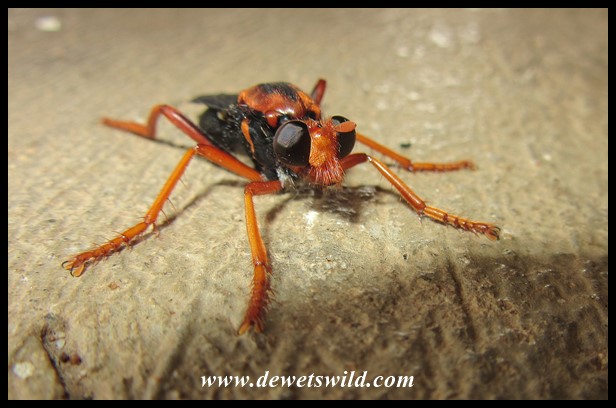
Another diverse insect group, with equally diverse survival strategies, are the Bees and Wasps.

My aptitude at identifying the various kinds of Damselflies and Dragonflies is still sorely lacking.

Web-spinners are a small and little known insect order.

A group of Gregarious Spotted Cockroaches scrambling up the wall of the laundry building at Satara was a welcome distraction on washing day.

So scary and large was this Bark Katydid crawling up a tree in Satara that you’d have to forgive me for the photograph not being entirely in focus…

Bark Katydid

Millipedes are such a familiar group of animals, and yet every time we visit the Kruger Park we are astounded to see just how many unique kinds find a home there!

We end of this post with a group that makes many peoples’ skins crawl: Spiders. Being responsible in no small part for controlling the numbers of all the other invertebrates, the entire ecosystem would collapse in their absence.


Satara Summer 2021 – Reptilian Encounters

There’s just something about reptilians that grabs our attention. Maybe it’s the fact that they’re cold-blooded, or covered in scales, or because they remind us of dinosaurs and dragons. Whatever the case might be, if you are as fascinated by reptiles as we are then the Kruger National Park, home to at least 118 species of reptiles, should definitely be on your list of places to visit and perhaps this collection of reptile photos taken during our visit in December 2021 is all that is needed to convince you.

Of course, there’s probably not many people who think of Flap-necked Chameleons as being dangerous. These masters at camouflage whose eyes can move independently to see almost every inch of their surroundings are always a welcome sight. Easy to notice when they cross a road or pathway, they quickly disappear from sight as soon as they reach the vegetation on the verge.

There’s a rich variety of lizards and geckos in Kruger Park, and the best place to see them is undoubtedly inside the rest camps and picnic sites where they’re accustomed to having people around.

Of course we can’t forget Satara’s show-off Agama King we posted about on the 22nd of January!

Due to their massive size the two species of monitor lizard that occur in the Park – the Rock and Water Monitors – really are a class apart!

We were parked at a leopard sighting when Marilize noticed this Western Stripe-bellied Sand Snake in a bush next to our car. For a while we forgot all about the leopard above our heads…

Stripe-bellied Sand Snake (photo by Joubert)

Tortoises and terrapins too are sure to please the crowd. Often seen crossing the road in hot weather their endearing habit of crawling into their shell when you stop next to them never gets old. Seeing two Speke’s Hinged Tortoises mating – the female munching on flowers through the process – was an unexpected highlight of our latest visit.

To end of this post with, the fearsome Nile Crocodile. Kruger Park is home to some of the biggest specimens of these top predators you could ever imagine seeing.