Tag Archives: picnic spots

Treat

It doesn’t matter whether you wear clothes or feathers, no one can resist a picnic!

Treat2

Marilize and Joubert had a family of yellow-billed hornbills join them for a picnic at Afsaal, in the Kruger National Park.

Treat3 Treat1

Treat” is the theme for this week’s WordPress Photo Challenge.


A new treasure unveiled in Kruger; the Pafuri Border Camp

An omnipresent sense of history permeates the grounds and buildings of Pafuri Border Camp, with the call of a wild frontier on your doorstep clarion clear and impossible to refuse.

Here at Pafuri in the Far North of the Kruger National Park, Harold and Tiny Mockford built their lives, raised a family, grew old. From 1938 to 1985, Mockford was the recruiting agent and administrative officer at the labour recruitment station established at Pafuri by the Witwatersrand Native Labour Association (WNLA, colloquially simply “Wenela”, later TEBA – The Employment Bureau of Africa) to provide migrant workers for the mushrooming gold mines at Johannesburg.

Comprising the beautifully restored and period-furnished residences inhabited by the Mockfords and other WNLA / TEBA staff, the Pafuri Border Camp will offer overnight accommodation in three very spacious self-catering units: the one-bedroom (4-sleeper) Mockford Cottage, the three-bedroom (6-sleeper) Doctor’s House, and the four-bedroom (8-sleeper) Mockford House. Relaxing on the wide verandas that wrap around the houses, enclosed by mosquito gauze just as they were when their original inhabitants lived there, it is hard not to imagine what daily life entailed for those who lived and worked here all those years ago. The camp’s deep swimming pool will be a delight on hot summer days, as it was no doubt for the family Mockford. A small room next to the tiny reception office will be dedicated as a museum in which Pafuri’s fascinating history can be regaled. More “modern” amenities, such as a fuel station, shop and restaurant, is available at Punda Maria Rest Camp, approximately 65km to the South-West.

One of the biggest highlights of the new Pafuri Border Camp is its proximity to Crooks Corner, the Luvuvhu River and Pafuri Picnic Site. Being first to arrive at the river viewpoints in the morning and the last to have to leave those serenely beautiful scenes in the evening is a privilege not to be underestimated. Crooks Corner, so named because the borders of South Africa, Zimbabwe (then Southern Rhodesia) and Mozambique (then Portuguese East Africa) meet here and allowed scoundrels of all description to escape the long arm of the law, has a very special allure in the golden light of sunrise and dusk. Spending time along the Luvuvhu as the riverine forest slowly awakes in the morning delivers a serenity to the human spirit that must be experienced to be truly appreciated.

You can bet that the birdwatching fraternity will be ecstatic at the news of Pafuri Border Camp’s opening. Pafuri is South Africa’s bird-watching mecca; the diversity of its feathered inhabitants simply astounding.

Mammalian wildlife abounds in the Luvuvhu’s riverine bush, with nyala, impala, warthog, baboon and vervet monkey occurring in exceptional numbers. Several other species, including elephant, buffalo, hippo, waterbuck, kudu, blue wildebeest, zebra, and seldomly-seen predators, add to the show. An astonishing number of Nile crocodiles, some in excess of 5 meters in length and probably weighing more than a ton, rule the murky waters of the Luvuvhu.

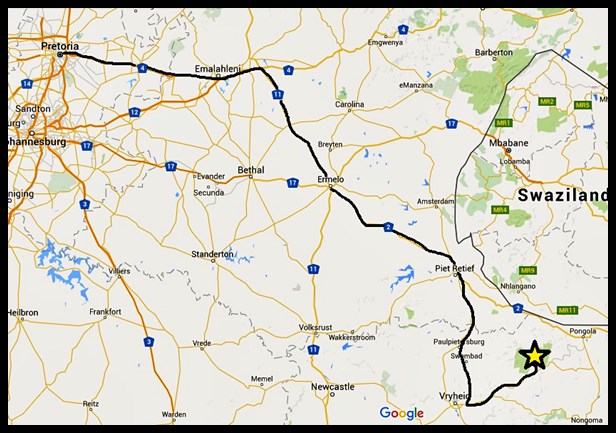
Come 1 November 2015, this new destination, hard not to describe in superlatives and quite literally a stone’s throw away from the border post into Mozambique, will open to its first official guests. We recently had the immense pleasure and privilege to spend two nights at Pafuri Border Camp while the finishing touches were being made to the accommodation. It is sure to prove very popular with nature lovers and history buffs from all over the world. Bookings for Pafuri Border Camp is through South African National Parks. Via the N1 highway and Kruger’s most northern entrance, Pafuri Gate, the camp is located approximately 620km from Pretoria.

(Google maps)

(Google maps)

Marievale’s for the birds (and birdwatchers)!

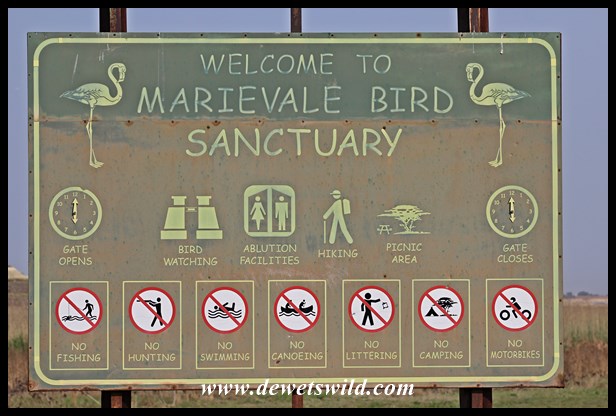
This past Sunday, my brother introduced Joubert and me to the Marievale Bird Sanctuary, a popular destination for birdwatchers and photographers in Gauteng’s Far East Rand.

Marievale 11Oct2015 (16)

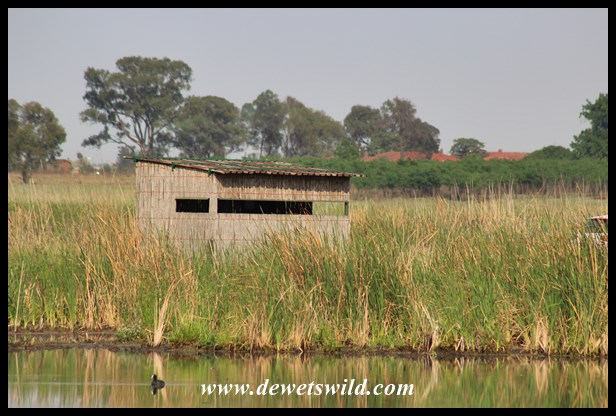
Marievale protects 1012 hectares of the much larger Blesbokspruit RAMSAR wetland, surrounded by mine dumps and other development. Facilities include two 4-bed chalets overlooking the wetland for overnight visitors, a conference centre, picnic sites, walking trails and several photographic hides. The roads in the reserve are rough gravel, for the most part easily traversed in a normal sedan.

Marievale 11Oct2015 (13)

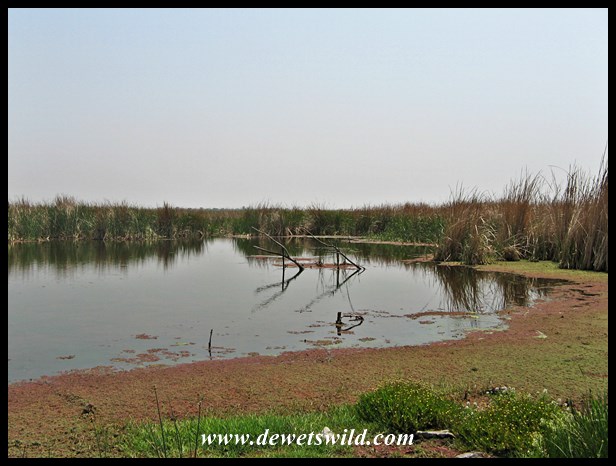
The reserve’s vegetation comprises extensive stands of reedbeds (about 70% of its surface area) and flooded grasslands, interspersed with areas of open water and, during drier periods, mud flats frequented by impressive concentrations of wading birds. The area can hardly be described as pristine however, as the wetland itself owes its existence to the altered flow of the river caused by mining, railways and roadworks, inundating what would otherwise have been grasslands. Pollution from the mines and industries surrounding it, and upstream, is now threatening Marievale’s man-made wetlands.

Marievale 11Oct2015 (35)

Nevertheless, the list of bird species recorded at Marievale has around 280 entries; during the extremely enjoyable six hours we spent in the reserve on Sunday we managed to tick 70 of those. Many of the birds are quite accustomed to the steady flow of human visitors and offer excellent photographic opportunities from the hides or while walking and driving around.

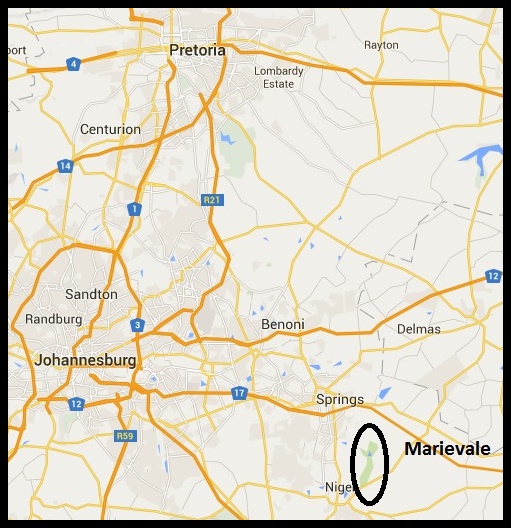
Marievale Bird Sanctuary is controlled by the Gauteng Province’s Department of Agriculture and Rural Development and is easily accessed from the R42 to Delmas, just 4km outside the town of Nigel (map drawn with Google Maps).

Marievale location


Happy Place

A selection of photos from Shingwedzi Rest Camp, in the Kruger National Park. As near as you can get to heaven on earth.

Happy Place” is the theme for this week’s WordPress Photo Challenge

The joys of spring at Ithala

We’ve been singing Ithala Game Reserve‘s praises on this blog for a long time and our recent Heritage Day long weekend visit to this South African treasure further cemented our belief that Ithala is one of our country’s prime conservation areas.

Colourful spring flower displays were in evidence all over the reserve, despite not receiving much rainfall yet. With over 900 plant species at Ithala, including some extreme rarities like the pepper-bark tree and Lebombo cycad, Ithala is a botanist’s delight. Unfortunately we don’t know the names of most, but that doesn’t mean we didn’t enjoy the show just the same!

The giraffe is Ithala’s emblem, and we were lucky to enjoy several encounters with these curious animals.

Most large game species were eradicated from the area before the reserve was proclaimed in 1972, and Ithala therefore had to be restocked. Today it is home to all the species that occurred here historically, with the exception of lion, and all-in-all provides sanctuary to 83 mammal species.

Ithala’s a bird-watcher’s paradise, with a list of 318 species recorded in the reserve. While we didn’t tick quite that many species during our visit – most of the summer migrants have not yet arrived – we were very thrilled with our close-up sighting of a pair of blue cranes shortly after arriving. Being South Africa’s national bird, it seemed a particularly special treat for Heritage Day!

Ithala’s not only about the big and obvious birds and animals, and closer inspection will reveal a multitude of insects, arachnids, amphibians and reptiles. We even encountered three of the reserve’s 41 snake species while walking around Ntshondwe Camp; they pose no danger as long as you don’t threaten them and true to form all three moved away very quickly and quietly.

Talking about Ntshondwe, we just have to mention again how beautifully the accommodation units are placed into the natural vegetation, offering privacy and a really intimate nature experience.

INtshondwe Unit 15, Ithala Game Reserve, September 2015

Ntshondwe Unit 15, Ithala Game Reserve, September 2015

Its faunal and floral diversity aside, Ithala is richly blessed with amazingly diverse scenery. The reserve extends over 30,000 hectares, its area ranging in altitude between the 1,450m peak of Ngotshe Mountain to 400m above sea level along the Pongola River. The reserve’s vegetation ranges from grasslands to woodlands to dense riverine forest.

We’re already making plans for our next visit to Ithala in early 2016, and you can probably see why!

Ithala Game Reserve is managed by Ezemvelo KZN Wildlife, and lies a 500km drive to the South-East of Pretoria.

Pretoria to Ithala (drawn with Google Maps)

Pretoria to Ithala
(drawn with Google Maps)


A Lazy Sunday At Rietvlei

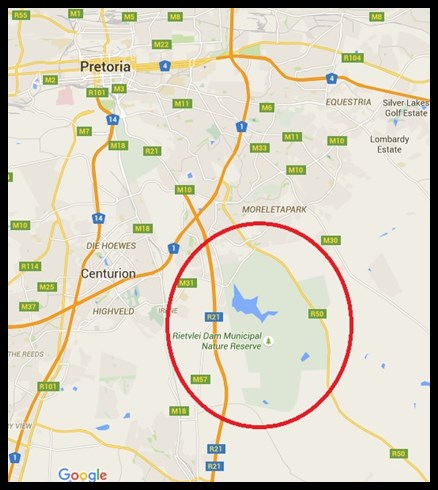
Rietvlei Nature Reserve is the largest of the natural areas within the Pretoria city limits, protecting 3800 hectares of endangered bankenveld grasslands and reedbeds around the Rietvlei Dam. Rietvlei offers sanctuary to an astounding variety of indigenous game and birdlife just minutes away from our home, and was the perfect destination for a picnic with a good friend on the last Sunday of August. The gallery that follows comprises some photos we took on the day, and is a perfect introduction to what this special reserve has to offer – in the few hours we spent there we ticked 13 kinds of mammals (including plains zebra, eland, waterbuck, reedbuck, buffalo and white rhino) and 53 different birdspecies.

The Rietvlei Nature Reserve, on the southern outskirts of Pretoria, is owned and managed by the City of Tshwane Metropolitan Municipality and is very popular, especially over weekends and on public holidays. The reserve offers chalet accommodation and camping, self-drive game- and birdviewing , photographic hides, picnic sites, a coffee shop, lion camp (guided tours only), guided night drives, fishing, sailing, rowing, hiking, mountain biking and horse trails.

Rietvlei location

Rietvlei lies roughly 19km south of the Pretoria City Centre (drawn with Google Maps)


Winter, or not, at Royal Natal

Early August is still considered winter in South Africa. In preparing for our latest trip to Royal Natal National Park, in the uKhahlamba Drakensberg Park and World Heritage Site, we had therefore anticipated snow, at least on the high peaks, and severely cold temperatures. Watching the weather forecasts in the days before our visit was a confusing affair. One private weather site was predicting extreme cold and gloomy weather, while the national weather service predicted glorious sunshine with temperatures in the mid 20’s. Not knowing what to expect, we packed for any eventuality.

The Women’s Day long weekend was only three days long, and so we decided to get an early start out of Pretoria. Through the Free State, the outside temperature remained around freezing. Imagine therefore our excitement seeing the temperature reading on the dashboard rise as we descended the Drakensberg Range into Kwazulu-Natal Province, with not a flake of snow to be seen anywhere! By the time we arrived at Rugged Glen, just to the east of the Royal Natal National Park‘s entrance, it was warm enough to start taking off some layers of clothing and soak in the sunshine. The South African Weather Service got it right this time!

Despite it being a long weekend, the campsite at Rugged Glen was devoid of people; perhaps the predictions of poor weather dissuaded many campers from venturing to “The ‘Berg” for a break. Whatever the case may have been, we didn’t complain about having only Rugged Glen’s diverse birdlife and a few nervous reedbuck to share our first mountain picnic with.

From Rugged Glen, which is also the base for the popular guided bridle trails that traverse these scenic hills, we headed to the Park’s gate, supported the crafters selling their wares and then drove the short distance to the Mahai Visitor Centre. Time for another picnic at one of the tables along the Mahai stream before making our way along, and a little beyond, the pretty and easy Cascades boardwalk, passing several dainty bushbuck ewes along the way while a herd of eland grazed high above us on the slope of Dooley Mountain (named after an Irish logger given a concession to cut wood here in the late 1800’s).

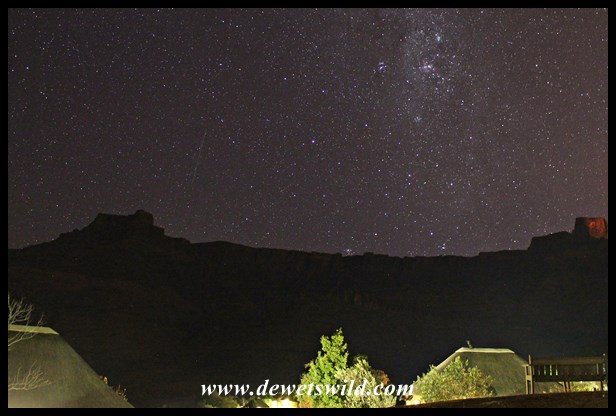
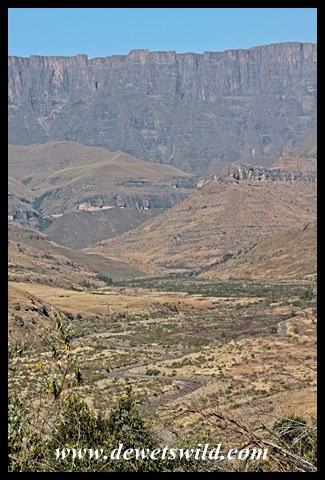
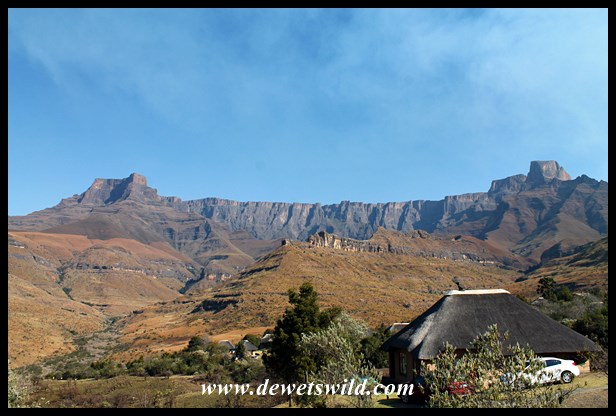
With our hiking boots now introduced to Royal Natal’s network of walking trails it was time to head to Thendele Camp and our accommodation for the two nights we’d be spending at the foot of the magnificent Amphitheatre formation, a basalt cliff-face almost 1000m high and 5000m wide. To the left of the Ampitheatre is the Eastern Buttress, 3011m above sea level, and to the right Sentinel peak soars to 3165m ASL. These majestic natural features absolutely dominates the scenery at Royal Natal, which together with Rugged Glen covers over 8000 hectares, and was the main reason for the Park’s proclamation in 1916. The “Royal” moniker was added to the reserve’s name after a visit by the British Royal family in 1947. The vegetation in the Park, more than 900 species strong, is mostly open grassland dotted with a few hardier trees and shrubs, with heathland on the summit and mountain forests in the sheltered valleys.

We found Thendele alive with bird song, and just below the huts a small group of mountain reedbuck were right at home. Despite the camp’s 29 units (offering between 2 and 6 beds each) being fully booked, it was a haven of peace and tranquility – just the way we like it. At 1580m above sea level, Thendele lies a lot lower than the peaks that tower above it.

Evening temperatures were admittedly a lot cooler, and our chalet’s lounge with its cosy fireplace was just the place to enjoy dark chocolate and a cup of coffee at the end of a wonderful day spent outdoors.
Royal Natal August 2015 (36)

The early morning sun on Sunday bathed Thendele and the Amphitheatre in a glorious gold, inviting Joubert and I to walk around camp while Marilize prepared a hearty breakfast.

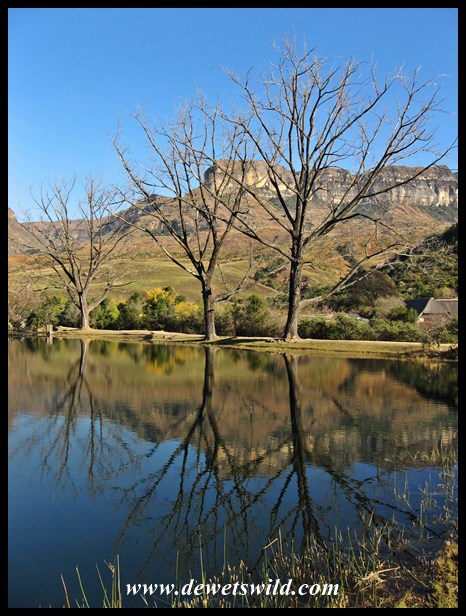
Our first destination this morning was the trout dam at Mahai, where the windstill conditions made for splendid reflections on the water’s surface and we found out just how easy it is to loose complete track of time while marveling at the spectacular scenery around us.

Royal Natal’s biggest attraction is the selection of well demarcated hiking trails traversing the area and excellent pocket guides and maps are available at the shops at Thendele and the Visitor Centre. One of the easier trails is Otto’s Walk, which starts at the Visitor Centre’s parking area and named after one of the reserve’s early Superintendents, Otto Zunckel. It follows the course of the Mahai stream through dense mountain forest for most of the way before returning along the main access road, a total distance of 3km. The pair of rare Mountain Wagtail we encountered at a pleasant spot next to the stream was a real highlight. Another particularly interesting walk is to the San Rock Art site in the Sigubudu Valley, accessible at a small fee and accompanied by a local guide.

Along the main access road from the gate to the Visitor Centre there’s a viewpoint offering an absolutely unobscured view of the Amphitheatre and the wider Drakensberg range. With winter being the dry season, the Thukela River was barely flowing, with only a trickle evident among the rocks and pebbles in the river bed. There was also no sign of the Thukela Falls, which with a combined drop of almost 950m is the 2nd highest waterfall on the planet. One of the Park’s most popular trails follows the impressive gorge cut by the Thukela through the Drakensberg’s sandstone.

Royal Natal August 2015 (57)

We spent the afternoon relaxing around Thendele, enjoying an ice cream on the lawns outside the reception office and exploring the short forest walk behind the camp.

On our final morning, before heading back to Pretoria, we awoke to a Thendele cloaked in thick mist. And cold. Neither the Amphitheatre above nor the Thukela Valley below was to be seen. The wintry weather we had been dreading seemed to have set in just as we were about to depart. After spending two lovely days walking and picnicking in these beautiful mountains, we were immensely grateful for the blessing of good weather! And as we drove out the park that morning, we were already going through our diaries to see where we’d be fitting in our next visit to this magnificent mountain landscape.

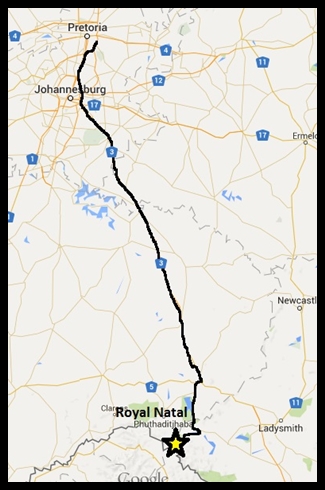
The previous time we visited Royal Natal (April 2012), we traveled to the Park via the Oliviershoek Pass and found it such a pothole-ridden affair that we took a 100km detour to return via Van Rheenens Pass instead. This time we decided to give Oliviershoek (the R74) another try for the last 70km from Harrismith to the Park. The road is being rebuilt and by the time it is finished this should again be one of the country’s most enjoyable drives. For the moment, there’s a 6km stretch of one way traffic on which Stop / Go controls are operating, and a further 15km portion on a wide, smooth gravel detour, perfectly safe to travel in a sedan as long as you don’t try to drive too fast.

Route to Royal Natal

Pretoria to Royal Natal (drawn with Google Maps)

The Royal Natal National Park, Thendele Resort and Mahai and Rugged Glen Campsites are managed by Ezemvelo KZN Wildlife.

Another beautiful day at Royal Natal

Royal Natal definitely has some of the most spectacular scenery in the entire Drakensberg Range, and when you’re lucky to have the kind of beautiful weather we enjoyed here today, it really would be a sin to spend any time indoors!

Royal Natal 09-08-2015

Back in the mountains!

We’re spending the Women’s Day long weekend at Thendele, in the Royal Natal National Park. We couldn’t have asked for a more glorious winter’s day. We’ve been hiking and having picnics all day, and now we’re kicking back in one of the most beautifully situated camps in the country.

Thendele 08-08-2015

Beneath your feet…

is your shadow!

The de Wet family looming over the Mahai stream, in the Royal Natal National Park.

Beneath your feet

Beneath your feet” is the theme for this week’s WordPress Photo Challenge