Tag Archives: outdoors

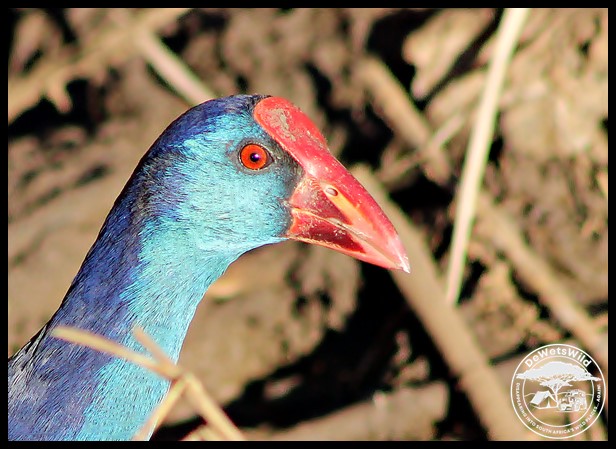
African Swamphen

Porphyrio madagascariensis

The African Swamphen is a shy, skulking inhabitant of dense reedbeds along slow flowing rivers, marshes, swamps and temporary wetlands where they feed mainly on aquatic plants, insects and other invertebrates, fish, frogs and eggs. They are usually seen singly but may be encountered in small family groups from time to time. African Swamphens breed at any time of year, though there is a distinct peak in the summer months. Their nests are large and built of and among reeds. Clutches contain between 2 and 5 eggs, are incubated by both parents and hatch after about 3 weeks. Both parents care for the chicks, which fledge at about two months old.

Adults are around 42cm long, weigh approximately 600g and are by far the biggest members of the rail family occurring in South Africa.

In South Africa, the African Swamphen, or Purple Gallinule as it was previously known, is distributed very patchily on the highveld and along the eastern and southern coastlines. Some authorities consider the African Swamphen to be a subspecies of the Purple Swamphen (P. porphyriowhich has a wide distribution over Africa, Europe, Asia and Australia), and is listed as being of least concern by the IUCN.

Southern Foam Nest Frog

Chiromantis xerampelina

Foam Nest Frogs are excellently adapted to an arboreal lifestyle, living near seasonal and permanent water in the savanna biome and often seen inside houses and other buildings in these parts. At 9cm in length, adult females are slightly larger than males.

During spring and summer Foam Nest Frogs congregate around pools of standing water to mate. The female secretes a fluid from her oviducts and then, using their hind legs in a process that may take several hours, she and the attending males churn it into a thick white foam ball that attaches to a branch or other structure hanging over the water and in which up to 1,200 eggs, fertilised by several of the present males, are then laid. At times the mating frogs congregate in large groups creating enormous, collaborative foam nests. Inside the foam balls, now with a hardened outer edge and looking very meringue-like, the eggs and newly hatched tadpoles are kept moist and safe from smaller predators. When they are a few days old the tadpoles drop from the foam ball into the water to find food and complete their metamorphosis.

In South Africa, Foam Nest Frogs are commonly encountered in the north of Kwazulu-Natal, the lowveld of Mpumalanga and widely through the bushveld regions of Limpopo. They are also distributed widely over much of the rest of southern, central and eastern Africa. The IUCN considers it to be of least concern.

White-necked Raven

Corvus albicollis

Powerfully built with a most intimidating beak and boasting a wingspan of over 80cm and weighing around 800g, the White-necked Raven is the largest member of the crow family occurring in South Africa. They are true omnivores, feeding on carrion, small vertebrates, insects, eggs, fruits and grains, and they will also scavenge human waste (although they’re not as frequently associated with human habitations as others of the family). It has also been observed that they’ll pick up tortoises and drop them from a great height, usually on rocks, to break the shells.

White-necked Ravens are usually encountered in territorial pairs or small family groups, but at times congregate in groups that may number over a hundred at a good food source, especially outside of the breeding season. Their preferred habitat is open hilly and mountainous areas where they nest on cliffs during the spring and early summer. Their large stick nests, lined with fur, wool and grass, are often utilised by other birds once the ravens have deserted it after their own chicks fledged. Clutches contain 2-5 eggs and are incubated by both parents.

White-necked Ravens occur patchily from Uganda and Kenya southwards to South Africa, where they can be found in all our provinces with the exception of Gauteng and the North West. While noting that some populations are declining due to unspecified reasons (though I suspect poisoning is probably a major factor) the IUCN lists the White-necked Raven as being of least concern.

Brown-hooded Kingfisher

Halcyon albiventris

Despite what their name suggests, the Brown-hooded Kingfisher does not feed predominantly on fish – their diet consists mainly of invertebrates, small birds and reptiles caught on dry land and only occasionally includes small fish, crabs and tadpoles. It is a bird of savannas,  woodlands, riverine thickets and forest edges and does not need to live near water. They’re becoming ever more frequently encountered in suburban parks and gardens.

Brown-hooded Kingfishers are usually seen singly or in pairs (that often stay in the same area for many consecutive years) or in family groups following the end of the spring-summer breeding season. Their nests are burrows (up to a meter deep) excavated by both parents in river banks or other earthen walls, and in which the female incubates clutches of 2-5 eggs for around 2 weeks. Fully grown they measure around 23cm in length and weigh about 60g.

The Brown-hooded Kingfisher lives in Africa south of the equator, and mainly in the eastern half from Kenya southwards to South Africa (all provinces, though very patchily in the arid central and western provinces and mainly in association with introduced vegetation around human settlements in those parts). Thanks to a large and stable population the IUCN considers the species to be of least concern.

Red-necked Spurfowl

Pternistis afer

A denizen of dense habitats, such as mountain forests and riverine thickets, as well as adjacent clearings in which they will forage for seeds, fruits, berries and insects, the Red-necked Spurfowl (or Francolin) is one of our most attractive game birds. Adults measure up to 40cm in length and weigh between 400 and 800g.

Red-necked Francolins are usually encountered in pairs or family groups, and often associates with the closely related Swainson’s Spurfowl with which it has been known to interbreed. Their breeding season stretches from summer to mid-winter, with nests being bare scrapes on the ground in which clutches of 3-9 eggs are laid.

The Red-necked Spurfowl is considered to be of least concern by the IUCN, though they are prone to habitat modification and destruction. They occur widely throughout central Africa, extending southwards along the Indian Ocean coast and adjacent interior to South Africa, where they have been recorded on the Mpumalanga escarpment, in the Drakensberg range and from southern Kwazulu-Natal to the Garden Route.

Spur-winged Goose

Plectropterus gambensis

The Spur-winged Goose is the largest member of the duck family occurring in Africa, with adults weighing up to 7kg with a wingspan of up to 2 meters (males are considerably larger than females). They are found in association with rivers, swamps, marshes and lakes, usually near stretches of open grassland where they feed mainly on grasses and grains, and will migrate over short distances should local conditions become unsuitable. They are often found associating with Egyptian Geese and feed mainly at dusk and dawn, resting on or next to the water by day.

Spur-winged Geese are gregarious, usually encountered in groups of up to 50 individuals but at times congregating in enormous flocks numbering into the thousands, especially during the 2-month winter moulting period following the breeding season, which stretches through spring and summer.  They use a variety of sites for their nests, ranging from aardvark burrows to the large disused nests of eagles and hamerkops, though they prefer to utilise hollows in large trees or dense vegetation for the purpose. Pairs are monogamous and usually nests well away from others of their kind, with there usually being between 6 and 14 goslings in a clutch. The female takes most, if not all, of the responsibility for incubation (± 7 weeks) and rearing the young, which fledge by the time they’re about 3 months old.

The IUCN considers the Spur-winged Goose to be of least concern, and despite being hunted for meat their populations seem to be growing. They occur over almost all of sub-Saharan Africa, and in South Africa can be found in every province, being absent only from the driest parts of the Northern Cape.

Rufous-naped Lark

Mirafra africana

The Rufous-naped Lark is a common and conspicuous inhabitant of agricultural fields, open grasslands and savannas, where males display prominently atop perches like tree stumps, fence-posts and termite mounds. They follow a mixed diet of insects and seeds. Adult Rufous-naped Larks measure around 17cm in length and weigh about 44g.

Rufous-naped Larks are usually found singly or in pairs, being territorial and monogamous. Their nests are domed structures built of dry grass at the base of a bush or tuft of grass. They breed almost throughout the year, though there’s a distinct peak in the summer months. Clutches of 2-4 eggs are incubated for 2 weeks, with the female taking most of the parental responsibility after the eggs have hatched. The chicks leave the nest before they’re 2 weeks old and before they can fly.

The IUCN lists the Rufous-naped Lark as being of least concern, though it does mention a probably declining and fragmenting population in the north of the species’ range. In South Africa they occur in the Eastern Cape, Free State, Northwest, Gauteng, Kwazulu-Natal, Mpumalanga and Limpopo, and north of our borders they’re distributed patchily over much of sub-Saharan Africa.


Magpie Shrike

Urolestes melanoleucus

The unmistakable Magpie, or Long-tailed, Shrike inhabits open savanna habitats, typically where thorn trees dominate, and feed on invertebrates, lizards, small mammals, carrion and occasionally fruit. They generally avoid man-altered habitats and human habitation.

Adult Magpie Shrikes measure up to 50cm long and weigh around 85g.

Magpie Shrikes are gregarious and territorial, with groups numbering 3-12 occupying home ranges of up to 70 hectares in size (though much smaller while nesting). Their nesting season spans spring and summer. The dominant pair is monogamous and usually assisted by other group members in raising the chicks.

In South Africa, Magpie Shrikes are found mainly in Limpopo and Mpumalanga, extending marginally into Gauteng, Free State, Northwest, Northern Cape and Kwazulu-Natal. They also occur patchily through the rest of southern and eastern Africa. The IUCN indicates that the overall population of the Magpie Shrike is decreasing, possibly due to habitat loss, but still lists it as being of least concern at the moment.

White-crested Helmetshrike

Prionops plumatus

The very active and gregarious White-crested Helmetshrike occurs commonly in savanna and woodland habitats from northern Kwazulu-Natal through Mpumalanga and Limpopo to Gauteng and North West, and north of our borders can be found throughout central, east and west Africa. It is listed as being of least concern by the IUCN.

White-crested Helmetshrikes breed in territorial groups numbering 3-10 individuals, their peak egg-laying season being spring and early summer. There is a strict hierarchy within the group, and all members assist in the rearing of the 2-5 chicks, though the dominant pair takes care of the construction of the nest, which is a compact cup made of plant material and spider web. The eggs are incubated for 3 weeks and the chicks leave the nest about the same period of time after hatching, though group members will keep feeding them until they’re over two months old. Outside the breeding season groups often join up to form larger flocks of 20 or more, and often join mixed bird parties as they move quickly from tree to tree.

Adult White-crested Helmetshrikes grow to about 18cm in length and weigh around 34g. They feed primariliy on insects, other invertebrates and small reptiles, but will also consume fruits in season.

Green Milkweed Locust

Phymateus viridipes

The Green Milkweed Locust, or African Bush Grasshopper, is a large – up to 9cm long – poisonous locust that can congregate in enormous numbers (as we experienced on Sunday at the Walter Sisulu National Botanical Garden, apparently an annual occurrence there in September and October), and may migrate over great distances, flying strong and high. They feed on toxic plants and are rather sluggish on the ground, preferring to stay in trees and bushes and flying between them. When feeling threatened they will raise and rustle their wings and exude a noxious foam (poisonous if ingested) from their bodies as defense. Eggs are laid in the ground and the nymphs (also called “hoppers”) are highly gregarious, moving around in tight clusters until they are almost fully grown.

And yes, they scare me. Terribly.