Tag Archives: nature

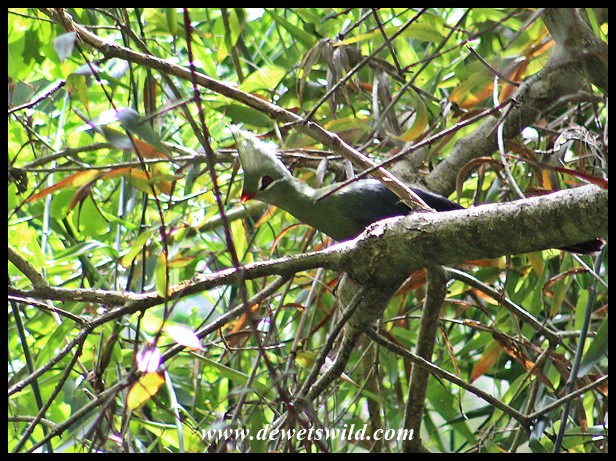
Livingstone’s Turaco

Tauraco livingstonii

Livingstone’s Turaco is a beautiful but very shy bird of evergreen forests, where it feeds on buds, fruits and flowers. It is very similar in appearance and closely related to, and was previously considered a subspecies of, the Knysna Turaco. They’re usually encountered in pairs or family groups foraging in the forest canopy. Pairs are monogamous and normally raise two chicks during the spring and summer months. Adults measure about 45cm in length and weigh between 260 and 370g.

Livingstone’s Turaco has a very limited distribution in South Africa, being found only in the north-east corner of Kwazulu-Natal where it is common, though much easier heard than seen, in the iSimangaliso Wetland Park. Beyond our borders it occurs as far north as Tanzania and Burundi. The IUCN considers this species to be of least concern, though citing habitat loss as a concern.

Sweet Thorn

Vachellia (Acacia) karroo

The Sweet Thorn is a cosmopolitan tree, occurring in almost every corner of South Africa and beyond our borders as far as Angola and Zambia. Depending on the depth and water content of the soil where it grows, the Sweet Thorn may be shrub-like in appearance or grow to a tree 5 to12m high. The formidable paired thorns, or spines, are often longest on younger plants and may be as long as 17cm!

The bane of hay fever sufferers all over the country, masses of yellow pom-pom flowers are produced during the summer months. These flowers are pollinated by a large variety of insects. Sweet Thorns are hardy, thanks to their deep en extensive root systems, live for up to 40 years, and does become invasive in areas suffering from overgrazing. The IUCN lists the Sweet Thorn as being of least concern.

The Sweet Thorn is an integral part of the history of many South African cultures, with uses as wide-ranging as traditional medicine, a coffee-substitute, bee farming, fodder for game and stock, fencing, tanning of hides, making ropes, and even needles! Even its name is suggestive of the sweet and tasty gum exuding from wounds on the trunk and branches, prized not only by humans but also animals like the lesser bushbaby.

Black-bellied Starling

Notopholia corusca

(previously Lamprotornis corruscus)

The smallest of the five “glossy” starlings occurring in South Africa, with a weight of around 50g and a length of 18cm, the Black-bellied Starling is also the most melodious of the family and capable of mimicking the calls of quite a number of other bird species.

Black-bellied Starlings feed mainly on a wide variety of fruit, supplementing their diet with the occasional snail, insect or spider. They drink and bathe regularly and may congregate in large flocks, at times numbering more than a hundred, during the non-breeding season but are found in monogamous, solitary pairs during the breeding season. They nest in holes in trees during the summer months, with the female being solely responsible for incubating the clutch of 2-4 eggs, though the male does do his fair share when it comes to the feeding of the hatchlings.

Its distribution being reflective of its preference for dense, high-rainfall coastal and riverine forest habitats, the Black-bellied Starling occurs along our eastern coastline, from the Garden Route through to the border with Mozambique, extending marginally into the extreme south-east corner of Mpumalanga. Beyond our borders its distribution extends along Africa’s Indian Ocean coast as far north as Somalia. Throughout this range it is very rarely found more than 100km inland. The IUCN lists the Black-bellied Starling as being of least concern.

Novice Butterfly

Amauris ochlea

The Novice is a foul-tasting butterfly that flies slowly and settles often on flowers and wilting plants. It inhabits forests and dense woodlands and the edges of these. Adults have a wingspan of 7cm and are on the wing throughout the year. In South Africa it is common along the Kwazulu-Natal coast and adjacent interior as well as in the Lowveld and escarpment of Mpumalanga and Limpopo.

The Deceptive Diadem (Hypolimnas deceptor) mimics the Novice in appearance and thus avoids predators.

Blue-cheeked Bee-eater

Merops persicus

The Blue-cheeked Bee-eater visits South Africa during our summer months after migrating from their breeding grounds stretching from North Africa to central Asia, arriving from October and departing again by April, some stay as late as May. Locally, most Blue-cheeked Bee-eaters head for the north-coast of Kwazulu-Natal and locations in Gauteng, Mpumalanga and Limpopo, but individuals occasionally pop-up in other parts of the country as well.

While here these insectivorous birds (they have a preference for dragonflies caught in flight) inhabit moist savannas, wooded grasslands and swamps. They’re quite gregarious and usually encountered in small flocks of around 20 with individuals roosting tightly together. Adults weigh around 50g and measure approximately 30cm in length.

The IUCN considers the Blue-cheeked Bee-eater to be of least concern.

Eastern Coastal Skink

Trachylepis depressa

Largely endemic to southern Mozambique, the distribution of the Eastern Coastal Skink extends only marginally into South Africa, where it is found in the Pafuri region of the Kruger National Park and the north coast of Kwazulu-Natal, being commonly seen in the iSimangaliso Wetland Park. The IUCN hasn’t yet evaluated this species’ conservation status, and little is known of its biology, except that it inhabits dense vegetation on sandy soils and will actually hide from danger by digging itself into the sand. Adults measure around 8cm in length, excluding their tails.

African Pygmy Kingfisher

Ispidina picta

The African Pygmy Kingfisher is the smallest of the family occurring in South Africa – adults weigh only 15g! Despite their family name, Pygmy Kingfishers live mainly on insects, spiders and small reptiles and inhabit forests, woodland, savanna and thickets, often far removed from open water. They are shy, secretive and easily go unnoticed despite their colourful plumage.

During the breeding season, which spans the spring and summer months here in South Africa but may be year round in Africa’s equatorial zone, Pygmy Kingfishers form monogamous pairs, and both parents help to excavate the nesting chamber, up to 60cm deep, in vertical soil walls, termite mounds or the inside of animal burrows. Clutches consist of 3-6 eggs and are incubated by both parents for almost three weeks. The chicks grow quickly, leaving the nest when they’re between two and three weeks old and becoming independent soon afterwards.

These tiny winged jewels are summer visitors to our country, arriving from equatorial Africa around September and leaving again by March. While here they can be found along the eastern coast and adjacent interior and in Gauteng, Mpumalanga and Limpopo. Their distribution range covers most of sub-Saharan Africa. The IUCN considers the species to be of least concern.

Green-banded Swallowtail Butterfly

Papilio nireus

The Green-banded Swallowtail, also known as the Black Velvet, is a large and strikingly coloured butterfly with a wingspan of almost 10cm. Adults can be seen throughout the year, though much more commonly in the summer months. About equal in size, females can be distinguished by the greenish sheen to the bands on their wings while that boasted by males are bluer in colour. They fly fast and direct, and often hover over flowers, mud puddles and fresh droppings. The larvae feed on a wide variety of food plants, including citrus.

In South Africa the Green-banded Swallowtail occurs from the Garden Route through most of Kwazulu-Natal and into Mpumalanga, Limpopo and Gauteng, inhabiting forests, woodland, savannas and well planted suburban gardens and parks, with its distribution further extending over most of the rest of Sub-Saharan Africa.


Terrestrial Brownbul

Phyllastrephus terrestris

The Terrestrial Brownbul is a shy inhabitant of forests and thickets, skulking in the undergrowth where it turns over the leaf litter looking for insects and other invertebrates, small reptiles, fruit and seeds.

Outside of the breeding season they form small groups of up to six individuals, but during the breeding season, which spans the spring and summer months, Terrestrial Brownbuls form monogamous, territorial pairs. Both parents build the flimsy cup-shaped nest in which a clutch of two or three eggs are incubated over a two week period. The chicks become independent very soon after fledging. Adult Terrestrial Brownbuls measure around 21cm in length and weigh approximately 36 grams.

The Terrestrial Brownbul is found over much of southern and eastern Africa, with an isolated population in southern Angola. In South Africa they’re found in suitable habitat from the Garden Route, along the Eastern Cape coast into Kwazulu-Natal, the Lowveld and escarpment of Mpumalanga and Limpopo and into the Waterberg region. We’ve had our best encounters with this otherwise secretive bird at Jack’s picnic spot in the Addo Elephant National ParkThe IUCN lists the Terrestrial Brownbul as being of least concern.

Yellowwood Trees

Podocarpus-species

Even though South Africa is not rich in indigenous coniferous trees, arguably some of our most impressive trees fall into this category. Colloquially known as Yellowwoods, four species are found in South Africa and they are all protected in legislation.

1. The Outeniqua Yellowwood, Podocarpus (Afrocarpus) falcatus, is our tallest indigenous tree, growing to 60m and even taller in height – these enormous specimens are estimated to be more than a thousand years old! Sadly the majority of these most impressive trees were lost in rampant logging during the 1800’s. It is also known as the Bastard Yellowwood in the other African countries where it occurs. The IUCN lists it as being of least concern.

2. Henkel’s Yellowwood, Podocarpus henkelii, and also known as the Natal and Drooping-leaf Yellowwood, has a more restricted distribution and is mainly found in the forests of the Drakensberg in the Eastern Cape and Kwazulu-Natal. It can grow up to 30m tall and has a very recognisable pyramid-shaped growth form. The IUCN considers it to be an endangered species.

3. The Real Yellowwood or Broad-leaved Yellowwood, Podocarpus latifolius, is our officially designated national tree, and is considered to be of least concern by the IUCN. The Real Yellowwood grows to 35m tall.

4. The Breede River Yellowwood, Podocarpus elongatus, is the smallest of the four species found in South Africa and often appears more a multi-stemmed shrub than a tree, growing as wide as it does in height. It seldom grows taller than 6m, though some sheltered specimens have been measured at around 20m in height. It too is not considered to be in any danger in the opinion of the IUCN, though it occurs only in a relative small corner of the country in the winter rainfall region of the Western Cape province.

Occurring in coastal, riverine and montane forests, our Yellowwoods are slow-growing, evergreen trees that grow naturally in the moist south and east of the country. Yellowwoods are dioecious, which means there are separate male and female trees. You probably figured out that the wood is yellowish in colour, with that of the Outeniqua and Real Yellowwoods prized for making high-quality furniture, floors and ceilings. The Yellowwoods are also beautiful border or specimen plants in gardens, though they never attain their full potential size outside their native forests (which might be a good thing, come to think of it!). Various kinds of birds and animals consume the ripe fruit.

Yellowwoods are ancient trees, having been endemic to the super continent of Gondwana before it broke up into Africa, India, South America, Australia and their associated islands.