DeWetsWild conducted a two-week tour of the Kruger National Park with altogether nine people to see out 2025 and ring in 2026 and every day for the month of February I’ll be sharing just a few of the many memories our group collected.
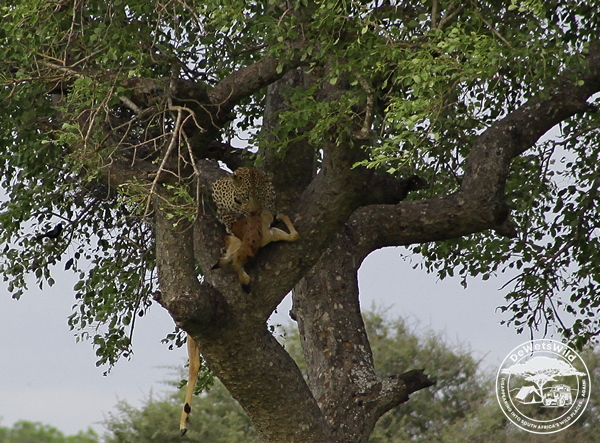
Early evening on Christmas Day, returning to camp after our afternoon drive, we found a Leopard up a marula tree virtually on Satara’s fenceline. The Leopard stashed the remains of an impala carcass there to enjoy later, but being so close to the camp there was a throng of tourists gawking at it and it quickly decided to wait a little longer to feast on the leftovers.
Leopard and impala carcass in a marula tree
Leopard in a marula tree
Leopard in a marula tree
Leopard leaving the marula tree
Leopard leaving the marula tree
If you’d like to join me on a guided tour of South Africa’s wild places, of even if you’d just like a bit of help putting your reservations together, don’t hesitate to reach out!
DeWetsWild conducted a two-week tour of the Kruger National Park with altogether nine people to see out 2025 and ring in 2026 and every day for the month of February I’ll be sharing just a few of the many memories our group collected.
We found a Leopard up a tree with the scraps of an impala kill near Tshokwane Picnic Site one morning. Leopards are always a prize sighting and, being on one of the roads less in that part of the Park, we could enjoy the sight of the large cat lying lazily on a thick Marula branch to our hearts’ content.
Leopard in a tree with its kill near Tshokwane
Leopard in a tree with its kill near Tshokwane
Suddenly a herd of Impala came dashing from the other side of the road, heading straight to the tree in which the Leopard was. The Leopard immediately jumped up and moved down the tree, being ever the opportunist on the lookout for an easy kill. Our attention however was caught by the sight of a massive female Spotted Hyena (radio-collared as part of a research project) chasing after a newly born Impala lamb at an amazing speed. We had only a split-second glimpse of the chase but it was clear the hyena would be the victor.
Spotted Hyena chasing an impala lamb
Spotted Hyena chasing an impala lamb
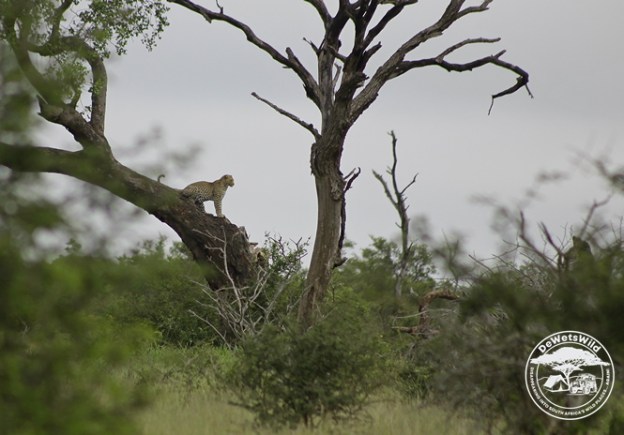
With hyena and impalas vacating the scene in a flash our attention could return to the Leopard surveying the landscape from its elevate perch, having never jumped to the ground in the chaos.
Leopard in a tree near Tshokwane
Leopard in a tree near Tshokwane
If you’d like to join me on a guided tour of South Africa’s wild places, of even if you’d just like a bit of help putting your reservations together, don’t hesitate to reach out!
In October 2024 I had the immense pleasure of hosting long-time blogging friend John Steiner (of Journeys with Johnbo), his wife Lynn, John’s niece Patricia Broesder and her husband Gary on a tour of Cape Town and the Kruger National Park. In Kruger we were joined by colleagues Hannes Rossouw and Irving Knight, both experts in their respective fields.
Now, you never can guarantee that you’ll see a Leopard; they’re just such experts at camouflage that they can disappear in plain sight. We were therefore all very excited at our first leopard sighting of the trip, in the early afternoon on the main road between Letaba and Satara, though she was certainly difficult to see!
Just look how well this leopard hides in the long grass underneath the thorn bush
Our next leopard sighting was brief but thrilling – we saw a brute of a male strangling an impala he had just caught and then seconds later he pulled the still kicking antelope underneath the dark bush where we could only see glimpses of movement afterwards.
Leopard killing an impala
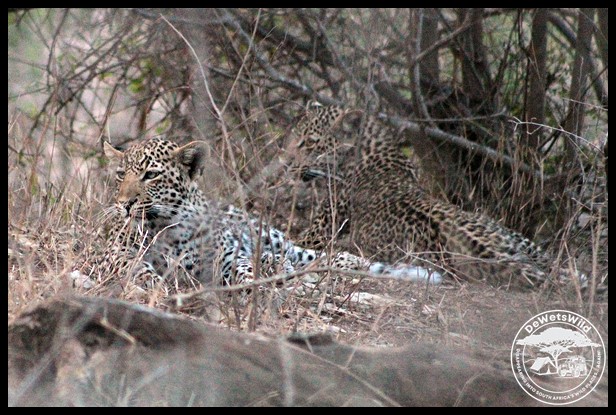
Another memorable leopard encounter on this trip was that of a female and two well-grown cubs who had their fresh kill stolen by a crocodile, who dragged it back into the Sabie River. All these predators also almost caused a nervous breakdown in a vervet monkey that was anxiously trying to hide in a tree stump whilst making alarm calls. The despondent cats gave us some good views later that afternoon where they lay on the ground and draped over a branch.
Vervet Monkey calling in alarm
Leopard cubs
Leopard cub
Female leopard lying on a branch
Female leopard lying on a branch – just look at the camouflage!
We drove straight past this leopard and all that gave him away was the terrible smell. Just as well that he slinked off to the river, hopefully to wash the blood off his body so that his aroma won’t scare away his next meal!
Leopard disappearing into the thick bush along the Sabie River
Here’s another leopard lying so still and beautifully blended in with its branch overlooking the Sand River that it was almost impossible to see!
Just look how well this leopard blends into its surroundings!
Up north at Shingwedzi we came across this leopard using a gully to stalk a mixed herd of waterbuck and impala grazing in the dry bed of the Shingwedzi River. Eventually though he was thwarted when he was seen by one of the sharp-eyed antelope.
Leopard stalking next to the Shingwedzi River
Leopard stalking next to the Shingwedzi River
Leopard stalking next to the Shingwedzi River
Leopard stalking next to the Shingwedzi River
Leopard stalking next to the Shingwedzi River
I am a fully accredited and legally registered tour guide (with all the necessary insurance, professional drivers license and first aid certification) – don’t hesitate to reach out if you’d like me to arrange a guided tour of beautiful South Africa and all her natural wonders, like the Kruger National Park, for you as well, or even just to assist with your holiday reservations for our national parks and nature reserves throughout the country.
Midday on the last full day of our 2024 Manyeleti Magic Photo-Safari this past June we were whiling away the hours in Buffelshoek Camp, our base for the trip, photographing a variety of birds including a pair of very obliging Pearl-spotted Owlets, a pair of Red-billed Hornbills feeding their chicks in their mud-cell nest, and a family of Cardinal Woodpeckers. Our group of eager photographers were certainly kept very entertained and busy!
Red-billed Hornbill at the nest
Red-billed Hornbill nest, opening almost entirely enclosed by mud
Yellow-billed Hornbill
Cardinal Woodpecker
Pearl-spotted Owlet
Pearl-spotted Owlet
Pearl-spotted Owlet (showing eye-spots on the back of the head)
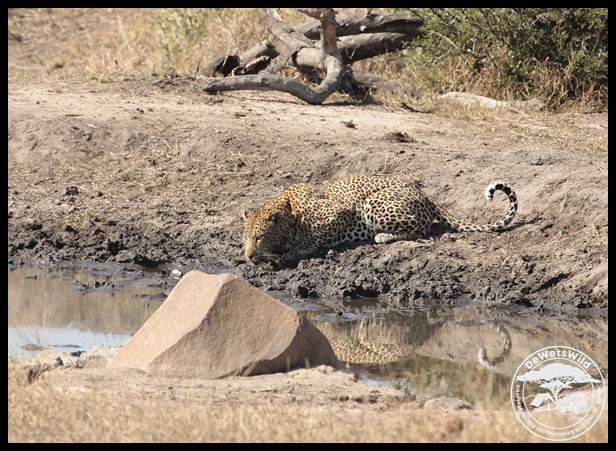
It was the commotion of a group of Vervet Monkeys that moved through the camp just minutes before that first alerted us to the fact that something dangerous was about. We soon picked out the shape of a Leopard moving through the long grass, headed for the waterhole just outside of camp. Pretty quickly we were all – cameras at the ready – in the open safari vehicle and on our way towards the beautiful but very shy animal. It didn’t drink long and crept down into the drainage line, disappearing from sight.
Leopard
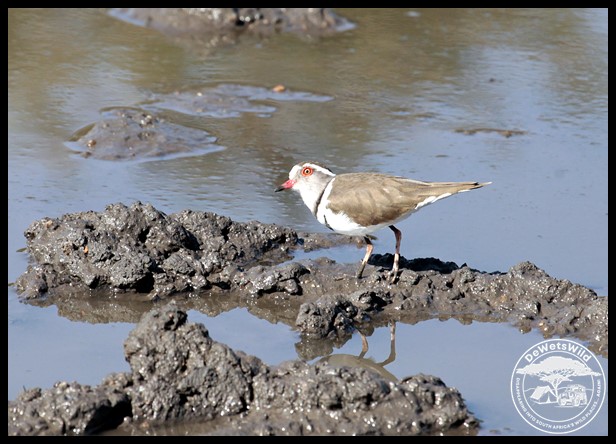
We searched high and low for it for several minutes, but the leopard vanished just as quickly as it appeared. If this little Three-banded Plover, who was at the water’s edge the whole time, knew where the big cat went it wasn’t giving up the secret.
If this little Three-banded Plover, who was at the water’s edge the whole time, knew where the big cat went it wasn’t giving up the secret.
We’re already taking bookings for our 2025 Manyeleti Magic Photographic Safari and Workshop, to be conducted out of Buffelshoek Camp again in June of next year in conjunction with Hannes Rossouw Photography. Contact us if you’d like to join this one, or if you and a group of family and friends are keen to do something similar on other dates we’d be very glad to accommodate you!
Of all the “Big 5” animals none are as difficult to find as the Leopard. Seeing one is usually the highlight of a visit to a nature reserve in South Africa. Having six sightings of these beautiful cats – of which four were on one day! – will mean our latest visit to the Kruger National Park will not soon be forgotten!
Our first sighting, near Lower Sabie late afternoon just minutes before the gates closed, was not very awe-inspiring, even by Leopard standards. Being as lazy as only cats can be this individual did not even deign to show us its face.
Lazy Leopard near Lower Sabie
Early one morning while travelling along the S56 Mphongolo Loop north of Shingwedzi we came across a pair of Leopards in a tall tree – a smaller individual very high up in the tree and visually afraid of the bigger one below guarding the remains of a kill. Visitors who were on the scene before us later shared how the male stole the female’s kill and chased her to the top of the tree where he was too heavy to get to her.
Lofty Leopard (Photo by Joubert)
The male at the lowest fork of the tree, with the kill well hidden (photo by Joubert)
The arrow indicates how high the female climbed into the tree to escape the male. By the way, parking into the veld and hanging out of your vehicle like the visitors in the Land Cruiser is not only bad etiquette but also dangerous.
After spending quite some time at the Leopards in the tree we decided to move on to breakfast at Babalala Picnic Spot when, only 4km further along the same road, we found a young and curiously calm Leopard next to the road at the turnoff to Sirheni Bushveld Camp. She posed beautifully for all the photographers in the car, not fazed in the least by our proximity! Having been treated with such grace by the young princess we slowly backed away from her so that she could repose in tranquility.
Young Leopard at the Sirheni turnoff (photo by Joubert)
Young Leopard at the Sirheni turnoff(Photo by Joubert)
Young Leopard at the Sirheni turnoff (photo by Joubert)
Young Leopard at the Sirheni turnoff
Young Leopard at the Sirheni turnoff (photo by Erlo van Aswegen)
Young Leopard at the Sirheni turnoff (photo by Joubert)
Mere minutes later, still sauntering along the S56 towards Babalala, we found our third Leopard encounter for the morning where it was using a small outcrop of rocks as a vantage point and being particularly interested in a huge kudu bull lying nearby. The kudu soon saw the Leopard and did not even think the cat enough of a threat to stand up. Knowing it was outgunned, the Leopard gave the kudu a wide berth and disappeared into the dense shrubbery next to the Shisha stream.
Leopard looking out for prey from a rocky outcrop (Photo by Joubert)
Leopard looking out for prey from a rocky outcrop
Leopard descending from the rocks to try its luck with a kudu bull
Stealthily moving closer (photo by Erlo van Aswegen)
Keeping cover (photo by Joubert)
Leopard posing beautifully (photo by Joubert)
That same afternoon, still extremely excited about our morning, which by then also included sightings of other charismatic or rare species of wildlife including lions, roan antelope, tsessebes, buffaloes and elephants we found our fourth Leopard sighting of the day along the S50 Kanniedood Road southeast of Shingwedzi. The apparently heavily pregnant female was in a hunting mood and stalking a mixed herd of impala, kudu and waterbuck mingling on the bank of the river. She was soon discovered however and slinked back across the road and out of sight.
Leopard along the Shingwedzi River (Photo by Joubert)
Leopard walking over the S50 to stalk a mixed herd of antelope (photo by Joubert)
Leopard walking over the S50 to stalk a mixed herd of antelope (photo by Joubert)
Leopard slinking away after being discovered by her prey
Leopard rushing away after being discovered by her prey (photo by Joubert)
Our final Leopard sighting of the trip (and I am sure we missed more than we saw thanks to their exceptional camouflage!) was before sunrise as we left Shingwedzi for a morning drive. This was a shy individual, trying to hide behind a palm frond for a minute or two and then deciding to retreat into the riverine vegetation lining the Shingwedzi.
Shy Leopard in the early morning (photo by Joubert)
Shy Leopard in the early morning (photo by Joubert)
I made a little compilation video of some of the Leopard encounters I told you about.
Famous South African golfer Gary Player’s words can certainly be applied to searching for South Africa’s wild animals as well, for today, having visited Marakele National Park regularly for 20 years, we had our first encounter with one of the Park’s elusive leopards. These shots were taken by Joubert this afternoon.
Our first sighting of a leopard in Marakele National Park
Our first sighting of a leopard in Marakele National Park
Our first sighting of a leopard in Marakele National Park
The beautiful Leopard is at the top of the wishlists of many visitors to South Africa’s wild places, and certainly deserves its position among Africa’s “Big Five“. One of the most adaptable of the large carnivores, their build and colouration is supremely attuned to the environment in which they live. Depending on the harshness of the environment and the size of prey available, the weight of adult males can vary between 20 and 90 kilograms (females weigh slightly less), with a shoulder height ranging between 55 and 80cm.
Serene leopard near Punda Maria
Catnapping leopard near Punda Maria
Leopard seen near Olifants
Beautiful leopard encountered near Red Rocks
Leopard male and kill
Leopard and kill (photo by Joubert)
She quickly repositions (photo by Joubert)
Leopardess eyeing an injured wildebeest calf
Her interest peaked by a growl from the male, the leopardess moves to a lower branch
Leopardess in a tree
There’s a leopard hidden in the Sausage Tree
Leopard along the Timbavati
Hidden leopard
Leopard in a tree
Lazy leopard
Leopards have adapted to every habitat on the African continent, from the driest deserts to the tropical rainforest and high mountain ranges. They are just as catholic in their diet, which ranges from insects, fish, amphibians, reptiles, birds and rodents to large mammals and even other predators (including jackals, spotted hyenas and cheetahs) or carrion, though they normally prefer commonly occurring medium-sized antelope and wild pigs. Though they are not dependent on the availability of surface water they will drink regularly if it is available. Their penchant for storing the carcasses of their prey up high in the branches of trees, where it is inaccessible to competing predators, allows them to feed from the same carcass for up to 6 days.
Leopard hunting jackals
Leopard lying in wait at a waterhole
Leopard lying in the bed of the Nwatimhiri near Skukuza in the Kruger Park
Remains of a leopard kill
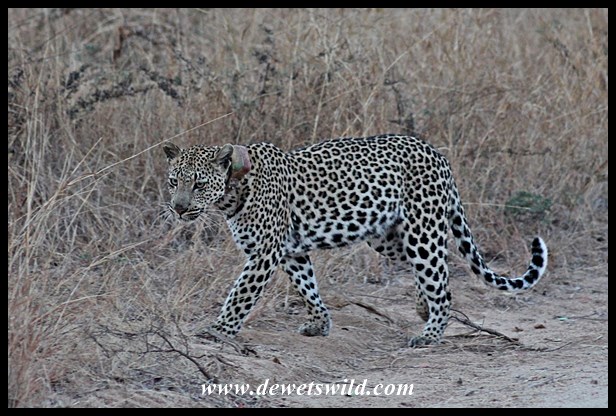
Leopard on the prowl
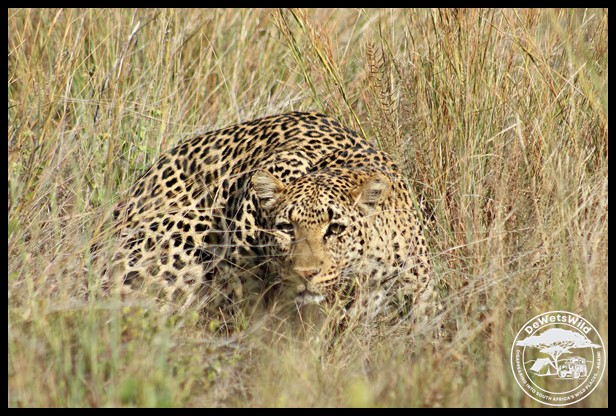
Leopard hiding in long grass
Leopard camouflage in a thicket
Lazy Leopard
Leopard up a tree near Phalaborwa Gate
Leopard in a tree on the bank of the Tsendze River south of Mopani
Leopard seen early morning in the Sedudu Valley
Leopard stalking a steenbok in the Kruger National Park
Solitary by nature, Leopards only associate with others of their kind when mating or when cubs accompany their mother. Adults of both sexes hold territories that may cover enormous areas, depending on the availability of prey, are advertised by their rasping call and marked with urine, scat and scrape marks against prominent trees, and defended viciously, sometimes to the death, against interlopers of the same sex. Male territories are larger and can overlap with the areas of up to six females. Leopards are nocturnal, with most activity occurring from dusk to dawn, resting up in the deep shade of tree canopies, thickets and caves. They love basking in the early morning or late afternoon sun. Leopards can reach a speed of up to 60km/h, but can only maintain it for short bursts and rely on their camouflage and expert stalking skills to get within range of their prey.
Leopard at Nwanetsi Bridge, on a night drive from Satara in the Kruger Park
Leopard hunting jackals
Leopard in a tree, S36 (Kruger Park)
Leopard in a tree on the S3 near Skukuza, Kruger Park
Leopard on the Maroela Loop, near Skukuza in the Kruger Park
Leopard on the Maroela Loop, near Skukuza in the Kruger Park
Leopard in tree, at Ximangwaneni Dam (Kruger Park)
Leopard on Ngubhu Loop in Ithala Game Reserve
Leopard trying to hide among the thorns
Leopard sighting on the Grassland Loop on the Eastern Shores of Lake St Lucia – 15th June 2015
Leopard in golden early morning sunshine
Leopard in golden early morning sunshine
Leopard in a tree south of Skukuza
Leopard near Lower Sabie
Leopard
Leopard lounging in a tree
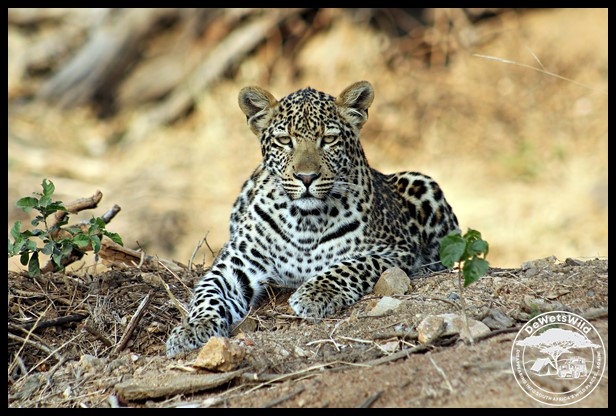
Female Leopards usually give birth to 2 or 3 cubs (range from 1 to 6) after a short 3 month gestation at any time of the year. Newborn cubs are kept hidden in caves, among boulders, in thickets and even burrows while the mother is out hunting, until they start accompanying her at the age of about two to four months. Cubs become independent anywhere between 12 and 24 months of age, though only about half of the cubs born reach that age. Lions and spotted hyenas will attack and kill adult Leopards, while even jackals pose a threat to unguarded cubs.
Leopard female calling for her cubs
Sub-adult leopard cubs
Leopard cub in a rocky outcrop between Tshokwane and Skukuza
Leopards have a wide distribution in Africa and Asia, but their populations have been reduced and become confined to increasingly isolated pockets over most of that range, leading the IUCN to classify it as “vulnerable” due to the persistent threats of illegal hunting and loss of habitat and prey. In South Africa, Leopards can be found in the mountains of the Western and Eastern Cape, along the Namibian and Botswana borders with the Northern Cape, in the Drakensberg range and northern Kwazulu-Natal, and widely in the North-West, Limpopo and Mpumalanga provinces, but their secretive nature makes it virtually impossible to determine their population size, with the EWT estimating the number of leopards occurring in South Africa between 2,800 and 11,600. In our experience, the Kruger National Park, Kgalagadi Transfrontier Park, Mapungubwe National Park, Pilanesberg National Park, Hluhluwe-Imfolozi Park, iSimangaliso Wetland Park (especially the Eastern Shores section) and Ithala Game Reserve presents the best chance of finding these elusive cats on a self-drive safari in South Africa.












 DeWetsWild