DeWetsWild conducted a two-week tour of the Kruger National Park with altogether nine people to see out 2025 and ring in 2026 and every day for the month of February I’ll be sharing just a few of the many memories our group collected.
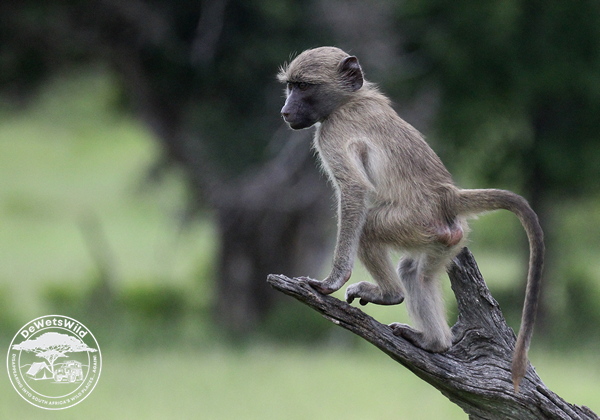
Young baboons are such jolly, carefree creatures!
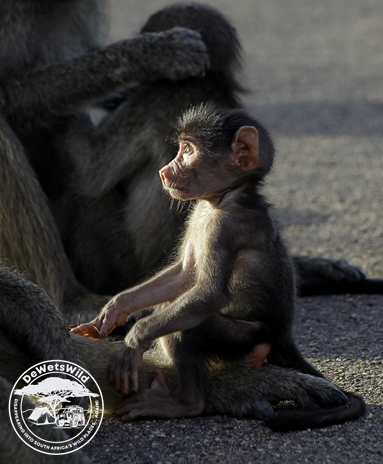
Baby baboon
Baby baboon
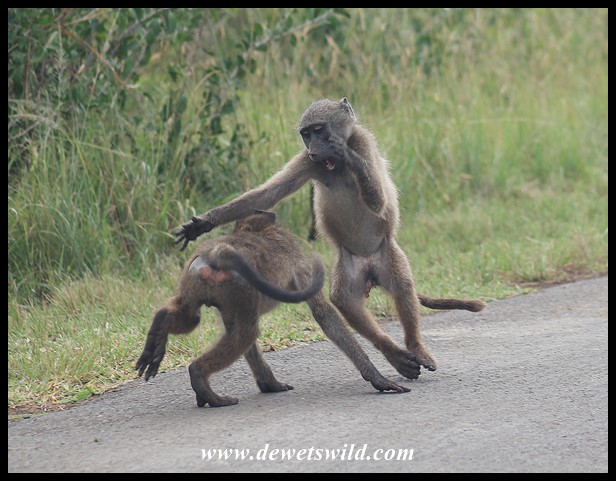
Playful baby baboons
Playful baby baboons
Playful baby baboons
Playful baby baboons
Playful baby baboons
Playful baby baboons
Playful baby baboons
If you’d like to join me on a guided tour of South Africa’s wild places, of even if you’d just like a bit of help putting your reservations together, don’t hesitate to reach out!
DeWetsWild conducted a two-week tour of the Kruger National Park with altogether nine people to see out 2025 and ring in 2026 and every day for the month of February I’ll be sharing just a few of the many memories our group collected.
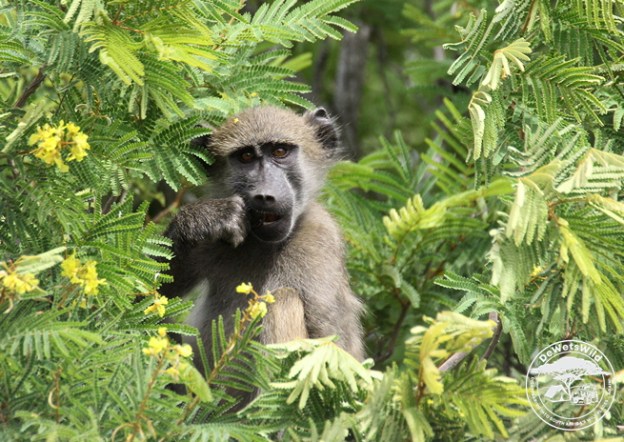
This young baboon, so curious about us that he pressed the branches of the weeping wattle he was sitting in out of the way, was just too cute not to photograph! If you’d like to join me on a guided tour of South Africa’s wild places, of even if you’d just like a bit of help putting your reservations together, don’t hesitate to reach out!
DeWetsWild conducted a two-week tour of the Kruger National Park with altogether nine people to see out 2025 and ring in 2026 and every day for the month of February I’ll be sharing just a few of the many memories our group collected.
Baboons are always a treat to watch, and thankfully they’re quite commonly encountered in the Kruger National Park. From the playful antics of the youngsters to the long-suffering expressions on the faces of the adults it is impossible to watch them without a smile (or recognizing at least one of your own family members!). This troop entertained us royally one morning on the main road between Satara and Tshokwane.
Baby Baboon
Mom catches a baby just in time before he jumps on his meditating sibling…
“Does your nappy need changing?”
Wrestling match interrupted
Little one being a bully
Dad just doesn’t have the nerve to watch…
Playful baboon youngsters
Playful baboon youngsters
Wondering when mom’s lecture will end…
Family bonds
If you’d like to join me on a guided tour of South Africa’s wild places, of even if you’d just like a bit of help putting your reservations together, don’t hesitate to reach out!
Chacma Baboons are great entertainers and most visitors to the Kruger National Park enjoy seeing these animals. I suppose that’s because their obvious intelligence, playful nature, endearing family interactions and the occasional aggressive altercation is like a mirror held up to our faces.
Baboon reaching for a grass stem full of seeds
Baboons are omnivores (photo by Joubert)
Baboon reaching for a grass stem full of seeds
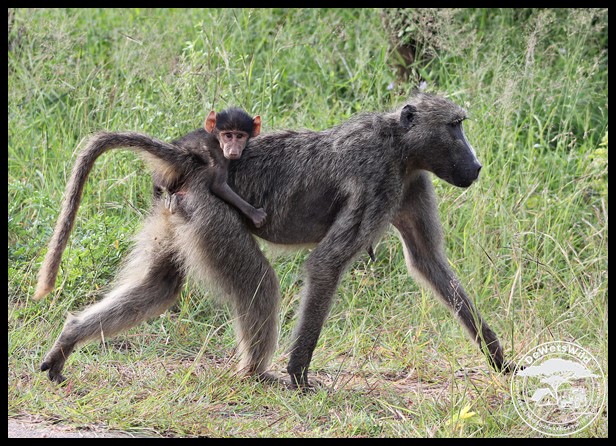
Baby Baboons ride their mom like a jockey when they’re a bit older
Baby Baboons ride their mom like a jockey when they’re a bit older
Baby Baboons ride their mom like a jockey when they’re a bit older
Baby Baboons ride their mom like a jockey when they’re a bit older
Playful Baboon toddlers
Male Baboon looking very unimpressed
Is it just a Baboon yawn, or a sign of aggression?
We’d love for you to join DeWetsWild on a guided tour of the Kruger National Park or to help you arrange a self-guided visit. Don’t hesitate to reach out!
On our way to the Memorial Gate on the 2nd of April, as we were heading home from a wonderful week in Hluhluwe-Imfolozi Park, we got distracted by these rambunctious Baboons! I think they must’ve watched a rugby game at some point…
With one exception, these are all Joubert’s photographs.
Baboons playing “King of the Castle”?
Young Baboons having a jol (photo by Joubert)
Young Baboons having a jol (photo by Joubert)
Young Baboons having a jol (photo by Joubert)
Young Baboons having a jol (photo by Joubert)
Young Baboons having a jol (photo by Joubert)
Young Baboons having a jol (photo by Joubert)
Young Baboons having a jol (photo by Joubert)
Young Baboons having a jol (photo by Joubert)
Young Baboons having a jol (photo by Joubert)
Young Baboons having a jol (photo by Joubert)
Young Baboons having a jol (photo by Joubert)
Young Baboons having a jol (photo by Joubert)
Young Baboons having a jol (photo by Joubert)
Young Baboons having a jol (photo by Joubert)
Young Baboons having a jol (photo by Joubert)
Young Baboons having a jol (photo by Joubert)
Young Baboons having a jol (photo by Joubert)
Young Baboons having a jol (photo by Joubert)
Young Baboons having a jol (photo by Joubert)
A kiss for mom (photo by Joubert)
At last a toy he can call his own (photo by Joubert)
Every visitor to a game reserve in South Africa knows the “ooh’s” and “aaah’s” that are elicited during an encounter with the continent’s wild primates. These close cousins of ours are always a joy to watch, even if they can be quite naughty (especially when they’ve learned that humans equal feeding opportunities, so please don’t feed them). We were delighted to see some very large troops of Chacma Baboons around Satara during our visit in December 2021.
Baoon troop south of Satara (photo by Joubert)
Baboon troop on the move at Ngotso
Baboon troop on the move at Ngotso
This of course presented wonderful opportunities to enjoy all their antics, and often from very close up!
Baboon gymnast
Baboon portrait (photo by Joubert)
Female Chacma Baboon slowly waking up
Baboon youngster
Big male Baboon passing in a hurry (photo by Joubert)
Baboon sentry at his post
A precarious perch (photo by Joubert)
The concentration on this Baboon’s face as he struggled to get the elephant dung off his fingers!
The hand of a big male Chacma Baboon
The way they care for their babies is probably one of the most endearing characteristics about Chacma Baboons, even if the babies will struggle to win the baby photo competition at the local pharmacy…
Wet Baboon piggy-back (photo by Joubert)
Baboon family on the move
Chacma Baboon mother and baby
Baboon baby with a thirst for milk
Thank goodness mom’s back is higher than the wet grass!
Speaking about mothers and babies immediately brings to mind this loving mother Vervet Monkey and her young baby that we saw near Satara on the S100.
It was the afternoon of the 16th of August 2021 and Joubert and I were parked on the shores of Sunset Dam, just outside Lower Sabie in the Kruger National Park, enjoying the serene scenes playing out all around us as a myriad of birds and animals, including a troop of Chacma Baboons, mingled at the water’s edge.
Baboons peacefully foraging on the shore of Sunset Dam
Suddenly there was a frightful commotion as the baboons started screaming in alarm. Almost immediately we noticed a young baboon, shrieking to high heaven, being chased by two slightly older “teenage” baboons. This in itself was not abnormal, as there is often disagreements in a baboon troop, and peace usually returns quickly after the necessary discipline has been dispatched. The young baboon rushed into the muddy water at the dam’s edge, eliciting even more worried squeals from its mother as Sunset Dam is home to some monster crocodiles.
Baboon attack at Sunset Dam (photo by Joubert)
Baboon attack at Sunset Dam
Baboon attack at Sunset Dam
Baboon attack at Sunset Dam (photo by Joubert)
Baboon attack at Sunset Dam
However, as soon as one of the “teenage” baboons got hold of the youngster, it was clear that this attack was much more sinister. We have no idea about their motive, but judging by the viciousness of their bites to the skull, neck and throat and the very rough way they tried to pull the younger baboon apart limb from limb, there was no doubting that the two teenagers were intent on killing their unfortunate target. At one stage early into the encounter an adult, perhaps the mother of the younger one, tried to intervene but this proved only a temporary reprieve – instead of running away the badly injured youngster tried to hide in the mud again where he was soon cornered once more.
Baboon attack at Sunset Dam
Baboon attack at Sunset Dam
Baboon attack at Sunset Dam (photo by Joubert)
Baboon attack at Sunset Dam (photo by Joubert)
Baboon attack at Sunset Dam
Baboon attack at Sunset Dam (photo by Joubert)
Baboon attack at Sunset Dam
Baboon attack at Sunset Dam (photo by Joubert)
Baboon attack at Sunset Dam (photo by Joubert)
Baboon attack at Sunset Dam (photo by Joubert)
Baboon attack at Sunset Dam (photo by Joubert)
Baboon attack at Sunset Dam
Baboon attack at Sunset Dam (photo by Joubert)
Baboon attack at Sunset Dam
Baboon attack at Sunset Dam (photo by Joubert)
Baboon attack at Sunset Dam
Baboon attack at Sunset Dam (photo by Joubert)
Baboon attack at Sunset Dam (photo by Joubert)
Baboon attack at Sunset Dam (photo by Joubert)
Baboon attack at Sunset Dam
Baboon attack at Sunset Dam
Baboon murder
Baboon attack at Sunset Dam
Baboon attack at Sunset Dam
By now the attack had gone on for about four minutes. Probably as was to be expected, the fracas attracted the attentions of a large crocodile that was hitherto lying dead still on the bank. With the tables likely to be turned on them within a second, the attacking baboons let go of their quarry and ran for safety.
A crocodile breaks up the fight (photo by Joubert)
A crocodile breaks up the fight (photo by Joubert)
A crocodile breaks up the fight
The youngster that was so viciously mauled also scampered away, heading over the road towards the Sabie River, and out of our sight. His attackers apparently also lost track of him, as they searched every bush in the general vicinity looking for the young baboon without success.
One of the murderous baboon “teenagers” passing by us as he looks for their victim. (photo by Joubert)
Whether the little one could’ve survived its injuries we’ll never know, nor whether the murderers managed to track him down and finish the job… This definitely was one of the most harrowing experiences we’ve ever had in the bush.
While driving slowly back to Satara Rest Camp along the S100 one evening, we came across a mixed group of Impalas and Baboons peacefully whiling away the final minutes of sunlight at Shibotwana waterhole. It is then that we noticed a Black-backed Jackal moving through the group, obviously looking for an easy meal. The Jackal spied a young Baboon and gave it a little more attention than the Baboon wanted; it shrieked and set off running towards its mother and then things took a very quick turn for the worse for the Jackal, who managed to escape a serious hiding by the skin of his teeth!
Black-backed Jackal eyeing a young Chacma Baboon
The little Baboon starts running to safety, raising the alarm
The Chacma Baboon is the biggest wild primate occurring in South Africa. Males can weigh up to 50kg, while females are more lightly built and weigh up to 28kg.
Evil-looking juvenile Baboon
Pensive baboon
Baby baboon missing out on attention
Baboons abound along the Sabie
Baboon near Satara
Baboon smile
Young baboon
Chacma Baboon
Coy Baboon (photo by Joubert)
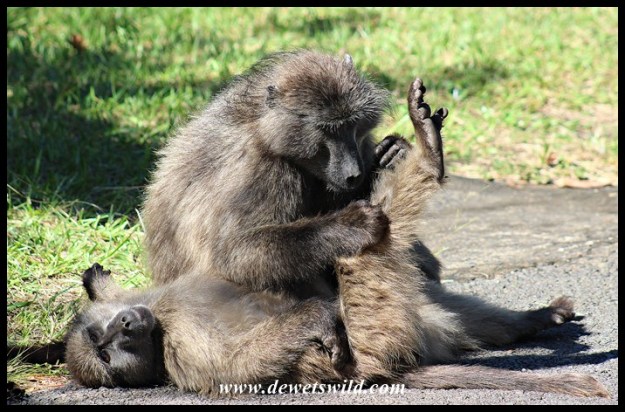
Baboons grooming
Sleepy Baboon
Baboon
Young Chacma Baboons
Baboons can be found in virtually any habitat, provided there is a reliable supply of drinking water and safe places to sleep at night (usually in the form of tall trees, cliffs or caves). They are equally easy to please when it comes to their diet, taking fruit, berries, grass, leaves, flowers, mushrooms, roots and tubers, insects, scorpions, snails, eggs, small birds, reptiles and mammals (including the lambs of antelope) and, along the coast, molluscs, crayfish, crabs, etc. Unfortunately they quickly learn that humans and their waste is an easy source of food, and in many reserves, towns and cities have become quite adept at raiding human habitations.
Bold baboons frequent the camp at Giant’s Castle
And then quickly grabbing a loaf of bread from an unguarded kitchen
Preparing for their early morning raid on the camp
Baboon
Baboon scratching for grass roots
Baboon acrobats
Baboons
Baboons are a common sight at Giant’s Castle
Thirsty Baboon
Surveying the landscape
Baboons taking a swim on a hot day
Baboon
Baboons at Umbondwe Picnic Spot
Chacma Baboon on a cliff-face
Baboons at Umbondwe Picnic Spot
Chacma Baboon
You stuck what in there!?
Baboons frequent the camp in the mornings
Chacma Baboons keep to large troops, some over 300 animals in size, in which a strict hierarchy is maintained, sometimes through violent fights. This dominance hierarchy determines where an individual will feature when it comes to access to food, water, sleeping spots and mating partners. They also forge alliances and friendships strengthened by mutual grooming. Lower ranking adult males take turns to act as sentinels on the look-out for danger. Chacma Baboons are diurnal and mainly terrestrial and troops can cover as much as 15km in a day while foraging. Because they have such keen senses Baboons are often accompanied by other herbivores.
Bold baboons frequent the camp at Giant’s Castle
Baboon
Time for some mutual grooming before the game begins
Playful baboons at Kumasinga
Playful baboons at Kumasinga
Playful baboons at Kumasinga
Playful baboons at Kumasinga
Roofing thatch apparently make wonderful toys for little baboons
The big males are the most confident
Baboon
Baboons
A huge troop of baboons
Baboon beauty treatment
Baboons often pass through camp looking for scraps and stealing from the accommodation units
Male Baboon taking a break
Fast asleep in the early morning sun
Male Baboon taking a break
Baboons have learnt that unlocked cars could be an easy source of food
Yawn!
Baboon escaping from a chalet at Thendele Camp
Chacma Baboon
Time for grooming
Wet Baboon after a rainstorm
Baboon surveying the landscape
Baboons having fun at Lengau Dam
Baboons having fun at Lengau Dam
Baboons having fun at Lengau Dam
Baboons relaxing in the shade
Baboons settling in for the night
Baboon
Baboons huddling together in the rays of early morning
Baboon
Young Baboon disliking the attention of human onlookers (photo by Joubert)
Young Baboon
Chacma Baboon
Baboons
Baboon troop
Baboons
Female Baboons give birth to single young (rarely twins) at any time of the year. Newborn babies hang from their mother’s tummy when she’s walking, while older babies ride on her back like a jockey. Youngsters remain dependant on their mother until they are at least a year old. Females remain in their maternal troop when they reach adulthood, while young males join other troops. All animals in the troop are extremely protective of babies, and when attacked by a predator the large males will usually launch a counter attack. Leopards are the main threat to adult baboons, but they are not easy prey by any means. Chacma Baboons have a life expectancy of up to 45 years in the wild.
Like father, like son. Baboon spectators at Kumasinga
Baby baboon getting a piggy-back ride
Baby Baboon getting a piggy-back ride
Baboon jockey
Shingwedzi jungle-gym
Shingwedzi jungle-gym
Shingwedzi jungle-gym
Shingwedzi jungle-gym
Shingwedzi jungle-gym
Shingwedzi jungle-gym
Baboon family life
Baboon mothers make excellent vantage points!
Young Baboons hang from their mother’s tummy
Older babies ride on mom’s back like jockeys
Young Chacma Baboon
Young Baboons love playing
Sibling bonding
Baboon youngsters at speed!
Baboon youngster
Levitating Chacma baboon youngster
Female Baboon in oestrus
Baboons
Chacma Baboons
Chacma Baboons (photo by Joubert)
Chacma Baboons (photo by Joubert)
Chacma Baboons (photo by Joubert)
Chacma Baboons (photo by Joubert)
Baboons on the roof of the reception office at Potberg
Baboons are probably the most easily seen mammal in Giant’s Castle, as they move through the Rest Camp daily
A pair of mating baboons high in the mountains
Baboons are probably the most easily seen mammal in Giant’s Castle, as they move through the Rest Camp daily
Baboons are probably the most easily seen mammal in Giant’s Castle, as they move through the Rest Camp daily
Baboons are probably the most easily seen mammal in Giant’s Castle, as they move through the Rest Camp daily
Baboons use precarious beds
Baboons use precarious beds
Baboon chasing a Black-backed Jackal
Baboon
Baby baboon
Baboon
Baboon sentry
Baboon
Young Baboon
Curious baby Baboon
Baboons
Baboon
Chacma Baboon
Chacma Baboon
Baboons
Baboons in Mapungubwe National Park
Baboon feeding on water plants in Mapungubwe National Park
Baboons in Mapungubwe National Park
Baboons in Mapungubwe National Park
Baboons in Mapungubwe National Park (photo by Joubert)
Chacma Baboon
Male Baboon clinging to a log for his afternoon nap
Baboon spa treatment
Chacma Baboon
Chacma Baboon
Baboons occurring in neighbouring countries north of the Limpopo belong to a different subspecies, P. u. griseipes, and have a slight yellowish tinge to their fur.
Baboon of subspecies Papio ursinus griseipes
Baboon of subspecies Papio ursinus griseipes
Baboon of subspecies Papio ursinus griseipes
Baboon of subspecies Papio ursinus griseipes
Baboon of subspecies Papio ursinus griseipes
Baboon of subspecies Papio ursinus griseipes
Baboon of subspecies Papio ursinus griseipes
Baboon of subspecies Papio ursinus griseipes
Baboon of subspecies Papio ursinus griseipes searching for seeds in elephant dung












 DeWetsWild