There’s more than 14,000 elephants in the Kruger National Park, and of course they are a big drawcard for visitors to this game reserve, being charismatic animals and members of the famed “Big 5”.
For us too, encountering elephants is always a special treat: witnessing the interactions between different herd members or the playful antics of the calves, and there’s few things in nature as beautiful as the gait of a confident elephant bull, his massive head swaying from side to side, intent on ensuring anything and everything in his way clears out before he gets there.
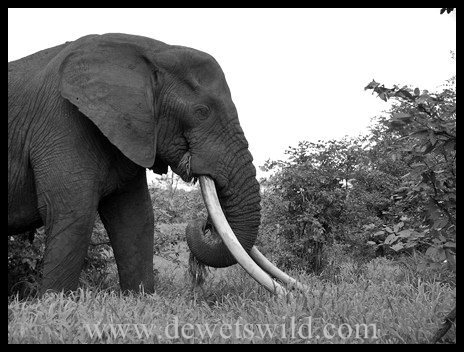
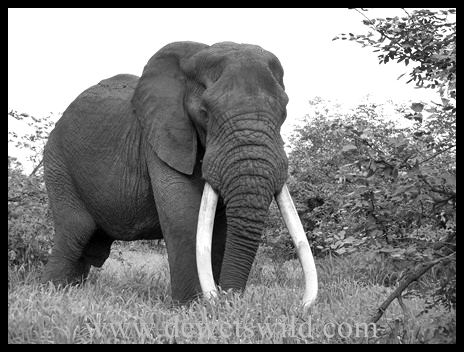
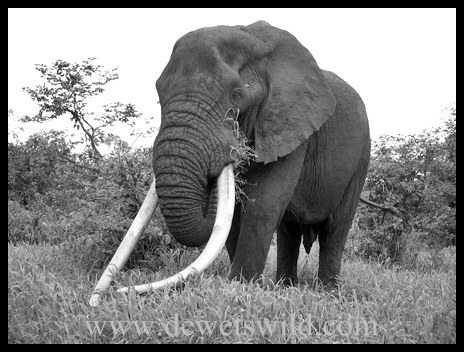
The Kruger Park is known as one of the few remaining places on the African continent where you still have the chance to see elephants carrying impressive tusks, sometimes in excess of 2 or even 3 metres in length and weighing anything between 40 and 70kg. In the Letaba Rest Camp there’s a fascinating museum dedicated to the elephant, where visitors can also marvel at the tusks of some of Kruger’s most famous tuskers.
Over the years, we’ve been extremely fortunate to have encountered a handful of these living monuments while exploring the Kruger National Park, especially in the northern regions of the park in the vicinity of Shingwedzi, Letaba and Mopani Rest Camps. Traditionally, these remarkable giants are given distinctive names, either for the area they roam or in honour of Kruger staff members who have dedicated their lives to the protection of this special place.
Eventhough I was then only a child travelling to the Kruger Park with my parents, long before the advent of cheap (digital) photographic equipment, encounters with the magnificent Mandleve and Mabarule will live in my memory forever.
The photographs we’re sharing here are more recent. In January 2006, Marilize and I became two of the very small number of people to have had the honour of seeing Masbambela -we’ve already posted some pictures of him in a previous post (here)

Masbambela
Our sighting of Ngunyupezi in April 2007, when the whole de Wet clan went camping at Shingwedzi, was just as special – it was only the second officially recorded sighting of this enigmatic bull, whose left tusk characteristically grows almost straight down. At one point he charged at us, head held high and that straight tusk leading the way like the lance of a medieval knight! Ngunyupezi is still seen in the Shingwedzi area from time to time.

Ngunyupezi
Hlanganini was a well-known tusker, regularly seen around Letaba Rest Camp. This is also where we met him, in September 2007. Hlanganini died a couple of years ago, following a fight with another bull.

Hlanganini
During a visit in June 2011, my brother Niel and I came accross two of the new generation of Kruger Tuskers: Machachule, right at Shingwedzi’s back gate, and Masanana, near Letaba.

Machachule
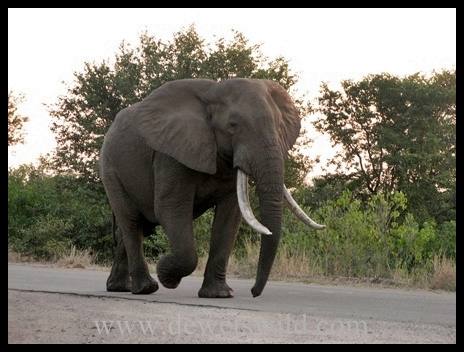
Masasana
We’ve already had five encounters with Masthulele, believed to be Kruger biggest tusker at the moment, over the years. This sighting was in April 2012 near Letaba, while visiting the Park with our friends the du Plessis’.
Edit: SANParks announced in September 2017 that Masthulele had died during 2016.

Masthulele
During our visit in September of 2012 we were lucky to see two more tuskers: Mandzemba welcomed us back to our beloved Shingwedzi, while Ngodzi bade us farewell us we departed from Mopani. These two tuskers haven’t been named “officially” by Kruger’s management (yet) and their names are, for now, derived from waterholes found in their home ranges.

Mandzemba
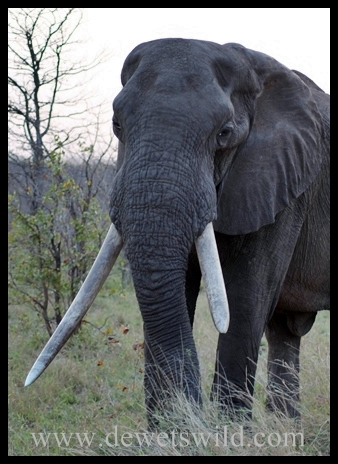
Ngodzi
Everytime we visit the Kruger Park, we hope for another special appearance by one of these majestic animals. It may be years before we are fortunate to have our path cross one of theirs again, but when it happens it will surely be another thrilling experience!

 DeWetsWild