Category Archives: South African Wildlife

The inhabitants of South Africa’s wild places

Red-eyed Dove

Streptopelia semitorquata

The Red-eyed Dove is a denizen of well wooded habitats (both naturally occurring and plantations), and is quite closely associated with watercourses. They are also a well-known garden bird in many of our towns and cities and have actually enlarged their distribution range in association with human settlements. They feed primarily on seeds but also takes some fruits, flowers and insects. Adults of these large doves weigh around 250g and grow to 35cm in length.

Unlike many other species of pigeons, Red-eyed Doves are not particularly gregarious and are usually seen singly or in pairs, with larger congregations of 50 to 100 birds being very rare. Pairs are monogamous and breed throughout the year. Their nests are flimsy stick platforms built in tall trees or reedbeds, and clutches usually consist of 2 eggs that are incubated for 2 weeks. The chicks leave the nest when they are around 3 weeks old.

The Red-eyed Dove occurs over most of sub-Saharan Africa, with the exception of the drier desert and semi-desert areas. In South Africa they are found in every province, avoiding only the driest districts of the Northern Cape. It is considered of least concern by the IUCN.

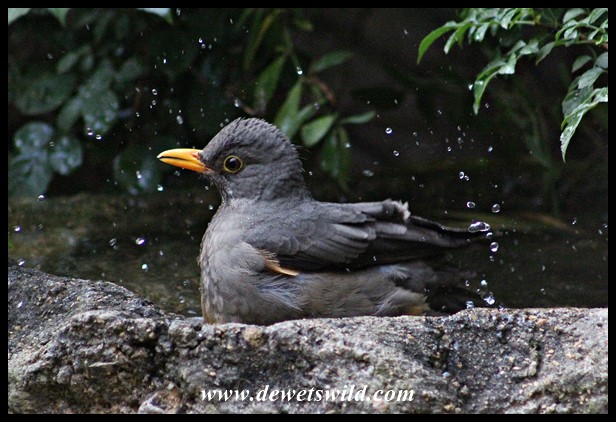
Karoo Thrush

Turdus smithi

The Karoo Thrush inhabits arid scrublands and grasslands, preferring the denser vegetation along drainage lines in these otherwise open areas. They’re also one of the most common garden birds all over their range, a fact that has aided an increase in both their range and population. Karoo Thrushes are usually seen singly or in pairs and follow an omnivorous diet, searching on the ground and scrounging through leaf litter for insects, worms, other invertebrates, small vertebrates and fruits and seeds. Adults are about 23cm long and weigh up to 86g.

At the start of the breeding season, which stretches through spring and summer, female Karoo Thrushes build cup-shaped nests of wet grass and other plant material in the forks of trees. They incubate clutches of 1-4 eggs for about two weeks, with the chicks becoming independent about 2-and-a-half months after hatching.

The Karoo Thrush occurs mainly in the central and western parts of South Africa, extending marginally into Lesotho, Botswana and Namibia. The IUCN considers it to be of least concern. It was previously classified as a subspecies of the Olive Thrush, which is generally found in forests.

Cardinal Woodpecker

Dendropicos fuscescens

The Cardinal Woodpecker is the smallest of its kind occurring in South Africa, with adults measuring around 15cm long and weighing in at about 30g. They inhabit a wide range of woody habitats, ranging from forest edges to arid savanna, where they feed mainly on insects and their larvae extracted from inside rotting wood or under bark.

Cardinal Woodpeckers are usually seen singly or in pairs or family groups, and often associate with other bird species while foraging. The breeding season stretches through spring and summer, but the monogamous pairs stay together throughout the year. They nest in holes hammered into dead trees or branches and sometimes fence posts. Both sexes incubate the clutch of 1-3 eggs for a period of 2 weeks. The chicks fledge at around a month old and become independent about two months later.

The Cardinal Woodpecker is widely distributed over sub-Saharan Africa, with the exception of some parts of the equatorial forests. In South Africa they can be found in all provinces, though they are abscent from large parts of the open and arid Northern Cape. The IUCN lists it as being of least concern.

White-breasted Cormorant

Phalacrocorax carbo lucidus

The White-breasted Cormorant inhabits estuaries, lagoons, shallow and sheltered coastal waters, swamps, lakes, dams and rivers. It is the only cormorant in South Africa that is equally at home in both marine and aquatic habitats. They feed primarily on fish, but will also take molluscs, amphibians, crustaceans, and the chicks of smaller birds. At a metre in length with a wingspan of around 1.5m and a weight of up to 3.2kg, it is Africa’s largest cormorant.

Breeding in White-breasted Cormorants have been recorded throughout the year, but reaches a peak at the end of the rainy season. While they are mostly solitary when foraging, they roost and nest in colonies, numbering anywhere between 10 and 1000 monogamous pairs, and often mixed with other kinds of waterbirds. Depending on where they find themselves these colonies may be located on rocky islands, cliffs, inaccessible (for land-based predators) sandbanks, shipwrecks, or in trees and reedbeds. Nests are platforms built by the female with sticks, reeds, seaweed, feathers and litter that is provided by the male. Clutches of 2-5 eggs are incubated by both parents for around 4 weeks. The chicks are fed regurgitated fish by both parents, perform their first flight when they’re about 8 weeks old and then become independent at about 4 months old.

White-breasted Cormorants occur almost throughout South Africa, even into the arid west along the Orange River and its larger tributaries. North of our borders they occur in a wide band through central and east Africa to the Red Sea and in isolated parts of Nigeria, Chad and Senegal. Most authorities consider the White-breasted Cormorant to be a subspecies of the Great Cormorant which has a much wider global distribution (every continent except South America and Antarctica), but some specialists suggest the White-breasted Cormorant should be considered a distinct species. The IUCN estimates the Great Cormorant’s population at as many as 2-million birds and lists the species as being of least concern. They are however persecuted by the aquaculture industry in many range countries and is at risk both from oil spills and of poisonous pollution-buildup in the fish stocks they subsist on.

Cape Sparrow

Passer melanurus

The Cape Sparrow is widespread and common in South Africa, Swaziland, Lesotho, Botswana and Namibia, extending marginally into Zimbabwe and Angola. The Cape Sparrow’s preferred natural habitat is grasslands and semi-arid thornveld and scrubland, particularly in or near wooded areas along drainage lines. They often live in close association with human settlements, and as such is one of the most commonly seen species in suburban parks and gardens as well as on farms and vineyards, where they can become pests. It is believed that this trait has aided both in the expansion of their distribution range and an increase in the populations size.  The IUCN considers it to be of least concern. Cape Sparrows feed predominantly on seeds, augmenting their diet with insects, fruit, flowers and nectar.

Adult Cape Sparrows measure about 15cm long, and weigh between 22 and 36g.

Cape Sparrows are usually seen in pairs or small family groups, but they do at times assemble in large, nomadic flocks of up to 200 outside of the peak breeding season, which stretches through summer (though breeding has been recorded throughout the year). They often associate with other seed-eating bird species while foraging. Monogamous pairs nest alone or in colonies of up to 100 pairs, and can raise several broods in a season. Their nests are untidy collections of grass, stems and other pliable plant parts and litter, hollowed out on the inside with a single side entrance and lined with soft feathers and material, built by both sexes in trees, bushes, inside disused swallow or weaver nests, or under the roofs of buildings. Clutches consist of between 2 and 6 eggs, incubated by both parents for 2 weeks. The chicks leave the nest when they’re around two weeks old, having been fed on insects (mostly caterpillars) by both parents up to that point and become fully independent at between 1 and 2 months of age.

Dwarf mongoose in Pretoruskop

Dwarf Mongoose

Helogale parvula

With a weight of only 350g and growing to a maximum length of 40cm (including its tail), the Dwarf Mongoose is the smallest mammalian carnivore in South Africa. They inhabit open savannas and woodlands with an ample supply of termite mounds and fallen logs and often in or near rocky outcrops. They prey on anything from insects, spiders and scorpions to reptiles (including snakes), birds and rodents, often banding together to overpower larger prey.

Diurnal in habits, Dwarf Mongooses live in clans of up to 40 members occupying a fixed home range within which they may have as many as 20 dens (often in termite mounds, tree stumps, rocky outcrops or in tunnels dug by themselves or other animals). These clans are controlled by a dominant pair that stays together for life. The dominant female gives birth to litters of 1-7 pups after a 2 month gestation, usually in the rainy season. While the babies will only suckle from their mother, all troop members assist in raising the young. Dwarf Mongooses are exceptionally curious, and even though they flee for cover at the slightest sign of danger it doesn’t take very long before they start popping up again to check out whatever it was that disturbed them. They have a life expectancy of only about 6 years in the wild.

The IUCN considers the Dwarf Mongoose to be of least concern. It occurs from Ethiopia and Somalia southwards to Angola and South Africa. In South Africa it is to be found from northern Kwazulu-Natal through Mpumalanga and Limpopo into the north-eastern corner of the North West Province.

White-throated Swallow

Hirundo albigularis

White-throated Swallows migrate in large flocks of up to 1000 birds to South Africa, Zimbabwe, Swaziland, Lesotho, Namibia and Botswana between July and September, in time for the breeding season, departing again for Angola, Zambia and the southern DRC around April and May. They are closely associated with rivers and open water, especially in grasslands, fynbos and mountainous areas, and feed primarily on insects caught in flight. Adults grow to a length of 15cm and weigh around 25g.

White-throated Swallows breed in our southern climes between August and March (peak between October and December). Pairs are monogamous and can raise multiple broods in a season, often returning year after year to the same nest. Their nests are small mud-cups lined with grass, fur and feathers, built against vertical surfaces (both natural and man-made) and often placed under overhanging rocks, bridges or roofs. Clutches of between 2 and 5 eggs are incubated for a little over 2 weeks, with the hatchlings fledging by about 3-4 weeks old and becoming independent about two weeks after that.

Being common with an apparently increasing population, the White-throated Swallow is listed as being of  least concern by the IUCN. During their breeding season they can be found in every South African province, being absent only from the driest parts of the arid Northern Cape.

Spotted Thick-knee

Burhinus capensis

The Spotted Thick-knee, or Spotted Dikkop, prefers open habitats, including fynbos, semi-arid scrublands, grasslands and savanna, but has adapted well to agricultural and urban environments and is often seen in fields, parks and gardens – at night their shrill call has become a familiar sound in our suburbs. They are mostly nocturnal in habit and feed primarily on insects and other invertebrates. Adults weigh around 500g with a wingspan of about 80cm.

Pairs of Spotted Think-knees are monogamous and solitary nesters, although they could assemble in groups of up to 50 outside the breeding season. Their nests are little more than a scrape in the ground, often out in the open but more usually in the shade of a bush or tree, and camouflaged with a few pieces of plants or pebbles, in which a clutch of 1-3 (usually 2) splendidly camouflaged eggs are laid. The parents take turns to incubate the eggs over a period of 4 weeks, and the chicks leave the nest within a day of hatching to move around with their parents. The chicks fledge at about 2 months old. Spotted Thick-knees breed through spring and summer and pairs can raise as many as three broods in a season.

Spotted Thick-knees occur over much of sub-Saharan African, being absent only from the equatorial forests, and is listed as being of least concern by the IUCN. In South Africa they occur over the entire country.

Easter Encounters with Tuskers

One of our greatest joys when visiting the Kruger National Park is being treated to an encounter with a real “Tusker”; a majestic elephant bull carrying massive ivory. There are only a handful of these enigmatic animals on the continent, and they are living monuments to those who protect our wild places for generations to come. Owing to their special status, they are given names by the Park authorities, often according to specific areas they roam or in remembrance of rangers or other members of staff that dedicated their lives to the Park.

During our Easter visit to Kruger, we were lucky to have seen no less than three of these awesome animals. Each one of them has some unique features – scars on the ears, marks on the trunk, characteristic tusk shape, etc. that aids in the identification. We’ve submitted our photographs to the Kruger’s Emerging Tuskers Project and will update this post once we hear the names of these tuskers.

This is Xidudla, the name being in reference to his large size:

This big bull is known as “Hahlwa“, which is Tsonga for “twin” because he looks so similar to Masasana, another big tusker roaming the Kruger Park.

This last bull has not been named yet, but the project team will be keeping a close watch on him until he too receives his well-deserved moniker.

For some more pictures of tuskers we’ve seen in Kruger in years past have a look at this post.

Western Stripe-bellied Sand Snake

Psammophis subtaeniatus

One of the most exciting and memorable sightings of our Easter trip to the Kruger National Park took place right in front of the reception office at Shingwedzi Rest Camp. We watched as a Western Stripe-bellied Sand Snake (aka Western Yellow-bellied Sand Snake) stalked, caught, killed and swallowed a skink – the whole episode playing out within perhaps ten minutes at the most.

This was a fairly large specimen of this slender species, which grows to around a metre in length. Western Stripe-bellied Sand Snakes are strictly diurnal, equally at home on the ground or in low trees and shrubs, and extremely fast moving. Aside from lizards they will also prey on frogs, small birds and rodents, which they dispatch with a dose of mild venom (not lethal to humans though).

Females lay between 4 and 10 eggs in summer, and probably lives for between 5 and 10 years in the wild.

The Western Stripe-bellied Sand Snake is described as widespread and common by the IUCN, which considers it to be of least concern. It is distributed from southern Angola and northern Namibia through to Swaziland and South Africa (North West, Limpopo, Gauteng, Mpumalanga and possibly northern Kwazulu-Natal), occurring in a variety of savanna types and being especially closely associated with mopane veld (such as which occurs around Shingwedzi).

While visiting Marakele National Park over Easter in 2019, we encountered another Western Stripe-bellied Sand Snake at the Thutong Environmental Education Centre, and watched as it searched, this time unsuccessfully, for a lizard to catch.

This Western Stripe-bellied Sand Snake visited our tent at Tlopi in the Marakale National Park during a visit in February 2021:

Western Stripe-bellied Sand Snake at our tent

While staying at Shingwedzi Rest Camp in the Kruger National Park in June 2019, a Western Stripe-bellied Sand Snake came to visit us at our campsite – seems Shingwedzi is a really good place to go looking for this species!

We were parked at a Leopard sighting while visiting the Kruger National Park in December 2021 when Marilize noticed this Western Stripe-bellied Sand Snake in a bush next to our car.

Western Stripe-bellied Sand Snake (photo by Joubert)

In July 2022 we visited Marakele National park and Tlopi Tented Camp again, and were delighted to find another Western Stripe-belllied Sand Snake guarding our tent again.