Category Archives: South African Wildlife

The inhabitants of South Africa’s wild places

Western Rock Skink

Trachylepis sulcata sulcata

Western Rock Skinks inhabit rocky outcrops in the Karoo and semi-deserts of the Northern Cape and Namibia, where they hunt by day for their principally insect prey. They are usually seen in pairs and hide in cracks and crevices at night or when danger threatens. Females may give birth to 2 broods of between 3 and 5 young in the summer months. Western Rock Skinks grow to 8cm long (excluding their tail, which can be shed to escape predators). These very active lizards are commonly seen along the trails in the Augrabies Falls National Park.

Namaqua Porkbush

Ceraria namaquensis

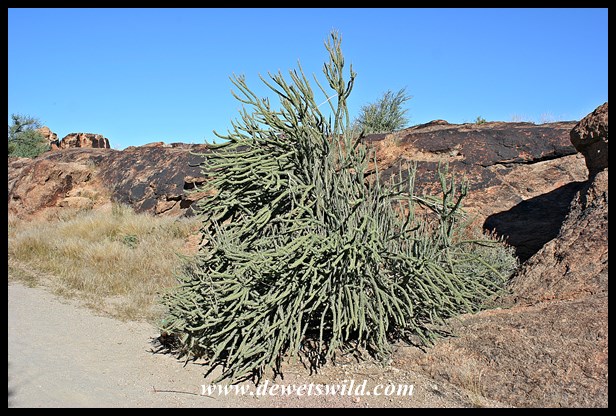
The Namaqua Porkbush is a hardy, slow growing, succulent shrub that grows up to 6 feet tall, excellently adapted to the extremely harsh semi-desert environment of rocky hills where it grows on the border of Namibia and South Africa’s Northern Cape. The bark of young shoots of the Namaqua Porkbush can be used to make a kind of elastic rope. The Augrabies Falls National Park is a wonderful place to see these tenacious plants, which seems to be able to grow in even the most meagre of substrate.

Pririt Batis

Batis pririt

Common in dry savanna habitats, especially those dominated by thorn trees, and along wooded drainage lines in more arid areas, the tiny Pririt Batis (10g in weight, 12cm long) follows an entirely insectivorous diet.

It is mostly the female’s responsibility to build the delicate cup-shaped nest using spiderweb and fine plant material inside the foliage of a tree or shrub. Breeding in this species has been recorded almost throughout the year (though there seems to be a spring peak), with clutches of 1-4 eggs incubated by the female for a little over 2 weeks. Both parents look after the chicks once hatched. The chicks leave the nest when they’re two weeks old but may remain with their parents for up to 6 weeks more. These little birds normally move around in pairs or small groups, often together with similarly sized birds of other species.

The Pririt Batis is distributed from southern Angola through Botswana and Namibia to South Africa‘s arid western provinces (Free State, North West, Eastern, Western and Northern Cape). The IUCN lists it as being of least concern.

Augrabies Flat Lizard

Platysaurus broadleyi

The Augrabies Flat Lizard, or Broadley’s Flat Lizard, is a South African endemic occurring in a tiny piece of the Northern Cape Province, centered on the Augrabies Falls where they are extremely common (one of the highest densities of any lizard anywhere on earth) and a familiar sight to visiting tourists. They grow to a length of around 8cm, excluding the tail, and their exceptionally flat bodies allow them to escape predators by hiding in the narrowest of crevices.

Preferring arid, sparsely vegetated, rocky habitats, Augrabies Flat Lizards follow an omnivorous diet that includes mainly insects (often caught by jumping into the air!), ripe Namaqua figs and pieces of food dropped by tourists. Augrabies Flat Lizards are active throughout the year and do not hibernate in winter, though they are active for shorter periods then. In the hot summer of their arid environs they will hide in the shade during the heat of the day. Their breeding season stretches from spring to early summer, during which the colourful males will display to the drab females and each other, and get involved in serious territorial disputes if need be. Females may produce two clutches of eggs in a season, the first young emerging from late December.

Augrabies Flat Lizards featured in a terrific clip on a BBC Wildlife programme presented by Sir David Attenborough. The IUCN considers the Augrabies Flat Lizard to be of least concern.

Orange River White-eye

Zosterops pallidus

Orange River White-eyes occur only in South Africa’s central and western provinces and into Namibia, where they commonly inhabit thorny riparian vegetation and well-planted gardens, feeding primarily on insects and other invertebrates. Little is known about the breeding habits of these tiny birds (9g in weight, 11cm long), though their nesting season apparently spans spring and summer.

The IUCN considers the Orange River White-eye to be of least concern. Many authorities consider it a subspecies of the closely related and very similar Cape White-eye, with which it sometimes interbreeds. We had our first encounter with the Orange River White-eye during a recent visit to Augrabies Falls National Park.

Mokala National Park is another wonderful place to see the Orange River White-eye:

Namaqua Fig Tree

Ficus cordata

The Namaqua Fig is an exceptionally hardy tree occurring in arid, rocky areas from South Africa’s Western Cape northwards to southern Angola. Despite the harshness of their environment, Namaqua Figs can grow to 10m high, bearing fruit in spring and summer that is sought after by primates, frugivorous birds and even lizards. The fruit however are normally heavily infested with insects and not fit for humans to eat. As is the case for many other kinds of fig trees, this species relies on a particular species of wasp, Platyscapa desertorumfor pollination. The bark of the Namaqua Fig is used to tan and dye leather.

The immediate area around the Augrabies Falls is an excellent place to marvel at these rock-splitting trees growing into and even seemingly hanging onto the bare rock and cliff faces.

Hartmann’s Mountain Zebra

Equus zebra hartmannae

With stallions weighing around 300kg and standing 1.5m high at the shoulder, the Hartmann’s Mountain Zebra is slightly larger than its close relative, the Cape Mountain Zebra. They share a similar liking for arid, broken terrain, though Hartmann’s Mountain Zebra will also exploit sandy plains adjacent to their preferred rocky, hilly abodes. Mountain Zebras are almost exclusively grazers and require regular access to a reliable water source – Hartmann’s Zebras have been known to dig wells in dry riverbeds to access clean water.

Hartmann’s Mountain Zebras occur in small family groups consisting of a dominant stallion, up to 5 mares and their offspring of various ages that may roam over vast areas. Unattached adult males come together in bachelor groups until they can establish a group of their own. Hartmann’s Mountain Zebras are diurnal animals and will rest in the shade during the heat of the day. Foals may be born at anytime of year, though there is a peak in births during the wetter summer months.

The Augrabies Falls National Park (where the herd below was photographed) is one of only two national parks in South Africa where a small population of the Hartmann’s Mountain Zebra can be seen – the other is the Richtersveld National Park. Small herds can also be found in a handful of provincially managed reserves and private farms in South Africa (the latter also outside the natural range of the Hartmann’s Mountain Zebra, posing a risk of crossbreeding with the Cape Mountain Zebra). The total population of the subspecies was estimated at around 25,000 (of which 8,300 mature animals) in 1998, with the majority of these occurring in neighbouring Namibia. The IUCN considers the Hartmann’s Mountain Zebra to be vulnerable, siting a probably declining population.

One of the protected areas outside the natural distribution of the Hartmann’s Mountain Zebra where it can be seen is the Rhino & Lion Nature Reserve in South Africa’s Gauteng Province.

Pale-winged Starling

Onychognathus nabouroup

Pale-winged Starlings inhabit arid, rocky landscapes, especially those with a preponderance of cliffs and other similarly inaccessible areas. They follow an omnivorous diet of fruit, nectar, seeds, insects and small reptiles, and unlike most other species of starling generally avoids areas of human habitation. They’ve also been observed to remove ticks and other parasites from mountain zebras and klipspringers. Adults grow to about 27cm in length and weigh around 100g.

Nests are cups of sticks and dry grass placed on cracks and crevices on cliff sides, usually in small colonies consisting of a few pairs nesting in close proximity. Clutches of 2-5 eggs are laid in spring and summer and incubated by the female for around 3 weeks. Both parents feed the chicks, which leave the nest between 3 and 4 weeks after hatching.

Pale-winged Starlings occur in South Africa’s Eastern, Western and Northern Cape, extending marginally into the Free State and North West Provinces. They also occur widely in Namibia as well as in the extreme south of Angola, and thanks to a common and stable population is considered of least concern by the IUCN.

Quiver Tree

Aloidendron dichotomum

(f.k.a. Aloe dichotoma)

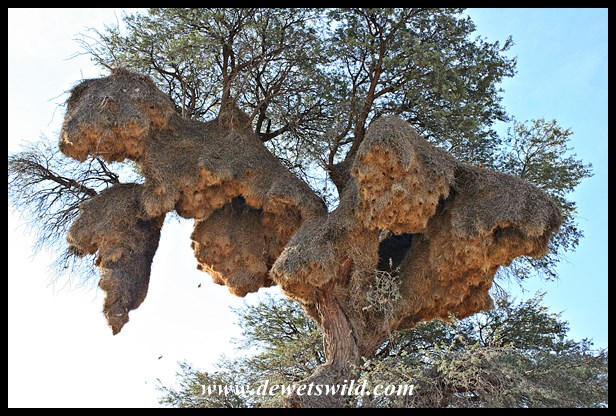
The Quiver Tree is a kind of tree aloe growing in extremely arid, often rocky, areas with well-drained coarse sand as substrate. These hardy plants can live for 80 years or longer and grow to over 7m tall. Quiver Trees bear their bright yellow flowers in winter (June & July) and these are a favourite source of food for many nectar-eating birds and insects, and also baboons. Large Quiver Trees are a favoured site for the huge communal nests of the sociable weaver.

Quiver Trees occur only in Namibia and South Africa’s Northern Cape Province. Augrabies Falls National Park is one of the best locations in South Africa to see magnificent specimens of this unique plant in its natural habitat.

The San people hollowed out the branches of the Quiver Tree to make quivers in which to keep their hunting arrows, hence the name. The fibrous trunk was also hollowed out to use as a natural refrigerator for meat, vegetables and water.

Brubru

Nilaus afer

The Brubru is a member of the shrike family occurring in savanna and woodland habitats, and specifically those dominated by Miombo, Mopane and Acacia trees. They feed mostly in the canopy, searching for insects and other invertebrates. Brubrus are about 14cm long and weigh around 24g

Brubrus are usually encountered singly or in pairs but will join groups of other insectivorous birds moving through their home range. Both parents work together to construct the small, neat and well camouflaged cup-shaped nest of fine plant material and spiderweb. Clutches of 1-3 eggs are usually laid in spring and summer (breeding attempts have been recorded throughout the year) and incubated by both parents for just short of 3 weeks. The chicks leave the nest when they’re 3 weeks old and are fully independent by the time they’re 3 months old.

In South Africa the Brubru can be seen in Kwazulu-Natal, Mpumalanga, Limpopo, Gauteng, North-West and the north of the Northern Cape Province. Brubrus are also found widely over sub-Saharan Africa, with the exception of desert and forest areas, and the IUCN considers them to be of least concern.