Category Archives: South African Wildlife

The inhabitants of South Africa’s wild places

World Wildlife Day 2019

What better way to celebrate World Wildlife Day than to look back at the 301 species of South African wildlife we featured here at de Wets Wild over the years?

Click on the first image, scroll through the gallery and by the end of it you are sure to believe, as we do, that South Africa is a treasure chest of beautiful creatures that you absolutely have to visit, and fully deserving of its reputation as one of the ten most biodiverse countries on the planet!


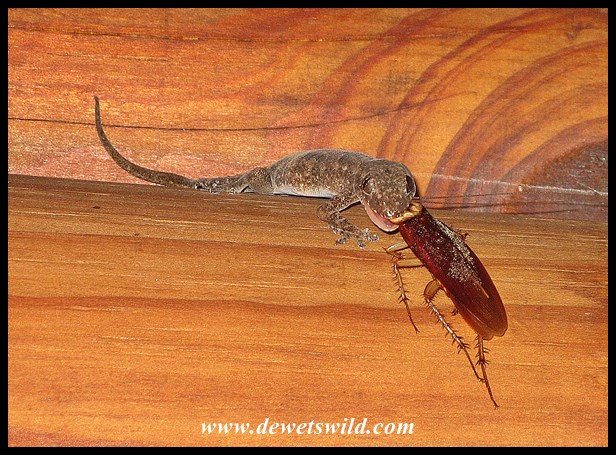
Common Tropical House Gecko

Hemidactylus mabouia

The Common Tropical House Gecko, also known as Moreau’s Tropical House Gecko, is a nocturnal species of gecko that is found in savannas, woodlands and forests. Naturally they’re arboreal, hiding under bark and in tree hollows during the day, but they have adapted to human habitations with great enthusiasm and is often seen catching moths, beetles, cockroaches and other invertebrates attracted by lights at night, occasionally even consuming smaller reptiles as well. They can grow to a length of about 12cm.

Males are territorial and get involved in vicious fights. In spring and summer females usually lay two sticky eggs in tiny hiding places but occasionally up to 60 eggs from different females may be laid in a specific spot. The eggs take about 2 months to hatch.

Their natural distribution range in South Africa stretches along the coast from the Eastern Cape through Kwazulu-Natal to Mpumalanga, Limpopo, Gauteng and North West Province. They’re also found naturally over much of the rest of sub-Saharan Africa. This species also colonized large parts of North, Central and South America and the Caribbean after being inadvertently introduced by humans since the days of the slave trade, and is listed as an invading alien species in many countries. Even here in South Africa populations have been established in towns and cities well outside their natural range.

Yellow-throated Longclaw

Macronyx croceus

Yellow-throated Longclaws inhabit relatively high rainfall savannas, open woodlands, grasslands and wetlands, usually with a few scattered trees and bushes. They’re mainly insectivorous in their diet. They sleep in long grass, but are often seen perched conspicuously at the top of thin branches or termitaria. They are usually encountered in pairs, or small family groups of up to 6 birds at the end of the breeding season, which stretches through all of spring and summer. Pairs are monogamous, with the female constructing a bulky nest well hidden in or under grass tussocks. The female also assumes most of the responsibility for the incubation of the clutch of 2-4 eggs that hatch after about two weeks. The chicks leave the nest before they’re 3 weeks old.

Adults measure around 21cm in length and weigh approximately 48g.

The IUCN considers the Yellow-throated Longclaw to be of least concern. The species has a discontinuous distribution over much of sub-Saharan Africa, from Senegal to South Africa, where they are to be found along the coast from the Eastern Cape through Kwazulu-Natal to the Lowveld of Mpumalanga and Limpopo.

Giant Legless Skink

Acontias plumbeus

The Giant Legless Skink is a southern African endemic, occurring only on the highlands of Zimbabwe and neighbouring Mozambique, the extreme south of the latter country, Swaziland and South Africa’s Lowveld, Kwazulu-Natal and an apparently isolated population around East London in the Eastern Cape.  It is not a snake but actually the world’s largest skink (type of lizard), measuring up to half a meter in length. The Giant Legless Skink lives in damp soil and leaf litter, mainly in a variety of forest and thicket habitats, and sometimes emerges above ground following drenching rains. It feeds on invertebrates, frogs and smaller reptiles. In late summer females give birth to between 2 and 14 live young.

The IUCN lists the Giant Legless Skink as being of least concern.

White-browed Scrub Robin

Cercotrichas leucophrys

An inhabitant of thorny savannas and woodlands with good grass covering, the White-browed Scrub Robin is a shy bird with a fairly characteristic song most often heard at sunrise or sundown. They feed predominantly on insects, especially ants and termites, caught on the ground. White-browed Scrub Robins are usually encountered in monogamous territorial pairs and breed in spring and summer. Their nest is a deep cup-shape built in dense foliage or thick grass, usually quite low to the ground. Clutches usually consist of 2-4 eggs and are incubated by the female only for a 2 week period, though both parents take an active role in feeding the chicks.

Adults weigh around 20g and grow to 15cm in length.

The White-browed Scrub Robin has a wide distribution through east, central and southern Africa. In South Africa they occur from the North West Province to the Eastern Cape, through Gauteng, Limpopo, Mpumalanga and Kwazulu-Natal. The IUCN lists the White-browed Scrub Robin as being of least concern.

Fever Tree

Vachellia (Acacia) xanthophloea

The beautiful Fever Tree is a large thorn tree with a spreading crown, growing up to 25m high and characterised by its smooth, greenish-yellow bark. It grows on river banks, in swampy areas and in savanna and woodland with a high water table, occasionally forming “fever tree forests” that are, to me, among the most beautiful scenes to be enjoyed in some of our favourite South African wild places – among which the Pafuri area of the Kruger National Park and uMkhuze Game Reserve in the iSimangaliso Wetland Park.

Early European settlers noted that malaria is often contracted in areas in which this tree grew, from there the name “Fever Tree”. It was only later that the vector for malaria was identified as mosquitoes, which of course also occurs in great numbers in the swampy areas the Fever Tree prefers to grow in. The leaves, shoots, gum, flowers and pods of young fever trees are eaten by browsing herbivores, while the bark is used in traditional medicine concoctions.

South Africa’s only naturally occurring populations of the Fever Tree is to be found in the north of Kwazulu-Natal, through the Lowveld and into the Limpopo Valley. However, despite being rather prone to frost, it has been planted widely as an ornamental plant in other parts of the country.

Common Ringed Plover

Charadrius hiaticula

The Common Ringed Plover is a summer visitor to South Africa, migrating to our country and much of sub-Saharan Africa, the Arabian Peninsula and Mediterranean from their arctic breeding grounds. Most of the birds move to the coast, where they prefer the muddy banks of estuaries and lagoons as well as rocky shores,with a lesser number overwintering at our inland water bodies – dams, marshes and even sewerage works. The first birds arrive from September, with the last ones departing by early May. A handful of individuals, perhaps those too weak to make the long distance journey, remain behind throughout our winter. They feed on small crustaceans and other aquatic and water-associated invertebrates.

The IUCN considers the Common Ringed Plover to be of least concern. It is estimated that the adult population worldwide may be as high as 1,4-million, of which as many as 10,000 arrive in southern Africa annually, from places as far afield as Siberia, 18,000km distant, and a remarkable feat for a bird so small! Adults measure about 19cm long, and weigh around 50g.

White-eared Barbet

Stactolaema leucotis

The White-eared Barbet is a forest bird that feeds mainly on fruit (being especially fond of wild figs), occasionally including insects in the menu. Adults measure around 18cm in length and weigh approximately 50g. Groups of up to eleven birds share a hole in a dead tree as a roost, They breed during spring and summer, laying clutches of 3-6 eggs. The chicks stay in the nest for about 5 weeks.

The IUCN notes that the overall population of the White-eared Barbet is probably decreasing due to habitat loss and modification, though still listing it as being of least concern. They occur in a narrow band along Africa’s east coast from Kenya southwards to South Africa, where they may be found only in the province of Kwazulu-Natal.

Kosi Raphia Palm

Raphia australis

The Kosi Raphia Palm is an enormous tree, growing up to 25m tall with leaves up to 18m long – among the largest leaves of any plant on earth. They grow in swamp forests, often forming dense stands. Around the age of 20-30 years the Kosi Palm flowers only once , producing an immense 3m high brown inflorescence at the top of the plant and then, after bearing thousands of fruit that takes two years to mature, dies. The Raphia Palm family is a main food source for the Palmnut Vulture. Humans use the leaves as thatching material and the petioles to construct huts and fences.

The Kosi Raphia Palm has an extremely limited distribution, occurring only in a few locations in southern Mozambique and around Kosi Bay in the extreme north-eastern corner of Kwazulu-Natal Province in South Africa. The total population of mature individuals number probably around 7,000 only, with the IUCN listing the species as vulnerable, and noting a continuous decline in their numbers due to habitat loss. In 1916 a grove of Kosi Palms were established in the town of Mtunzini, some distance south of their natural range, by the local magistrate. After becoming established and multiplying, Mtunzini’s Raphia Palm Forest was declared a National Monument in 1942. (You may want to click on the image below for an easier read)

Mtunzini’s Raphia Palm Monument

Yellow-bellied Greenbul

Chlorocichla flaviventris

The Yellow-bellied Greenbul is a species of bird that is most at home in forests, dense woodlands and savanna thickets but also increasingly in well-planted gardens, where this usually shy species can become rather confiding. It is a vocal species and moves about in pairs or small groups of up to six birds. They’re mixed feeders, including invertebrates, berries, fruits, seeds and flowers in their diet.

Yellow-bellied Greenbulls breed in spring and summer, monogamous pairs constructing flimsy cup-shaped nests in dense foliage, with most clutches consisting of 2 eggs (range 1-3) only. The female incubates the eggs for a two week period, with the chicks leaving the nest when they’re around 3 weeks old. Adults grow to about 22cm in length, and weigh around 40g.

In South Africa, the Yellow-bellied Greenbul can be found from southern coastal Kwazulu-Natal and into Mpumalanga and Limpopo, recently expanding its distribution marginally into North West and Gauteng. They also occur widely in central and eastern Africa and is considered to be of least concern by the IUCN.