Category Archives: South African Wildlife

The inhabitants of South Africa’s wild places

Sausage Tree

Kigelia africana

The Sausage Tree is distributed widely through sub-Saharan Africa, occurring from Senegal to Eritrea and southwards to the South African provinces of Limpopo, Mpumalanga and Kwazulu-Natal. It was also introduced to various other parts of the world as a decorative garden plant. The IUCN lists it as being of least concern. Sausage Trees are usually found growing along rivers, streams and flood plains in more tropical climatic conditions, being rather susceptible to frost damage in more temperate climes.

Sausage Trees can grow as tall as 20m and have an equally widely spreading crown. The beautiful flowers, carried in early spring, are pollinated by a wide variety of insects, birds and bats attracted by copious quantities of nectar. The enormous fruit from which the Sausage Tree takes its name can grow to between 30cm and a meter long, weighing between 5 and 12kg, posing a considerable hazard for anyone or anything unlucky enough to be below the tree when one of the fruits drop. The fruiting season stretches from December to June in South Africa.

The flowers and fruit are eaten by antelope, primates, bushpigs, elephants, hippos and giraffes, though both the green and fresh fruit are poisonous to humans and needs to be dried, roasted or fermented before it can be utilised as food.

Kurrichane Thrush

Turdus libonyana

The Kurrichane Thrush is a shy denizen of open woodlands and dense vegetation fringing river courses, and have adapted to well-planted parks and gardens in our towns and cities. They feed on a wide variety of fruit and invertebrates.

Usually encountered in monogamous, territorial pairs, Kurrichane Thrushes breed from late winter to early autumn. Their cup-shaped nests are placed in the forks of large trees and often lined with mud. Only the female incubates the clutch consisting of 1-4 eggs over a two-week period. While the chicks leave the nest roughly two weeks after hatching they may remain with their parents for up to two months more before becoming independent. Fully grown, Kurrichane Thrushes measure about 22cm and weigh around 63g.

Kurrichane Thrushes occur widely over eastern, central and southern Africa. In this country they are found from Kwazulu-Natal to North West, through Mpumalanga, Limpopo and Gauteng. The IUCN considers it as being of least concern.

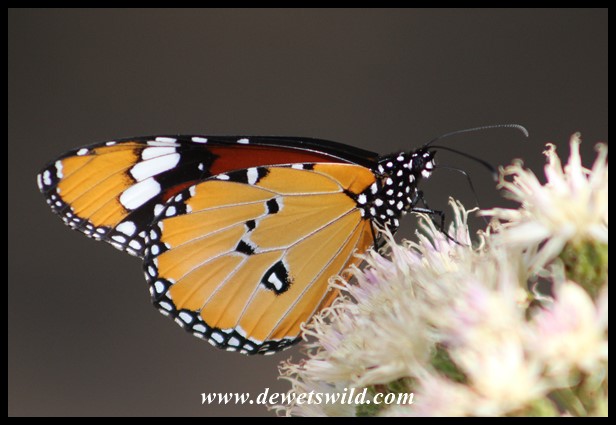
African Monarch

Danaus chrysippus orientis

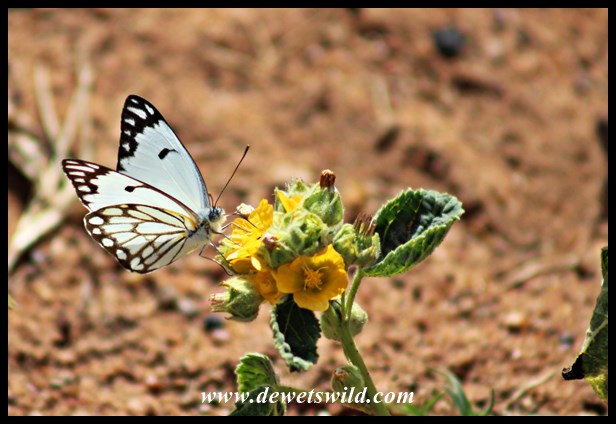
The African Monarch is one of our most commonly seen butterflies, flying throughout the year and occurring in every corner of our country. Furthermore they’re widespread over the rest of Africa, the Indian Ocean islands, large tracts of Asia and Australia, where they are known as the “Plain Tiger”. These butterflies prefer more open habitats, are regularly seen in parks and gardens, and fly rather slowly, settling often on flowers or wilted plants.

Females lay eggs singly on their favourite larval food plants from the Milkweed family (especially the genuses Asclepias, Ceropegia, Stapelia and Huernia). Their metamorphosis from egg to butterfly takes from 4 to 6 weeks depending on the local climate. Adults are medium-sized butterflies, with a wingspan of between 5 and 8cm, and feed on nectar and alkaloids from damaged or dying plants. Their colouration serves as warning to predators that this butterfly is foul-tasting (likely resulting from their feeding on milkweeds as larvae), and as a result several other kinds of more palatable butterflies mimic the same colours and patterns. They live for up to two weeks in their adult form.

Bennett’s Woodpecker

Campethera bennettii

Bennett’s Woodpecker inhabits woodland and savanna habitats with tall trees. It feeds mainly on ants and termites and their eggs and larvae, which it will dig out of their underground nests, and thus spends a lot of time on the ground. Adults measure about 23cm long and weigh around 70g.

These woodpeckers are usually encountered singly, in pairs or family groups, and use holes in trees as nests, either chiseled by themselves or taken over from other species. Both parents incubate the clutch of 2-6 eggs over period of almost three weeks. The chicks leave the nest about a month after hatching, but will remain with their parents up to the next breeding season, which spans spring and summer. It would appear that pairs are territorial throughout the year and not only in the breeding season.

The IUCN considers Bennett’s Woodpecker a species of least concern. It occurs from Burundi and Rwanda through much of east, central and southern Africa to South Africa’s Limpopo and Mpumalanga Provinces, with a few scattered records from other provinces. It is a close relative of, and easily confused with, the Golden-tailed Woodpecker. Shingwedzi Rest Camp in the Kruger National Park is a very reliable spot to see Bennett’s Woodpecker.

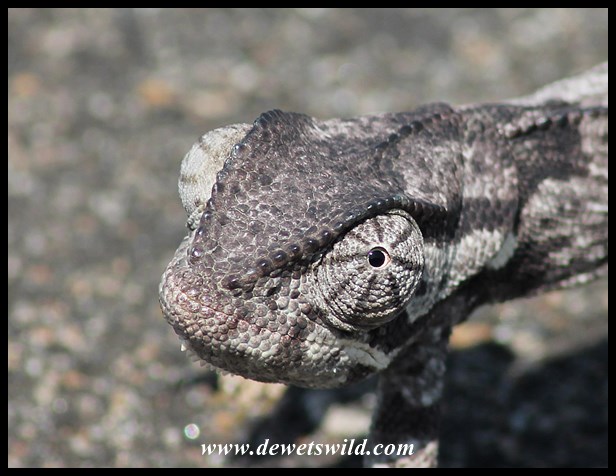
Common Flap-neck Chameleon

Chameleo dilepis

Few people would not be familiar with chameleons, those lizards with their independently moving eyes, long, sticky tongues and slow, deliberate movements belying their amazing ability to change colour in the blink of an eye (to blend in with their environment or to communicate their mood). We have 22 species of chameleon in South Africa, of which the Common Flap-neck Chameleon is the best known.

Flap-neck Chameleons feed on insects, mainly beetles and grasshoppers. They prefer savanna, thicket, woodland and forest habitats and are mainly arboreal, though thanks to their excellent camouflage amongst foliage they are mostly only noticed when moving across open ground. In South Africa they occur from coastal Kwazulu-Natal and the adjacent interior, into Mpumalanga, Limpopo, northern Gauteng, North West and the Kalahari regions of the Northern Cape. North of our borders they occur all the way to Cameroon in the northwest and Somalia in the northeast.

Three to four months after mating in the spring, female Flap-neck Chameleons lie clutches of 25-50 (exceptionally up to 65) eggs in a foot-long tunnel she digs in moist soil in the late summer months. The eggs can take up to a year to hatch. Newly emerged Flap-neck Chameleons measure about 5cm in length but grow quickly; adults grow to a length of 35cm (half of which is their prehensile tail).

When threatened, Flap-neck Chameleons inflate their bodies and open their mouths wide in a defensive display. They’re also quite likely to bite when handled. The IUCN considers the Flap-neck Chameleon to be of least concern. Unfortunately it is popular in the pet trade and often sold by informal traders along rural roadsides. This practice should never be supported by purchasing the chameleon, despite how sorry you may feel for the poor creature, as it just stimulates the market and triggers more and more people to go catch animals for sale, most of which will die, and leading directly to the local collapse of their populations.

Beautiful impala lily flowers

Impala Lily

Adenium multiflorum

An Impala Lily in full bloom must be one of our most beautiful succulent shrubs, especially as it blooms in an otherwise drab and dry winter in the hot savannas of the Lowveld and northern Kwazulu-Natal, the only places it occurs naturally in South Africa, where it grows in well-drained brackish and rocky soil. North of our borders they are found up to Zambia and Malawi. They are extremely drought resistant and can grow to 3m tall, though such large specimens are rare. Being toxic, it was once used as poison for arrows by the San people. However, some animals are able to browse on the Impala Lily without suffering any apparent ill effects. It is also used in a few traditional medicine concoctions.

Red-billed Teal

Anas erythrorhyncha

Being a quite common inhabitant of our freshwater dams and pans (and sewerage ponds), the Red-billed Teal can be expected at any inland open water body in South Africa that provides emergent and submerged vegetation. They feed on grass, seeds, waterplants and aquatic invertebrates, mostly at night – by day they rest on the water or at its edge. Apart from South Africa, the species is widely distributed over the rest of southern, eastern and central Africa as well as Madagascar.

Red-billed Teals congregate in enormous flocks at times, especially during their annual month-long flightless moulting period, but are usually seen in pairs when breeding, which may occur throughout the year but mostly follows the rainy season, nesting in thick vegetation on dry land near temporary or permanent expanses of water. Clutches consist of 5-12 eggs, and are incubated for a month by the female only, the male by this stage having long abandoned the family. The chicks take to the wing for the first time about two months after hatching.

Adults grow to a length of about 46cm and both sexes weigh just over half a kilogram on average. The Red-billed Teal is listed as being of least concern by the IUCN.

Thread-waisted Wasp

Ammophila

We have about 18 species of the genus Ammophila in South Africa, and finding a female Thread-waisted Wasp from this genus on the hunt can be an absolutely engrossing experience. Before setting out, she digs a short tunnel in sandy soil, ending in a wider nest chamber. She then searches for caterpillars and other soft-bodied invertebrates, which once found are paralysed with a series of stings and then, depending on the size of the prize, is carried in flight or dragged along the ground back to the nest. One or more incapacitated victims are provided per nest, the female wasp laying a single egg on the first prey item stored in the nest. Once the larder has been sufficiently stocked to provide adequately in the needs of the larval wasp, the female closes it up with pebbles and grains of sand, taking great care to expertly hide the tunnel from view. She then starts the process all over again at a suitable nesting site elsewhere.

Thread-waisted Wasp

The two galleries below were taken at Marakele National Park and Tembe Elephant Park respectively, and show the fascinating process of a female wasp provisioning her offspring with a food store.

The Tembe sequence:

Unlike the larvae, adult Thread-waisted Wasps feed on nectar. They measure 2-3cm in length.


Olive Sunbird

Cyanomitra olivacea

The shy but vocal Olive Sunbird is a forest denizen by habit, and usually the most commonly encountered sunbird where they occur. They nest throughout spring and summer. Adults weigh only between 8 and 15g, measuring around 15cm long. Not much else is known about these tiny nectar-feeders.

Due to its very specific habitat preferences, the Olive Sunbird has a very restricted distribution in South Africa – here they are found only along the Indian Ocean coast from East London through to northern Kwazulu-Natal, and in a small corner of Mpumalanga around Nelspruit and Barberton. Further north into Africa they are widely distributed through east, central and West Africa. The IUCN lists the species as being of least concern, despite the threat of habitat loss due to uncontrolled deforestation in much of its range.

Mopane

Colophospermum mopane

Anyone who has visited the northern Kruger National Park would be well acquainted with the Mopane, a tree that proliferates in hot, dry, low-lying areas. Apart from the Limpopo Valley and northern Lowveld in South Africa, the Mopane is mainly found south of the Kunene and Zambezi Rivers. In dry, shallow soils the Mopane grows as a short shrub, dominating the landscape, but in deep, damp alluvial soils they may grow to 30m tall, forming beautiful woodlands. The trees are a favourite for many browsing animals, with elephants especially being very fond of every part of the tree, including the rough bark.

Mopane wood is hard and termite resistant, making it sought-after as a building material, for fences and mining, railway sleepers and for making furniture. It is also one of the most widely used trees for fire-wood where it occurs. The Mopane is probably best known though as the food source for a uniquely African delicacy; the protein-rich Mopane Worm – more correctly the caterpillar of the Mopane Moth Gonimbrasia belina.