Category Archives: South African Wildlife

The inhabitants of South Africa’s wild places

African Common White Butterfly

Belenois creona

The African Common White is widely distributed on the continent south of the Sahara, extending into Arabia and also to Madagascar. In South Africa they can be found in the Eastern Cape, Kwazulu-Natal, Gauteng, Mpumalanga, Limpopo and marginally into the Free Sate and North West. This distribution reflects their preference for savanna habitats. Eggs are laid in clusters on plants from the closely related genusses Boscia, Capparis and Maerua which serve as larval food plants. Adults have a wingspan of around 4cm and can be seen year-round.

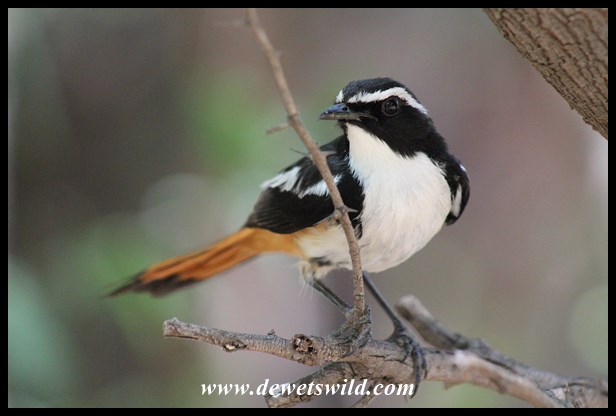
White-throated Robin-Chat

Dessonornis humeralis

The White-throated Robin-Chat is endemic to southern Africa, occurring in Botswana, Zimbabwe, Mozambique, Swaziland and South Africa’s North West, Gauteng, Limpopo, Mpumalanga and Kwazulu-Natal provinces, where it inhabits savanna habitats and riverine thickets and feeds on insects, other invertebrates, and fruit.

White-throated Robin-Chats are usually seen in monogamous pairs and breed in spring and early summer, building cup-shaped nests of fine materials on the ground in dense cover or other suitable shelter. Clutches consist of 2 or 3 eggs and are incubated by the female only over a 2 week period. The chicks fledge when they’re two weeks old but remain dependent on their parents for food for up to two months after leaving the nest.

The IUCN considers the White-throated Robin-Chat to be of least concern. Adults are about 15cm in length and weigh approximately 23g.

African Honey Bee

Apis mellifera

Two closely related subspecies of Honey Bee are commonly found in South Africa, the Cape Honey Bee from the Western Cape being more aggressive than the African Honey Bee that occurs from the Karoo northwards to Ethiopia and Sudan (distribution map). They were also imported to Brazil from whence they spread all over South and Central America and into the continental United States. African Honey Bees are much more aggressive and tenacious than their counterparts in the Northern Hemisphere, attacking intruders quicker and in greater numbers when defending their hive.

Honey Bees are well-known for being social insects with well-defined castes taking care of various functions within the hive, which is built of wax and resin in natural or man-made cavities. Hives may number up to 50,000 individual bees, with workers living a few weeks and their queen for as long as four years. They feed on both the nectar and pollen of a wide variety of flowering plants.

Honey Bees are vitally important pollinators of indigenous flowering plants as well as cultivated crops. The 20th of May annually has been designated “World Bee Day” to focus attention on declining bee populations and the impact this will have on natural ecosystems and human food production in future.


Layman

Amauris albimaculata

The sedate and elegant Layman inhabits forests, woodlands and savannas, occurring from the Eastern Cape through Kwazulu Natal into the Lowveld of Mpumalanga and Limpopo, and from there as far north as Cameroon and Ethiopia. They fly slow and high, descending only to feed on flowers and alkaloids seeping from damaged and wilted plants. Being a distasteful species, at least three other kinds of butterfly mimic the Layman’s colouration and patterns. Adult Laymans have a wingspan of 5 – 7cm and can be seen on the wing throughout the year. Females lay clusters of 3-40 eggs on the underside of the leaves of a wide variety of food plants.

Purple Heron

Ardea purpurea

One of our shier heron species, despite its impressive size, the Purple Heron inhabits densely vegetated shallow wetlands, reedbeds and riverbanks, seldom emerging into the open. They feed mainly on fish, frogs, small mammals and birds, and crabs and other aquatic invertebrates and is most active around dawn and dusk.

The Purple Heron forms monogamous pairs and usually nest in mixed colonies together with ibises, cormorants and other herons in reed beds and treed thickets. Both parents construct the flat platform nest using reeds and sticks and share the incubation duties for the clutch of 4-8 eggs over a 4-week period. They breed throughout the year, with a peak during the rainy season, and the chicks become independent when they’re about two months old.

Purple Herons measure around 85cm in length with a weight of approximately 870g, and is considered of least concern by the IUCN, which estimates their numbers at as many as half-a-million. Draining of their preferred wetland habitats and habitat destruction in other ways, is a threat to take note of. The species occurs widely over Europe, central and south Asia, the Indian subcontinent and sub-Saharan Africa and in South Africa they are found in all our provinces, though only rarely so in the arid Northern Cape and dry Karoo regions.

Spotted Joker

Byblia ilithyia

The beautiful Spotted Joker is found in Africa and Asia. In South Africa they commonly occur in all our provinces with the exception of the Western Cape, inhabiting grasslands and dry, open savanna habitats. The larvae feed predominantly on plants from the genus Tragia, while adults gather on rotting fruit, faeces and mud. Adults have a wingspan measuring 4-6cm and are on the wing throughout the year.

Buffy Pipit

Anthus vaalensis

An inconspicuous inhabitant of dry, grassy plains with patches of bare ground as well as open pastures and recently burnt fields, the Buffy Pipit subsists on a diet of insects and seeds. They are usually encountered singly or in pairs, occasionally forming flocks in winter.

The breeding season in Buffy Pipits stretches from late winter to the summer months, peaking from September to December. Pairs are monogamous and build a rough, cup-shaped nest usually hidden in a grass tussock. Clutches of 2 or 3 eggs are incubated for two weeks, and the chicks leave the nest by the time they’re 14 days old. Adults measure about 18cm in length and weigh around 30g.

The Buffy Pipit has a wide, if patchy, distribution across Africa south of the equator. In South Africa it is to be found throughout the central, eastern and northern parts of the country. With an increasing population due mainly to stock-farming and associated heavy grazing of otherwise long grass, the IUCN considers the Buffy Pipit to be of least concern.

Small Orange Tip

Colotis evagore

The Small Orange Tip butterfly has a patchy distribution in South Africa, being found in portions of the Eastern Cape, most of Kwazulu-Natal and Mpumalanga, all of Limpopo, North West and Gauteng, the western Free State and extreme eastern districts of the Northern Cape, preferring the drier, more open, savanna-type habitats. They’re also found over much of the remainder of the African continent and also occur in southern Spain and the Arabian peninsula. Females lay eggs singly on a wide variety of plants from the Capparaceae family. Adults have a wingspan of 3-4cm and can be seen at any time of year.

Black-chested Snake Eagle

Circaetus pectoralis

The Black-chested Snake Eagle is often seen hunting for their preferred serpentine prey over flat, open habitats such as savanna, grasslands, scrublands and semi-deserts. Apart from snakes they’ll also catch other reptiles, amphibians and small mammals. These eagles are quite adept at swallowing even large snakes in flight.

Usually seen singly or in pairs but occasionally congregating in groups numbering several dozen outside of the breeding season, Black-chested Snake Eagles form monogamous pairs to breed. Their breeding season spans winter and spring – probably as sparser vegetation then makes it easier to catch slithering prey. Females usually lie a single egg in a platform nest built of sticks in the tops of trees or on utility pylons. The egg hatches about 2 months later. The chick is fed by both parents and starts flying at about 3 months old. Fully grown they boast a wingspan of 1.8m and weigh around 1.5kg.

The Black-chested Snake Eagle is distributed widely over east, central and southern Africa, and is considered to be of least concern by the IUCN. It has a rather patchy distribution over most of South Africa, being most frequently encountered in the north-eastern provinces and less often towards the southwest.

Common Meadow White

Pontia helice

The Common Meadow White is a common and widespread butterfly of grassy areas throughout South Africa, and is especially conspicuous on expansive lawns, meadows and sports fields where they are fond of resting on tiny weed flowers. Apart from South Africa they occur as far north as Kenya on the African continent. Common Meadow Whites may appear to be slow flyers but are capable of remarkable speed and are exceedingly difficult to catch. Adults have a wingspan of between 3.5 and 4.5cm and are on the wing throughout the year. Larvae subsist on a wide variety of food plants.