Category Archives: Memorable sightings

A dry Kruger is a predator’s paradise

Our winter visit to the Kruger National Park, suffering through one of the worst droughts to hit it in recorded history, provided several excellent sightings of some of the predators for which the Park is renowned. While many of the herbivores are finding survival difficult now with limited water and grazing, the predators are having a royal time, as the movement of prey revolves predictably around the remaining water sources where they can be easily ambushed.

The Satara area of the Park is well known for excellent predator sightings, and the guided night drive we took part in there delivered lions, hyenas, black-backed and side-striped jackals and two leopard sightings!

Even just walking around the fenceline at Satara could provide close encounters with dangerous predators, though 99.9% of the time seperated by an electrified fence. Spotted hyenas are to be found on most nights, as visitors often feed them scraps from their evening meals. The reason why this is illegal is because the animals become very bold beggars, which often ends in tragedy for the hyenas and sometimes also for the human visitors, as evidenced by a hyena attacking a teenager when it somehow found its way into Crocodile Bridge recently. We therefore expected to find hyenas on our evening walkabouts and weren’t disappointed, but the leopard that unexpectedly appeared in the glare of our spotlight near Satara’s entrance gate, safely on the other side of the fence, caused us great excitement!


Dazzling in the Dust

With the Kruger National Park in the drought’s firm grip, we weren’t surprised that the majority of our sightings of Plains Zebra during our recent winter visit to the Satara and Mopani areas were near or at some of the artificial water holes maintained by the Park’s staff. The most spectacular congregations were at the Mooiplaas waterhole, where hundreds of zebras (if not more) milled around the water during the midday hours, kicking up dust (often further exacerbated by strong winds) and getting on each other’s nerves.

Searching for Buffalo

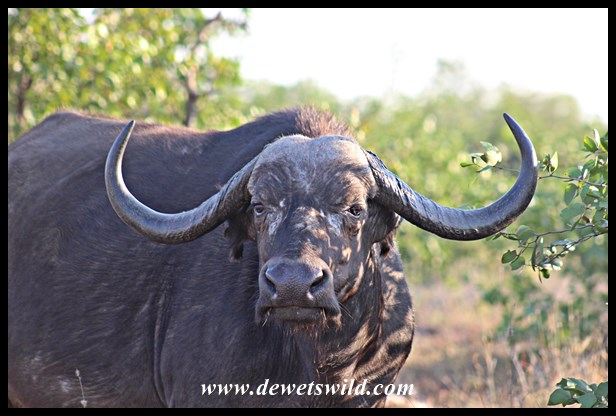
Probably due to the prevailing drought, we encountered very few buffalo in the five days we spent around Satara during our winter visit to the Kruger National Park. However, that all changed when we moved northwards to Mopani, where better winter grazing seems to have attracted even more of the huge herds of these bulky beasts than we would normally have expected to see in that region.

Hippos and Drought

The Kruger National Park is experiencing one of the worst droughts in recorded history, and the Satara area of the Park seems to be the worst affected of all.

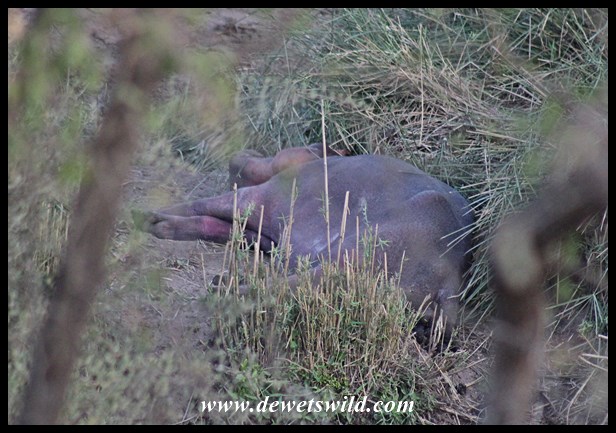
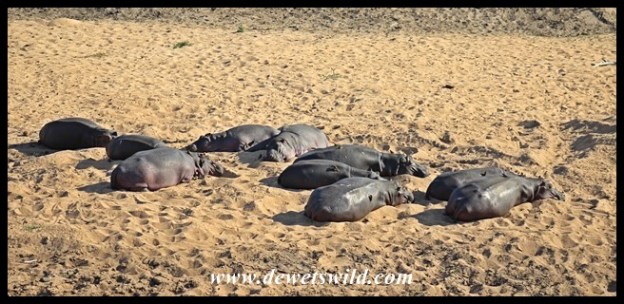
Of course, this has a tremendous impact on the water dependent hippopotamus. While there are still substantial pools of water remaining in man-made dams, stream and the large rivers, the lack of rain has meant that the available grazing around these water sources has been drastically denuded, causing the hippos to have to travel further and further to satisfy their considerable daily food requirement. For the first time I can remember, we encountered hippos spending the heat of the day out in the open veld, miles away from the nearest water.

On the second day of our winter 2016 visit, we noticed a hippo that had succumbed to the drought lying in a pool in the Nwanetsi River, just a few kilometers from Satara along the S100-road. Knowing that the carcass would soon start attracting predators intent on an easy meal, we decided to visit the sighting again that evening. Sure enough, we arrived to find a fairly large crocodile tearing at the bloating body. When the rest of the hippo pod occupying the pool started moving closer, we thought we were going to see them attack the crocodile to try and defend their fallen comrade. Bot nothing. They plodded past, barely giving the unfolding events a passing glance, almost as if resigned to the fact that they too will likely meet their end in this fashion, and leaving the crocodile to go about his gory business…

Harrowing as it was to witness, we had to remind ourselves that drought, and the deaths of the animals too old or weak to cope with the demands made by the difficult circumstances, is a part of the natural cycle in a wilderness like Kruger. We passed the same pool in the Nwanetsi again on our last afternoon at Satara, only to find that another emaciated member of this particular herd of hippos had lost the battle.

Drought Hippos (19)


Kruger Funnies

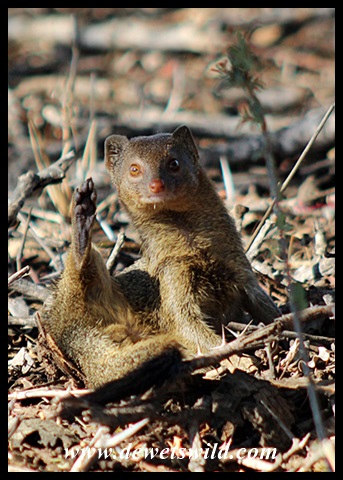
Before we get to some of the more dramatic stuff, let’s share a few funny shots taken during our recent winter visit to Satara and Mopani in the Kruger National Park.

Kruger’s Winter Babies

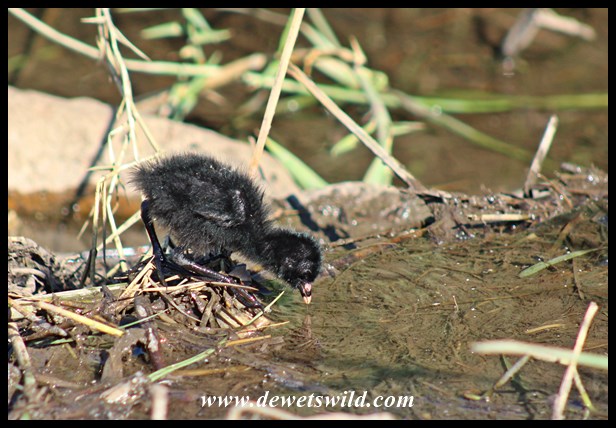
We thought we’d start the report back on our recent (winter 2016) visit to Satara and Mopani in the Kruger National Park by sharing a few of photos of some of the cute babies we encountered on our drives.

Black Heron

Egretta ardesiaca

One of the most interesting birds you could hope to see in action in South Africa’s wild places, is the Black Heron. It’s a smallish species, about 55cm long and less than 350g in weight. Their black plumage and bright orange-yellow feet make them easily recognisable.

Black Heron (10)

Black Herons roost and breed communally in reedbeds or trees, near or over water, with others of their own species, and other kinds of egrets, herons, cormorants and ibises. Nests are platforms built of twigs at the start of the rainy season, on which clutches of 2 to 4 eggs are incubated.

Black Heron (9)

They search for food, alone or in flocks of varying sizes, in rivers, swamps, lakes and estuaries, and feed predominantly on fish.

Black Heron

Black Herons occur widely in Sub-Saharan Africa, excluding the equatorial forests, The IUCN considers the species’ population stable and in no immediate danger of extinction, though they are highly threatened in Madagascar.

Black Heron (8)

A recent visit to Austin Roberts Memorial Bird Sanctuary afforded us the opportunity to enjoy up-close views of the Black Heron’s characteristic hunting method, knows as “canopy feeding“. The bird uses its wings to create an umbrella around its head, and then picks off fish and tadpoles beneath. This behaviour may serve a dual purpose of preventing glare from the water, making it easier to see their prey, and tricking the prey into thinking that the shadow is a safe hiding place. They are also known to wiggle their toes underwater to attract their fishy prey.

Waterhole meeting

There is always something interesting to see along the Mphongolo River, north of Shingwedzi Rest Camp, and the final afternoon of our recent visit to the Kruger National Park delivered another memorable sighting in this area. At one of the few pools remaining in the rived bed, and with temperatures peaking at a sweltering 40°C, a large herd of elephants and an equally sized herd of buffaloes were converging, and jostling for position at the water and mud (with the elephants obviously winning the contest). Hiding in the middle of the pool was a single crocodile, probably hoping and praying that none of the behemoths notice it!
________________________

If you enjoy de Wets Wild as much as we enjoy sharing our love for South Africa’s wild places and their denizens with you, please vote for us in the 2015 South African Blog Awards.

We’ve entered the categories for “Best Travel Blog” and “Best Environmental Blog”, and you are allowed to vote for us in both. Clicking on the badge below will bring you to the voting site.

SA Blog Awards Badge

Thank you very much for your support!

Almost orphans

On the 15th of December, making our way to Olifants Rest Camp, in fact just about a kilometer before the camp’s gates, we came across two tiny warthog piglets, probably not any older than a day or two. They were frantically running around in the road, squeeling to high heaven, and approaching every passing vehicle seemingly hoping that it was their mother.

It seemed they were abandoned and they were clearly in distress.

However, after spending a few minutes at the scene we noticed their mother hiding in the thickets, grunting to her little ones but probably frightened of the vehicles gathered around her babies. We decided to leave then, hoping that as soon as there were no more cars around she’d come and collect the errant piglets and take them back to the safety of her burrow.

When we passed the scene again a little later, the warthog family was nowhere to be seen and we hoped that the story had a happy ending.

________________________

If you enjoy de Wets Wild as much as we enjoy sharing our love for South Africa’s wild places and their denizens with you, please vote for us in the 2015 South African Blog Awards.

We’ve entered the categories for “Best Travel Blog” and “Best Environmental Blog”, and you are allowed to vote for us in both. Clicking on the badge below will bring you to the voting site.

SA Blog Awards Badge

Thank you very much for your support!

Surprise osprey at Shingwedzi

We were most excited to find an osprey, a rather uncommon bird in South Africa, fishing at a pool in the Shingwedzi River, just a few kilometers north of Dipene along the S50-route, during our recent visit to the Kruger National Park.

Osprey

It was just one of almost 200 bird species we identified on the ten day trip, and we’ll be telling you all about our visit and sharing many of the special wildlife encounters we enjoyed in the days and weeks ahead here at de Wets Wild!

________________________

If you enjoy de Wets Wild as much as we enjoy sharing our love for South Africa’s wild places and their denizens with you, please vote for us in the 2015 South African Blog Awards.

We’ve entered the categories for “Best Travel Blog” and “Best Environmental Blog”, and you are allowed to vote for us in both. Clicking on the badge below will bring you to the voting site.

SA Blog Awards Badge

Thank you very much for your support!