Category Archives: Memorable sightings

A day in Pilanesberg: Hour 6

We’re still on a high from our sighting of Rain the cheetah and her cubs when we turn from Nare Link into Sefara Drive in the Pilanesberg National Park, following the road uphill. Before we even crest the rise we become aware of the sound of thundering hooves moving at speed…

Buffaloes!”

The Park’s buffaloes are so seldomly seen that they’re known as the “ghosts of the Pilanesberg”, and any encounter with them is a thrilling treat. Even more so these particular buffaloes, as they are in quite a rush to get away as quickly as possible, allowing only a few photos as they run past us, thankfully without smashing into our vehicle. Was it us who scared them?

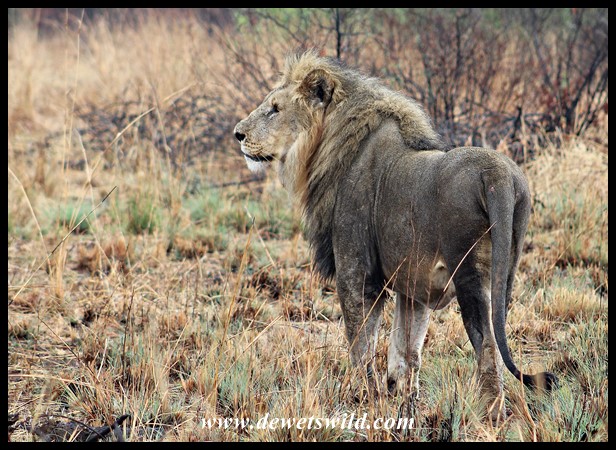
As the buffaloes stampede down into the valley, we get back our composure and drive on. We don’t get very far however before Joubert yells out, again, “Lions!” Could it really be our third lion sighting of the morning!?

Indeed, there obscured behind some twigs and branches, are a pride of 5 lions wrestling with a buffalo cow on the ground! Now the stampeding herd of buffaloes we saw half-a-minute ago makes perfect sense!

As the bellowing of the cow dies down, no longer to be heard above the sound of raindrops on the car’s roof, and her feverish kicking stops, it’s clear that the fight is all over. In the excitement it takes a while for me to figure out that if I drive past the scene we’d have a much clearer view of it looking back. Just as the feeding starts one of the younger lionesses gets up and walks off, presumably to collect the pride’s cubs to join the feast. While we wait almost an hour for her to return, she doesn’t, so the cubs must’ve been quite some distance away. In the meantime the sights and sounds of the lions tearing the buffalo cow open and apart is as bone-chilling as you can imagine.

And to think we’re only half-way through our day in the Pilanesberg!

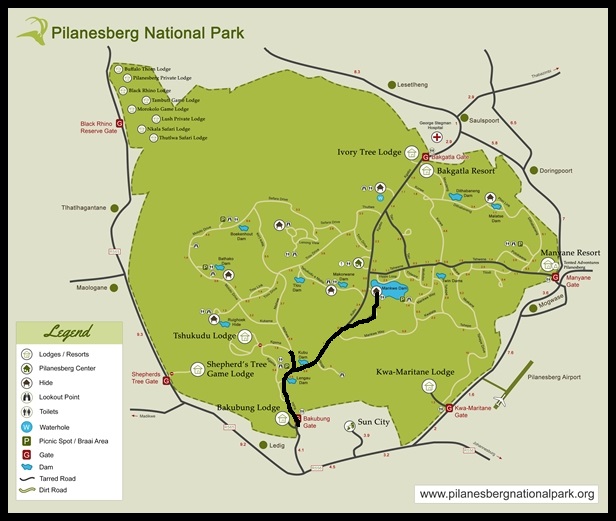
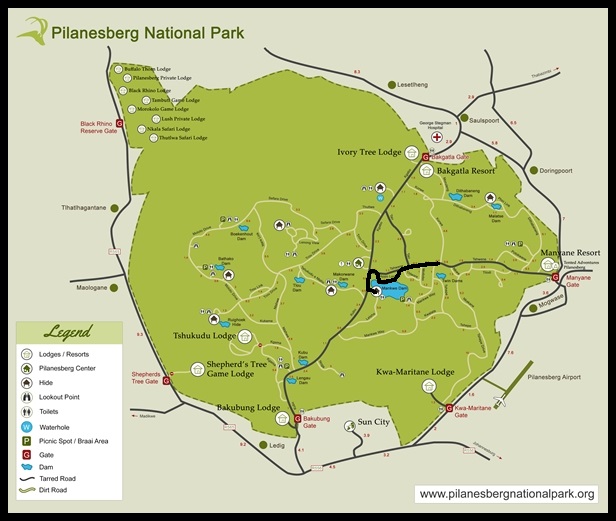
If you’d like to follow along as we explore the Pilanesberg, a map may come in handy (for a large format version click here)

Scene where we saw the buffaloes and lions on Sefara Drive

If you need to catch up on our drive through the Pilanesberg National Park, you can read all the previous posts here.

To be continued tomorrow.

A day in Pilanesberg: Hour 5

We’ve just been commenting on the scarcity of giraffe sightings so far into our day at the Pilanesberg National Park when we find ourselves in the middle of a giraffe roadblock on Tlou Drive.

It takes a bit of patient waiting before the giraffes clear the road for us. We turn off into Tshukudu e Ntsho Road to go and see what Makorwane Dam has in store for us. There’s a huge crocodile and a pod of hippos in the water, but a group of very noisy humans in the hide are spoiling the experience for everyone else and we don’t stick around for longer than necessary to use the ablutions. The view from the bridge over the stream feeding the dam is much more serene.

Back on Tlou Drive and then right on the Nare Link, there’s more wildebeest, red hartebeest and giraffes to see, and then…

“There they are! There they are!” Joubert sees the cheetahs first, some distance away from the road but thankfully out in the open and clearly visible despite the pouring rain. A female cheetah known, fittingly, as “Rain” and her three almost fully-grown cubs. We last saw Rain about 5 years ago, when she was still the only adult female cheetah in the Pilanesberg and already raising a litter of cubs. Since then the Park’s cheetah population has grown considerably, in no small part due to Rain’s success as a mother.

As we are watching the distant cheetahs this very wet black-shouldered kite is keeping an eye on us:

Soppy Black-shouldered Kite

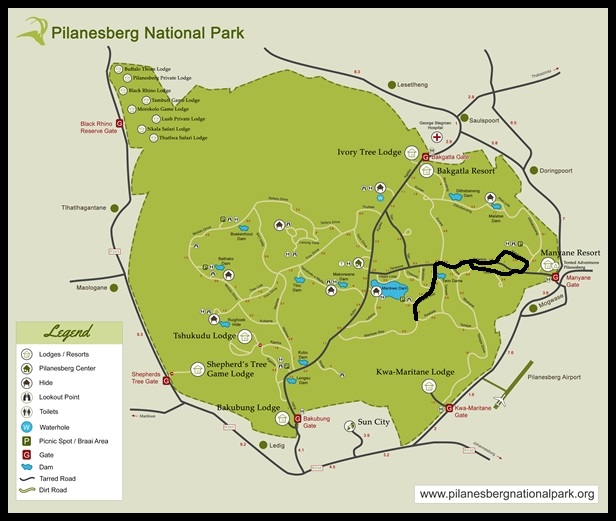
If you’d like to follow along as we explore the Pilanesberg, a map may come in handy (for a large format version click here)

Tlou Drive to Nare Link via Makorwane Hide

If you need to catch up on our drive through the Pilanesberg National Park, you can read all the previous posts here.

To be continued tomorrow.

A day in Pilanesberg: Hour 4

Mankwe Dam, a large man-made impoundment that holds water throughout the year and that’s a veritable magnet for wildlife, is located in the heart of the Pilanesberg National Park. On its banks you’ll find the Mankwe Hide, very popular with photographers and recently rebuilt after being destroyed in a veld fire. That is where we are headed next.

Back in the hide’s parking area this southern masked weaver is enjoying a bath in a small puddle- as if he is too scared to go swimming in the big pool on the other side!

Almost immediately after driving out of the parking area at the hide, we come across a pair of lions – our second lion sighting of the day and less than 200 steps from where we were standing outside our vehicle just a few seconds ago! Luckily, being a mating pair, their attentions are focused on satisfying other base instincts than finding food. Our day just keeps getting better!

Leaving the lions to their honeymoon, we head north along Kgabo Drive and take a left into Tlou. Along the way we add further to our list of birds seen, including this rufous-naped lark singing its lungs out from a prominent perch.

Rufous-naped Lark

Just as we get to the junction of Tlou and Thuthlwa drives we find another brown hyena, walking quite purposefully away from an old elephant carcass with a large chunk of bone in its jaws. We follow alongside until it disappears into a thicket, its destination remaining a mystery to us but we like to think that it is headed to a den with hungry youngsters waiting.

If you’d like to follow along as we explore the Pilanesberg, a map may come in handy (for a large format version click here)

Mankwe Hide to Tlou Drive

If you need to catch up on our drive through the Pilanesberg National Park, you can read all the previous posts here.

To be continued tomorrow.

A day in Pilanesberg: Hour 3

As we’re driving away from the sight, and smell, of Mavuso’s carcass we find ourselves on Mankwe Way, one of the most productive game-viewing routes in the Pilanesberg National Park. And today this scenic road certainly lives up to its reputation. What is it that Joubert has in his sights?

What is Joubert photographing?

Yes, our first lion encounter of the day. Why exactly this female chooses to lazily lie down out in the pouring rain is anyone’s guess. At one point she gets up and we’re relieved that finally she had some sense infused, but she only wants to turn around… Perhaps she thought it rude to be lying with her back to us?

Eventually we move off again, leaving the lioness to her shower. It continues to rain softly as we drive along Mankwe Way and Letsha Drive, spying kudu, zebra, wildebeest, impala and several kinds of birds on our way towards Mankwe Dam in the centre of the Park.

If you’d like to follow along as we explore the Pilanesberg, a map may come in handy (for a large format version click here)

Mankwe Way and Letsha Drive

If you need to catch up on our drive through the Pilanesberg National Park, you can read all the previous posts here.

To be continued tomorrow.

A day in Pilanesberg: Hour 2

We pick up our recollections of our day trip through Pilanesberg National Park at the the junction of Kwalata Road and Mankwe Way which was, on the 28th of August 2020, the scene of a deadly battle between two elephant bulls. Sadly Mavuso – a dominant bull that was brought to Pilanesberg National Park from the Kruger National Park back in 1999 and estimated to be around the mid-50’s in age – was killed in the fight. We were fortunate to have seen the gentle giant during a previous visit in November 2018.

Pilanesberg’s late tusker Mavuso, seen in November 2018

Mavuso’s massive carcass has been a magnet for scavengers since the unfortunate end to the fight, and it is amazing to think that even now six weeks later there’s still ample carrion available to attract the attention of black-backed jackals and brown hyenas. Apart from quickly popping in at the Fish Eagle Picnic Site for a body-break and a freshly made mug of coffee we spend almost an hour at the carcass watching the fascinating interaction between the scavengers. The pictures are gory, but trust me when I say that the smell is even more so!

If you’d like to follow along as we explore the Pilanesberg, a map may come in handy (for a large format version click here)

Kwalata to Fish Eagle and back

If you need to catch up on our drive through the Pilanesberg National Park, you can read yesterday’s post covering the stretch from Kwa Maritane Gate to Kwalata Road here.

To be continued tomorrow.

A day in Pilanesberg: Hour 1

We’ve just entered the Pilanesberg National Park through the Kwa Maritane Gate and following Tshepe Drive deeper into the Park.

As happens more often than not, the first animals we encounter are impala, followed soon after by a small herd of blue wildebeest. We notice that the winter fire season burned large tracts of land, but take heart from the flush of new green shoots poking through the blackened earth, and have no doubt that the continued drizzle we were driving through would boost the new growth enormously. Next sighting is the first of Africa’s “Big Five“: a nice big elephant bull and, not half-a-kilometre further, three more. Before we reach the junction of Tshepe Drive with the Nkakane road, 10km from the gate, a small herd of plains zebra, mixing with more impala, is our next “tick” before seeing yet another elephant, this one scaling a rocky hillside some distance from the road.

It’s a further 3km to the left turn into the Kwalata road, during which we’re not only excited by beautiful scenery (despite the gloomy weather), lots of birds beginning to appear and the sight of a small herd of rare tsessebe but also by fresh lion tracks appearing in the wet sand on the road every so often. This particular lion however did not want to be seen…

As we’re merrily driving along Kwalata road, enjoying each other’s company and regular sightings of more impala, we’re flagged down by the driver of a safari vehicle with some very wet tourists in the back. He wants to know whether we’ve come from Kwa Maritane’s side. “Yes”, we answer. “Any cats?” he asks, obviously desperate to make his shivering clients’ ordeal worth their while (and money). “Not yet!”, we answer. Turns out all he should have done was to follow Joubert and me around the rest of the day…

If you’d like to follow along as we explore the Pilanesberg, a map may come in handy (for a large format version click here)

Kwa Maritane Gate to Mankwe Way via Tshepe and Kwalata

To be continued tomorrow.

Pilanesberg for a day

Yesterday, Joubert and I slipped away for a day visit to the Pilanesberg National Park. We’ll soon be telling you all about our amazing day in the bushveld, but until then we’ll share this little teaser of what’s in store.


The bloody fight that never was

At the end of our Satara Summer, on the way to the Kruger National Park’s Orpen Gate from where we were to head back home to Pretoria, we were lucky to see a lone Cheetah resting in the shade of a small thorn tree. Having stopped for a last photo or two, it was Marilize who noticed a Spotted Hyena heading straight towards the Cheetah. Knowing just how hateful the relationship between Africa’s large predators are, we were sure we were probably going to witness a tremendous fight when the two meat-eaters meet, especially when the Cheetah noticed the Hyena, snarled at it viciously, and got up to defend its turf. But turns out this Hyena was not a fighter; he walked straight past the Cheetah as if it wasn’t even there, and not paying the cheetah’s tantrum any attention whatsoever. It was rather amusing seeing the Cheetah standing by himself, looking decidedly confused, as the Hyena disappeared from view…

Waiting hours for a glimpse at a White Lion

White Lions are exceedingly rare and especially so in the wild. Several zoos, “safari parks” and circuses around the world house White Lions, but these are often horribly inbred. These lions are not albinos, instead being the result of a mating between two lions carrying a recessive gene for white (leucistic) fur instead of the usual tawny colouration. Naturally White Lions are only ever found, from time to time, in South Africa’s Lowveld, where the Kruger National Park and a few renowned private nature reserves are situated. As far as wild White Lions are concerned, at present, there are known to be two young white cubs in the same pride that roam around Orpen in western Kruger and the adjacent Timbavati reserve, and a single young male born to a pride near Satara and fairly wide-roaming since he and his brothers were ejected from their natal pride.

It is this latter individual that we came across on the 3rd of January 2020, the final full day of our Satara Summer. Having fairly often visited the Kruger National Park my entire life, it was always my, hitherto unfulfilled, wish to see a truly WILD White Lion, so you will appreciate just how excited we were at this opportunity! It was an exceedingly hot day, and on hot days lions are seldom very active. So we sat for hours in our vehicle in the blazing sun, waiting, hoping, that he might get up, and move around just a little, so that we can get more than just a glimpse. He obliged, for a minute or two only, to move from the large tree where he was lying with his three brothers to a smaller shrub a few meters away. That was it. He didn’t move again until we had to leave to get back to camp before the gates closed. But we were thrilled and grateful for the chance to see such an enigmatic animal.

While they can not be considered wild, there is a pride of White Lions on view at the Rhino & Lion Nature Reserve near Johannesburg.

A most memorable encounter with Leopards

The 2nd of January 2020, almost at the end of our Satara Summer, delivered one of the most memorable sightings of the month we spent in the Kruger National Park. About half-way between Satara and Olifants we came across this pair of Leopards, and did they put on a show to remember! Trust us; seeing Leopards like THIS happens only very rarely…