Round about 04:45am on Saturday, the territorial rasping of a leopard really close lured Joubert and me out of our cosy tent into the cold winter morning air at Tlopi Tented Camp. Try as we might using our spotlight and headlamps the big cat remained unseen, so we warmed ourselves with hot drinks, waiting for the first rays of sunshine to appear. It was the morning of Marilize’s milestone birthday, and unfortunately this coincided with South Africa experiencing a “third wave” of Covid-19 infections precluding any big commemoration with the extended family and friends. It was up to me and Joubert to make the event memorable, so we surprised Marilize with a weekend breakaway to Marakele National Park.
First light made an appearance around 06:20 and a stream of birds started arriving at the dam – first a few double-banded sandgrouse, then a hadeda and a pair of egyptian geese, waking up the arrow-marked babblers in the tree shading our tent. It was only at 08:10 that the sun first peaked over the cliffs of the Waterberg towering over Tlopi and started heating up the crisp air. Somewhere in between Marilize joined us on the deck of our safari tent.

One of the most active actors on the dam stage was a pied kingfisher that regularly made attempts at dive-bombing fish in the shallow water, and was very successful at it too, providing us excellent views and photographic opportunities from very early on in the day.

Pied Kingfisher diving into the water at Tlopi (photo by Joubert)

Pied Kingfisher diving into the water at Tlopi (photo by Joubert)

Pied Kingfisher diving into the water at Tlopi

Pied Kingfisher diving into the water at Tlopi

Pied Kingfisher with its catch

Pied Kingfisher with its catch

Pied KIngfisher hovering above the dam at Tlopi

Pied KIngfisher hovering above the dam at Tlopi

Pied KIngfisher hovering above the dam at Tlopi

Pied KIngfisher hovering above the dam at Tlopi

Pied KIngfisher hovering above the dam at Tlopi

Pied KIngfisher hovering above the dam at Tlopi
There appears to be a very healthy population of bushbuck in the thickets around Tlopi. They regularly ventured out into the open to drink and feed in and around the dam.

Bushbuck Ram just outside the entrance into Tlopi Tented Camp

Bushbuck ewe

Bushbuck ewe (photo by Joubert)

Bushbuck ewe wading into Tlopi’s dam to feed on water plants

Bushbuck ewe

Bushbuck ewe crossing the shallows of Tlopi’s dam

Bushbuck ewe crossing the shallows of Tlopi’s dam

Bushbuck ewe and lamb
Throughout the day a family of tawny-flanked prinias put in regular appearances:

Tawny-flanked Prinia

Tawny-flanked Prinia

Tawny-flanked Prinia

Tawny-flanked Prinia

Tawny-flanked Prinia

Tawny-flanked Prinia

Tawny-flanked Prinia (photo by Joubert)

Tawny-flanked Prinia
The vervet monkeys had us laughing. As soon as they spotted anything on our deck that appeared to be food they could steal – and seeing as we were celebrating a birthday it must have seemed like a feast to them – they’d arrive from all corners, including from across the dam, to come and try their luck, in vain.

Vervet monkey waiting for a gap at our tent in Tlopi Tented Camp

Vervet monkey waiting for a gap at our tent in Tlopi Tented Camp

Vervet monkey jumping across the stream feeding into Tlopi’s dam

Vervet monkey jumping across the stream feeding into Tlopi’s dam

Vervet monkey jumping across the stream feeding into Tlopi’s dam

Vervet monkey jumping across the stream feeding into Tlopi’s dam

Vervet monkey jumping across the stream feeding into Tlopi’s dam

Vervet monkey jumping across the stream feeding into Tlopi’s dam

Vervet monkey waiting for a gap at our tent in Tlopi Tented Camp (photo by Joubert)
There truly is no need to venture out of Tlopi Tented Camp to go and look for Marakele’s wild inhabitants – there is a constant queue of animals and birds arriving at the dam in front of the camp, and around your tented accommodation, that would keep any nature lover enthralled all day long.

Reed Cormorant (photo by Joubert)

Hamerkop

Egyptian Geese (photo by Joubert)

Three-banded Plover

Emerald Spotted Wood Dove

Black Crake

Brown-hooded Kingfisher

Dark-capped Bulbul

Bushveld Orange Tip butterfly

Egyptian Goose

Speckled Rock Skink

Cape Wagtail

Blue Waxbills

Yellow Pansy butterfly on dry rhino dung

Brown-veined White in what I think is an Albizia (False Thorn) bush

Cape White-eyes and Dark-capped Bulbuls sharing a drink

White-fronted Bee-eater in flight

Long-billed Crombec

Jameson’s Firefinch

Green-winged Pytilia taking refuge from the midday sun

Cinnamon-breasted Bunting

Black Stork (photo by Joubert)

Grey Go-Away Bird

Hamerkop

Common Dwarf Gecko

Yellow-fronted Canary

White-browed Scrub Robin

Natal Spurfowl
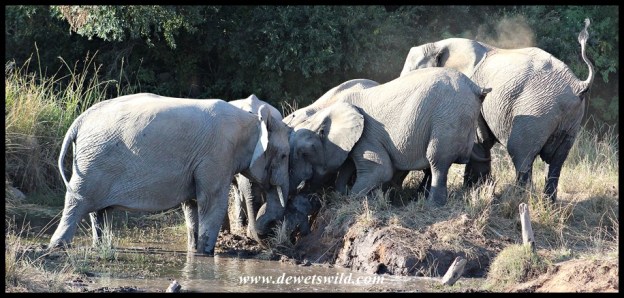
From about 14:00 in the afternoon, two herds of elephants made their way past the camp to the dam. They spent quite a while enjoying the water and the greenery around the dam, allowing us to take photographs of them to our hearts’ content. The little ones were especially endearing. Be sure to catch our next post to see what drama erupted next to the dam thanks to the elephants!

Big elephant bull in musth

Joubert eyeing a bull elephant at Tlopi Tented Camp in Marakele National Park

Elephants arriving at Tlopi’s dam

Elephant

Cute little elephant testing the air

Helping a reluctant friend cross the stream

Helping a reluctant friend cross the stream

Learning by imitating the grown-ups

Shaking off the dust from his ears (photo by Joubert)

This grass is so soft to lie on!

Young elephant trying to chase away the birds at the water’s edge

Practicing her balance! (photo by Joubert)

Practicing her balance! (photo by Joubert)

Making a splash

Elephant cow that’s had enough to drink now

Arriving at the water’s edge

The second herd of elephants were much bigger than the first

Matriarch of her herd

Ears peaked in irritation (photo by Joubert)

Ears peaked in irritation

Ears peaked in irritation (photo by Joubert)

Taking that first step across the stream

Big Bull

Big Bull (photo by Joubert)

Tiny youngster crossing next to mom (photo by Joubert)

Tiny youngster crossing next to mom (photo by Joubert)

Tiny youngster crossing next to mom

Tiny youngster crossing next to mom

Tiny youngster crossing next to mom

Tiny youngster crossing next to mom

Tiny youngster crossing next to mom

Tiny youngster crossing next to mom
At the end of a beautiful and happy day, with the sun setting to the west of Tlopi while the smoke from our evening braai (barbeque) wafted on the slight breeze, Joubert set up his camera for a few night shots after it went dark.

Sunset at Tlopi, with the smoke from our braai fire wafting over the dam

Sunset at Tlopi

Early evening at Tlopi (photo by Joubert)

The Milky Way above our tent (photo by Joubert)
To be continued…















 DeWetsWild