Category Archives: Kruger National Park

Red-billed Quelea

Quelea quelea

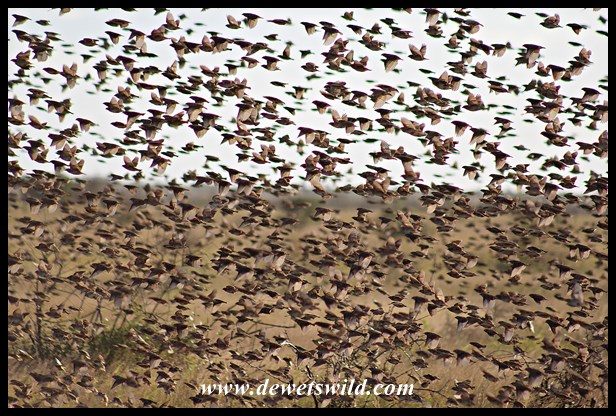
Some of the most impressive sights of our recent visit to the Satara area of the Kruger National Park was the enormous flocks of Red-billed Quelea occupying the grasslands of the central plains. Following the good rains that bought respite from an awful drought, the savannas are heavy with a rich harvest of seeding grasses, and literally millions of the little birds are making the most of the abundant foodsource. When their population reaches a peak, as it currently has, there could be as many as 33-million Red-billed Queleas swirling in cloudy swarms over the Park!

The Red-billed Quelea is a small (20g) seed-eating sparrow-like nomad inhabiting grasslands and grainfields (causing enormous losses to farming communities). Swarms that could number in the millions descend on watering holes at least twice daily. While feeding they “roll” over the grasslands in a wave-like motion, most impressive to witness! While seeds make up the vast majority of their diet they do catch small insects as well, especially when raising chicks.

Nesting occurs communally in the rainy months and hundreds, even thousands, of nests are woven per tree (prefers thorn trees) by the males. Breeding colonies could consist of more than 2 million monogamous pairs, and is a magnet for every imaginable predatory bird, reptile and mammal that is large enough to take adults and chicks. Clutches normally number three eggs and the female incubates them for only 12 days, whereafter the chicks fledge within another two weeks!

The Red-billed Quelea may well be the most abundant bird on the planet, with an estimated population as large as ten billion, and as such is considered as being of least concern by the IUCN. It occurs widely in the savannas of Sub-Saharan Africa and can be found in every one of South Africa’s provinces, where it must number in the hundreds of millions.

(The photos in the following gallery were taken on visits to the Kruger Park and elsewhere)

de Wets Wild turns five!

We’re fresh back from a wonderful breakaway in the Kruger National Park, and of course have lots to share with you from our latest trip to the bush, so stay tuned!

Today also marks the fifth birthday of de Wets Wild – Thank you to everyone who has supported and encouraged us along the way!

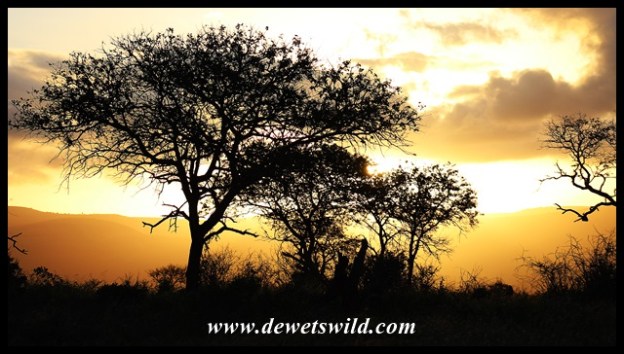
Sunset at Satara


African Bullfrog

Pyxicephalus edulis

While I doubt it reached proportions that would convince the Pharaoh to allow the Israelites to leave Egypt, the “eruption” of little froglets we saw at uMkhuze Game Reserve during our recent visit was quite fascinating. Rain or shine, literally hundreds (if not more) of tiny frogs could be seen jumping around on the roads all over the reserve, making driving quite tricky if you didn’t want to squash them under the vehicle’s wheels.

Thanks to the help of the iSimangaliso Wetland Park the little ones were identified as juvenile African Bullfrogs (also known as Edible or Lesser Bullfrogs), a species that occurs over wide areas of Eastern, Central and Southern Africa, and indeed is eaten by humans in many countries where they occur. Though these newly metamorphosed juveniles were only about the size of a thumbnail, the African Bullfrog can grow to 12cm in length.

African Bullfrog

They can be found in seasonally flooded savannas and grassy woodlands, remaining dormant underground for most of the year (up to 10 months) and emerging only when sufficient rain has fallen for breeding to commence. During the breeding season males act very aggressively towards one another and will even kill each other. Eggs are laid in well vegetated, shallow, seasonal bodies of water where the males guard the eggs and tadpoles against other males and predators. Interestingly, when the tadpoles’ pools start drying up the males will dig channels to deeper pools. African Bullfrogs feed on a variety of invertebrates and small vertebrates, including other frogs, and feature in turn in the diets of various species of birds, reptiles and mammals (humans included).

During a visit to the Kruger National Park in December 2019 we witnessed the breeding habits of the African Bullfrog following a few days of continuous rain.


Two days in Kruger

How much can you see in only two days in the Kruger National Park? Well, as this gallery taken over less than 48 hours around Skukuza Rest Camp during March 2017 proves, a whole lot actually!


Skukuza Nightlife

One of our favourite activities when out visiting South Africa’s wild places is to search the grounds of the places where we are staying with a flashlight at night, looking for nocturnal wildlife. Skukuza, being the biggest of the camps in the Kruger National Park, is usually especially productive, as most of the wildlife inhabiting the camp is exceptionally used to having humans gawking at them!

The pond in front of Skukuza’s reception is a wonderful place to photograph a variety of amphibians – on our latest visit the reeds and rocks there were alive with the calls of male Painted Reed Frogs and Sharp-nosed Grass Frogs trying their best to impress their female counterparts.


Playing hide-and-seek with a leopard

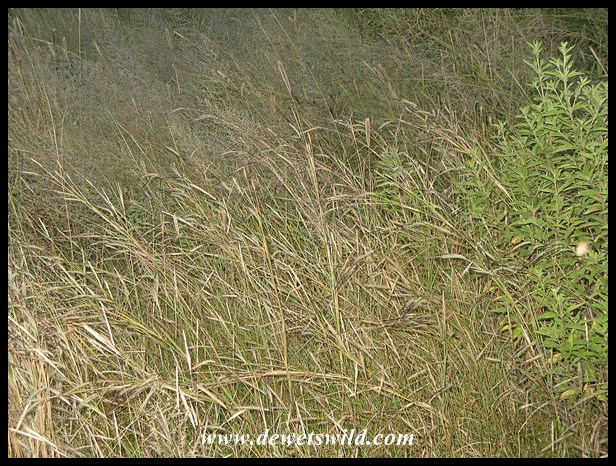
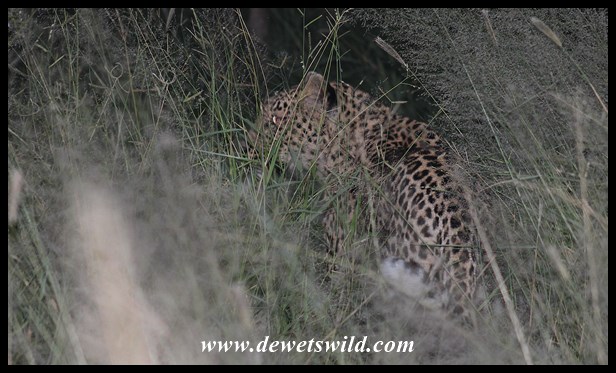
Believe it or not, but in the middle of this picture there’s a leopard hidden in the grass. Don’t worry; If I didn’t see her walk in there I wouldn’t have known it either.

Luckily she grew tired of her hiding spot, got up and walked into even denser vegetation, allowing just one quickly fired shot as proof…

This leopard was lying not two meters from our car and was totally invisible – what wonderful camouflage these cats have!

(Seen along the H3-road just south of Skukuza on Friday last week as we were departing from the Kruger National Park)

Alone time with the King of Beasts

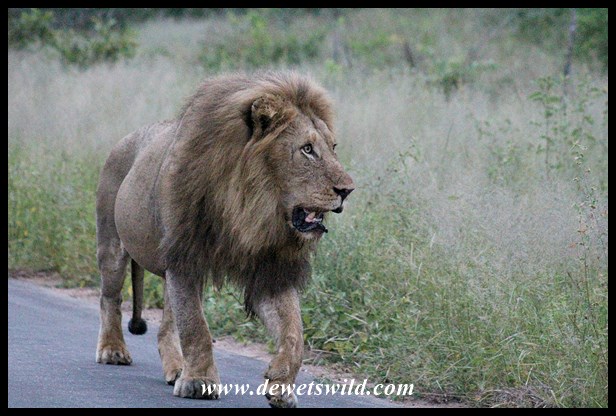
A week ago, on an early morning drive along the Sand River near Skukuza in the Kruger National Park, this magnificent male lion popped out of the thickets to patrol and mark his territory along the road.

After spending quite a bit of time with him as he walked at pace along the river road, mostly within arm’s length of the vehicle, another car arrived on the scene, and I drove off in order to allow them the thrill of some alone time with The King as well.

Fresh out of the bush

We’re fresh back from visits to the Kruger National Park and uMkhuze Game Reserve (part of the iSimangaliso Wetland Park) and of course we have lots of photos and stories to share – so stay tuned!

We’ll also be catching up with all the comments you’ve left for us while we were away in the coming days, I promise!

Our 2016 in pictures

Looking back on another year of enjoying South Africa’s beautiful wild places!

Them Big Old Bulls

What better way to wrap up the report back on our winter visit to the Kruger National Park‘s Satara and Mopani Rest Camps, than to appreciate those majestic elephant bulls that roam the Lowveld!