Natal Acraea Butterfly

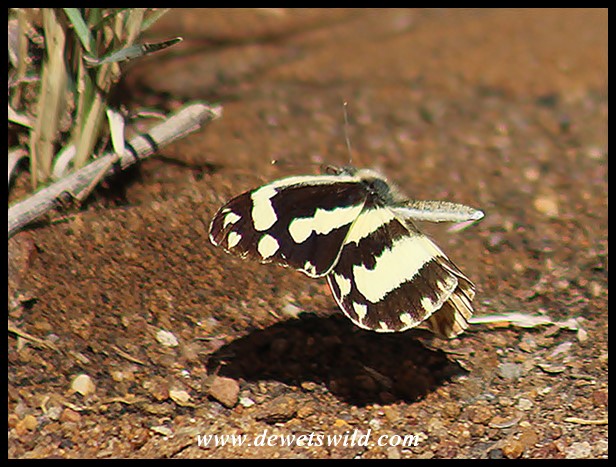
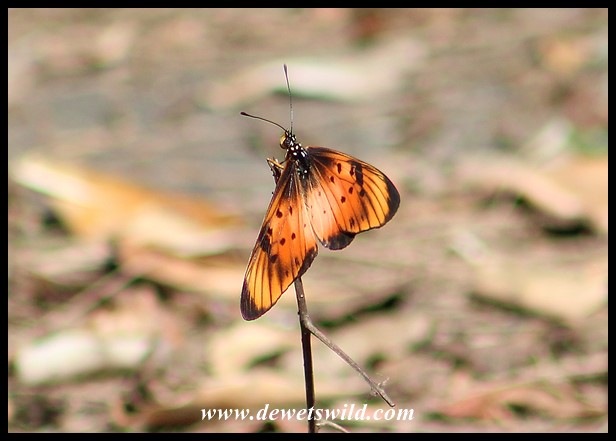
Acraea natalica

The striking Natal Acraea is a medium-sized butterfly with a wingspan of between 5 and 7cm. In South Africa it occurs commonly through all our northern and eastern provinces, where it is found in forest and savanna habitats. Like most others in the genus the Natal Acraea flies slowly and settles often on flowers, its seemingly lackadaisical attitude being a clue to the fact that it is foul tasting and avoided by predators.

Rattling Cisticola

Cisticola chiniana

The Rattling Cisticola occurs in savannas, especially those dominated by thorny trees and bushes, and woodland. It feeds mainly on insects and other invertebrates, but have also been observed taking nectar from aloes.

Rattling Cisticolas are usually seen in monogamous pairs or family groups, and breed in spring and summer. They construct ball-shaped nests near the ground in a shrub or tuft of grass. The female takes sole responsibility for incubating the clutch of 2-5 eggs for 2 weeks, with the chicks leaving the nest about the same length of time after hatching. Adults are approximately 15cm long and weigh around 16g.

According to the IUCN the Rattling Cisticola is of least concern, and it occurs from Ethiopia southwards. In South Africa it is commonly found through most of Kwazulu-Natal, in Mpumalanga, Limpopo, Gauteng, North West, the eastern reaches of the Northern Cape and the north-western parts of the Free State, often being one of the most numerous bird species where they’re found.

Bushveld Gardenia

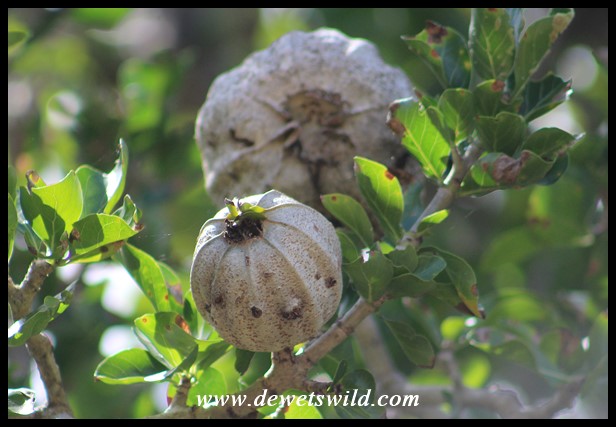
Gardenia volkensii

The Bushveld Gardenia is a small to medium-sized shrub or tree growing to a height of up to 10m and with its spreading branches often reaching down to the ground. The large, white flowers (older flowers turn yellow) have a sweet aroma and are carried from July to December. They open at night and are probably pollinated by moths. The leaves of the Bushveld Gardenia are browsed by a wide range of animals, including giraffes and kudus. The hard fruit ripen between December and April and are favoured by primates, antelope and elephants.

In traditional medicine the Bushveld Gardenia is used to treat intestinal parasites, while the hard wood is used for carving ornaments and utensils.

The Bushveld Gardenia grows in savanna and open woodland and in South Africa occurs through much of Kwazulu-Natal, Mpumalanga, Limpopo, Gauteng and North West Province.

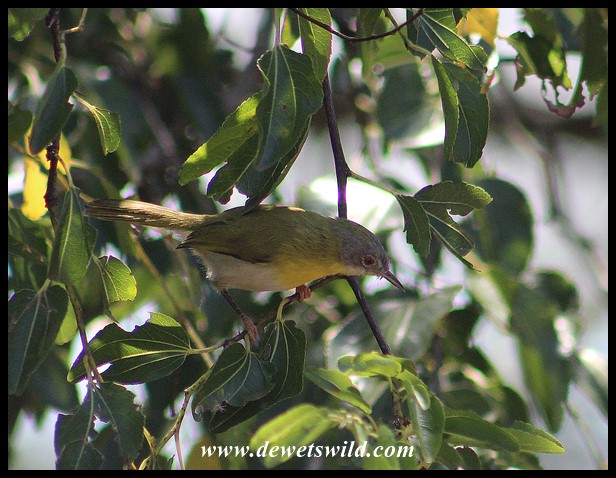
Grey-backed Camaroptera

Camaroptera brevicaudata

Many authorities, including the IUCN and Birdlife International, consider the Grey-backed Camaroptera to be the same species as the Green-backed Camaroptera (Camaroptera brachyura), and hybrids between the two are recorded from time-to-time. In South Africa the Grey-backed Camaroptera occurs mainly in the North West Province, Gauteng and Limpopo, where it inhabits thickets and riverine vegetation in the savanna biome and feeds on a wide variety of invertebrates. These are shy birds, usually encountered singly or in pairs, that rarely ventures from low, dense vegetation.

Their nests are constructed of living leaves woven and stitched together into a ball shape low to the ground in dense foliage. The nesting season stretches through spring and summer and into early autumn, with clutches of 2-4 eggs being incubated over a two week period. The chicks leave the nest when they’re approximately two weeks old – even before they can fly. Fully grown, the Grey-backed Camaroptera weighs around 10g and measure about 12cm long.

Large-leaved Rock Fig

Ficus abutilifolia

Seen growing on rocky outcrops and cliffs from northern Kwazulu-Natal through Mpumalanga and Limpopo to North West Province (and beyond our borders as far afield as Guinea in the west and Somalia in the north-east), the Large-leaved Rock Fig is an easily noticed and impressive tree not necessarily for its size but because it is capable of flourishing in apparently precarious locations and of splitting rocks with its roots. These trees seldom grow taller than 5m, though their roots can stretch up to 60m deep!

In keeping with many other kinds of fig, the Large-leaved Rock Fig is pollinated by wasps. Ripe fruit are much sought after by frugivorous birds, bats and primates (humans included!), and antelope and wild pigs are very fond of figs that have fallen to the ground. Though their use in a garden is limited due to the strong and expansive roots, these trees work excellently as bonsai.

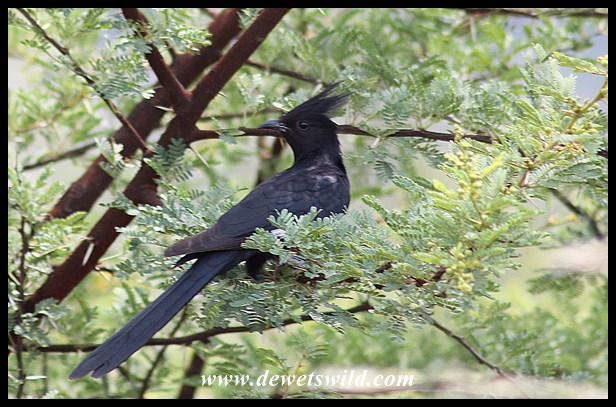
Meves’s Starling

Lamprotornis mevesii

A bird of riverine forests and floodplains with mature woodland, the Meves’s Starling (or Longtailed Starling) subsists on a diet of insects, fruits and flowers, foraged mostly on the ground. Adults measure approximately 34cm long, including the very long tail, and weigh around 75g.

These striking birds breed in spring and summer, building their nests inside cavities in trees – often using the same nest in successive years. The female takes sole responsibility for incubating the clutch of 3-5 eggs, which usually takes just short of 3 weeks, but both parents are involved in rearing the chicks, which fledge when they’re about 3 weeks old.

Meves’s Starling has a limited distribution in southern Africa – from Zambia and Malawi south to the Limpopo Valley on the border of South Africa with Botswana and Zimbabwe, meaning that the Mapungubwe National Park and the Pafuri region of the Kruger National Park is the most accessible locations in our country to go looking for them. The IUCN lists this species as being of least concern.

Black-faced Waxbill

Estrilda erythronotos

The Black-faced Waxbill is a tiny finch (12cm in length and weighing only about 10g), living in dry, thorny savannas with ready access to reliable waterholes and perennial streams. They feed mainly on seeds, supplementing their dietary intake with small invertebrates, berries, flowers and nectar.

Black-faced Waxbills are usually seen in pairs or small groups. During the breeding season, which peaks in late summer, pairs hold small territories and build together at the ball-shaped grass-nest, which has a long entrance tunnel at the bottom, well hidden in the tops of thorny trees. Both parents incubate the clutch of 2-6 eggs, which hatch within two weeks. The chicks leave the nest when they’re about 3 weeks old and stay with their parents for another two weeks or so before becoming fully independent.

The Black-faced Waxbill occurs in two separate parts of Africa, the one in East Africa stretching from Tanzania to Somalia and the other in Southern Africa (mainly South Africa, Namibia, Botswana and Zimbabwe extending marginally into Zambia and Angola). In our country specifically they are commonly found in the western half of Limpopo, the North West Province, Gauteng, the northwestern Free State and eastern reaches of the Northern Cape. The IUCN considers the Black-faced Waxbill to be of least concern.

Rietvlei on a winter’s day

Just some photographs from a serene Sunday spent in our local Rietvlei Nature Reserve yesterday.

Marakele National Park

Marakele National Park – the Setswana name meaning “Place of Sanctuary” – traces its existence to the proclamation of a 150km² tract of the Waterberg as the Kransberg National Park in 1986. Over the years, more land was added and today the expanded protected area known as the Marakele National Park covers 670km² of bushveld plains and soaring mountains.

Without a doubt the highlight of a visit to Marakele is the vista from Lenong Viewpoint high up on the mountain.

Marakele’s name is well deserved, considering that it is home to 91 kinds of mammals (including the famed “Big 5), 363 kinds of birds (including an important colony of Cape Vultures), at least 62 species of reptiles, 27 amphibians and as many as 20 species of fish.

The South African National Parks provides a range of overnight options to suit almost every taste and budget in the malaria-free Marakele National Park. Bontle Rest Camp is located just a kilometre into the Park, very near the main gate and reception office. Here guests can camp in their own tents and caravans or rent one of the fully self-contained safari tents that sleep either 2 or 4 people. The camp is unfenced and regularly visited by various kinds of animals and birds. Guided drives and walks can be arranged through the reception office, and a swimming pool was added to the camp’s facilities in March 2023.

Motswere Cottage, in a remote woodland corner of the Park, is the most secluded option available to overnight guests. It is a revamped farmhouse that can accommodate groups of up to 8 guests.

Motswere Cottage, Marakele National Park

Tlopi Tented Camp is Marakele’s most popular accommodation option, with the ten two-bed tents (an additional stretcher is available for kids) situated beautifully on the bank of a dam that attracts a constant parade of wildlife day and night.

The Thutong Environmental Centre provides dormitory-style accommodation for up to 128 people and is ideal for big organised groups from family reunions to schools and church groups.

Remember that DeWetsWild will gladly assist you with a reservation and planning if you’re interested in visiting Marakele National Park and making the most of your visit, whether you intend staying at Bontle, Tlopi, Motswere or Thutong.

Marakele National Park is within easy reach of Gauteng’s major urban centres, lying just 220km north of Pretoria along good tarred roads. The town of Thabazimbi, just 10km from Marakele’s gate, provides all the necessary amenities one might need, from shops and fuel stations to medical facilities. Inside the Park guests are able to explore along a network of rough gravel roads, with the route up to Lenong viewpoint being the only stretch of tarred road in the Park.

Mapungubwe National Park

The treasure we know today as the Mapungubwe National Park and World Heritage Site has a troubled recent history. In 1918 already the corner of our country where the borders of South Africa, Botswana (then the British protectorate of Bechuanaland) and Zimbabwe (then still the British colony of South Rhodesia) met was set aside as a botanical reserve due to the area’s unique plant communities. It soon became known as the Dongola Botanical Reserve. In March 1947, with its size much reduced to placate the local farming community, the South African government proclaimed the Dongola Game Reserve at the confluence of the Shashe and Limpopo Rivers. A change in government the following year however resulted in the fledgling conservation area being deproclaimed in its entirety almost immediately. A tiny portion of it, surrounding the Mapungubwe Hill, became a provincial nature reserve, Vhembe, in 1967. Then, in 1995, with South Africa now a multiracial democracy and Botswana and Zimbabwe independent countries in their own right, and after many years of a strict military presence on the border, this arid corner of our country was once again afforded the highest level of protection as the Vhembe-Dongola National Park. In September 2004, the park was opened to visitors and renamed the Mapungubwe National Park, in recognition of the fact that this area and its rich cultural heritage centred on Mapungubwe Hill was inscribed as a World Heritage Site the year before.


Mapungubwe’s human history dates back to hundreds of years before the colonial period however and is extremely fascinating. Visits to the interpretive centre near the gate and the archeological site on Mapunguwe Hill are not to be missed. Read more about it here.

Today, Mapungubwe covers 28,000 hectares and consists of two distinct parts, with private farming land isolating the two sections. Both sections adjoin the Limpopo River; the eastern portion is rugged and hilly – with beautiful baobab trees – while the western section is flat and dominated by a very different community of plants. Mapungubwe’s an arid place, with average annual rainfall below 400mm and summer temperatures that easily soar above 40°C.

Poacher’s Corner is an especially beautiful stretch of road through the riverine forest on the southern bank of the Limpopo.

Near Poacher’s Corner is Zebra Pan, itself a delightful place to park your vehicle and gawk at the constant stream of wildlife

The Maloutswa Pan and Hide in the west of the Park is yet another great spot to spend a few peaceful hours waiting for the birds and animals to come quench their thirst within easy reach of your lens.

Set atop a hill several lookout decks have been constructed from which to view the confluence of the Shashe and Limpopo Rivers where the borders of the three countries meet. Near the car park there are also a few picnic tables and braai (barbeque) stands which are very popular with visitors to Mapungubwe.

The Treetop Walk on the bank of the Limpopo River is another place visitors to Mapungubwe National Park should not miss.

Mapunbuwe is home to a rich variety of wildlife, with records indicating a tally of 34 fish species, as many as 36 kinds of frogs, up to 75 species of reptiles, 460+ species of birds and 94 species of mammals, including the famed “Big 5“.

The South African National Parks provides an assortment of self-catering accommodation options in Mapunguwe National Park, ranging from camping sites at Mazhou in the riverine forest along the Limpopo River to the top-of-the-range Tshugulu Lodge. Remember that DeWetsWild can assist you with your reservations for a visit to Mapungubwe. Guided drives and walks, including visits to the Mapungubwe archeological site, can be booked at reception, while there are several gravel roads available for exploration in your own vehicle (even more if you have a 4×4). Simple meals and firewood is available from the interpretive centre, but the nearest available fuel, and other services, to the Park is in the towns of Alldays or Musina, both about 70km from the gate.

Mapungubwe National Park and World Heritage Site lies right at South Africa’s northernmost corner, roughly 470km north of our capital Pretoria.

Location of Mapungubwe National Park (Google Maps)