The Kruger National Park boasts with a list of 550+ species of birds recorded within its boundaries, and even though some of these were rare vagrants while many others are summer visitors, the Park always has a huge variety and number of birds to entertain keen birdwatchers – even in winter.
African Goshawk
African Hawk Eagle
African Pipit
Arrow-marked Babbler (photo by Joubert)
Black Crake
Black Storks
Black-backed Puffback
Brown-hooded Kingfisher
Brown-crowned Tchagra
Immature Brown Snake Eagle (photo by Joubert)
Crested Francolin
Fork-tailed Drongo
Goliath Heron
Female Green-winged Pytilia (photo by Joubert)
Male Grey-backed Sparrow-Lark
Kori Bustard
Lilac-breasted Roller (photo by Joubert)
Little Bee-eater
Magpie Shrike
Marabou Stork (photo by Joubert)
Martial Eagle
Natal Spurfowl
Chestnut-backed Sparrow-Lark
Red-billed Hornbill (photo by Joubert)
Red-crested Korhaan
Saddle-billed Stork (photo by Joubert)
Secretary Bird (photo by Joubert)
Swainson’s Spurfowl chicks
Tawny-flanked Prinia (photo by Joubert)
Three-banded Plover (photo by Joubert)
Verreaux’s Eagle-Owl
Water Thick-knee (photo by Joubert)
White-crowned Shrike (photo by Joubert)
White-fronted Bee-eater snacking on a Guineafowl butterfly
The Kruger National Park is home to at least 147 species of mammals, among the highest counts of any national park in the world. Many of these are small and difficult to see and/or identify, such as the various kinds of bats, shrews and rodents. However, there are also a number of other animals that are easily spotted from the roads traversing the park and bring great joy to the hundreds of thousands of visitors that flock to the reserve every year. In this post we’ll be featuring some of the mammals we encountered during our visit in June 2023.
Chacma Baboons are always great crowd pleasers, with their all to familiar human-like characters and antics. You might also enjoy our short video of two youngsters interacting with each other and their parents.
Male Baboon clinging to a log for his afternoon nap
Baboon spa treatment
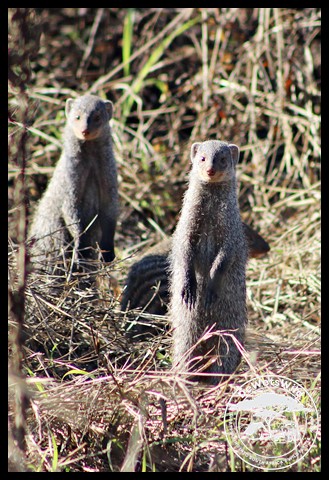
Banded Mongooses move around in troops and are often seen near picnic spots where they look for scraps, like these were doing at Tshokwane.
Black-backed Jackal seen early morning on the H10 road from Lower Sabie to Tshokwane
The comical Blue Wildebeest is a familiar sight all over the Kruger National Park.
Blue Wildebeest
Blue Wildebeest
Blue Wildebeest
Blue Wildebeest
We’ve already taken a closer look at the Kruger National Park’s big Buffalo herds.
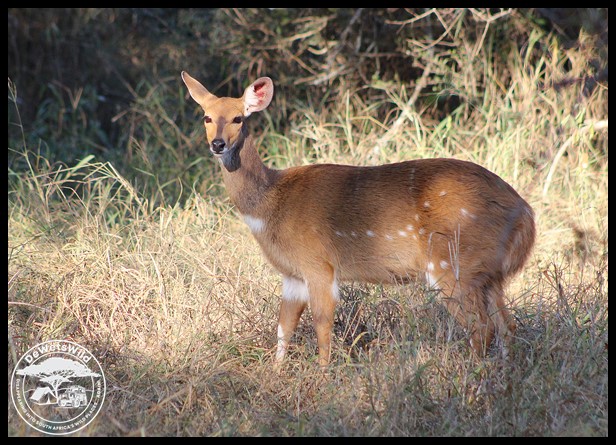
Bushbuck are found in areas of dense vegetation, such as the riverine forests lining most of the Kruger’s large rivers.
Bushbuck ewe
The Dwarf Mongoose is the smallest carnivore occurring in the Kruger National Park. They like living in termite mounds, and to sun themselves outside their homes on cold mornings!
Giraffe catching the first rays of sunshine on the Red Rocks Loop
Giraffe Calf
Hippos may look like jolly creatures, but they’re actually among the most dangerous animals in Africa!
Hippo Babies
Hippopotamus (photo by Joubert)
Hippo baby (photo by Joubert)
Hippo babies (photo by Joubert)
Lazy family of hippos at Mestel Dam
Pair of Hippos walking along the Letaba River
Hippo family at rest
Tamboti Tented Camp is well known for its Honey Badgers who come raiding the trash cans at night, which is why we had our little cameratrap set up outside our accommodation to capture the nightly attack!
Honey Badger raiding our trash can at Tamboti
Honey Badger raiding our trash can at Tamboti
Honey Badger raiding our trash can at Tamboti
The Impala is the most numerous large mammal in the Park and so familiar that most visitors pay them little more attention than a passing glance, which is a real pity as they are quite beautiful antelope!
Impala ewe
Impala ram
Impala ram (photo by Joubert)
Impala rams in a mock fight (photo by Joubert)
Impala ewe close-up (photo by Joubert)
Be sure to scan rocky outcrops for the dainty Klipspringer!
Many people consider the Kudu among the most regal of Africa’s antelope.
Kudu bull
Kudu Bulls
Kudu calf
Kudu Bull (photo by Erlo van Aswegen, Joubert’s friend who was visiting with us)
Kudu cow portrait
Kudu bull
This Large-spotted Genet also came snooping around the trash can in Tamboti while the Badger was roaming elsewhere in camp.
Large-spotted Genet
Large-spotted Genet
We’ll remember our June 2023 visit to the Kruger National Park for a long time thanks to our wonderful Leopard sightings!
Lions are at the top of the wish list for most visitors visiting the Kruger National Park, and there’s no denying that seeing these enormous cats roaming wild is always an awesome experience!
Young male lion
Lion just outside Pretoriuskop
Lioness in the minutes before dawn (photo by Joubert)
Pregnant Lioness
Lion (photo by Joubert)
Lion (photo by Erlo van Aswegen)
Can you see the lioness hidden among the lalapalms? (photo by Joubert)
I think the video of the Lioness and her cute cubs deserves another look!
Nyalas are seen more frequently in the northern reaches of the Kruger National Park.
Nyala calf
Nyala bull
Nyala bulls mingling on the banks of the Olifants River (photo by Joubert)
Nobody will complain about the fact that the photogenic Plains Zebras are frequently seen in almost every area of the Park.
Loving Zebras
Plains Zebra (photo by Joubert)
Plains Zebra Trio (photo by Joubert)
Plains Zebra
Plains Zebras gathering at a waterhole in the Shingwedzi River
Reedbuck are a rare sighting in Kruger, but the grassy plains north of Lower Sabie is a good place to go looking for them – we found this ewe along the H10 road.
Reedbuck ewe seen along the H10 road north of Lower Sabie in the Kruger National Park
The Roan Antelope is one of the two rarest species of large antelope found in the Kruger National Park, so we were very excited to have seen them twice during our visit in June 2023; a sizable herd at the Babalala Picnic Site and later a pair along the Shingwedzi River.
Roan antelope at Babalala
Roan antelope at Babalala
Roan antelope at Babalala
Roan antelope at Babalala
Roan Antelope along the Shingwedzi River
Roan Antelope along the Shingwedzi River
Scrub Hares can often be seen among the huts in Kruger’s rest camps after dark, but seeing them out-and-about during daylight happens less frequently.
Scrub Hare
Scrub Hare
The tiny Sharpe’s Grysbok is found most regularly in the far north of the Kruger National Park.
Sharpe’s Grysbok
Side-striped Jackals are seen much less often than their black-backed cousins, so regularly seeing this one near Shingwedzi (caught here by our little cameratrap) was a rare treat.
Side-striped Jackal at Shingwedzi
The Slender Mongoose is a very active, usually solitary, predator – we were lucky to find a few willing to pose for photographs!
Slender Mongoose sunning itself on a rock
Slender Mongoose sitting out in the open on a gravel road
Slender Mongoose (photo by Joubert)
Spotted Hyenas are mostly active between dusk and dawn and a regular sighting on guided drives conducted by the Park authorities after dark.
Spotted Hyena (photo by Joubert)
Spotted Hyena (photo by Joubert)
The Steenbok is probably Kruger’s most frequently encountered small antelope.
Steenbok
Steenbok
Steenbok (photo by Joubert)
Not only are Tree Squirrels very cute but they’re also excellent alarms when predators are around, so pay attention when you hear their excited chatter!
The north of the Kruger National Park, especially around Mopani and Shingwedzi Rest Camps, is the best place to go searching for the rare Tsessebe.
Tsessebes
Tsessebes
Warthogs might not be the most attractive animals, yet they’re sure to bring a smile to your face!
Warthog
Warthog
With their white-circled backsides the Waterbuck is instantly recognizable.
Waterbuck bull
Waterbuck trio
Waterbuck bulls
Waterbuck herd
Given the huge danger poaching poses to the continued existence of the White Rhino we were extremely grateful to have had three encounters with these enigmatic beasts when we visited the Kruger National Park in June 2023.
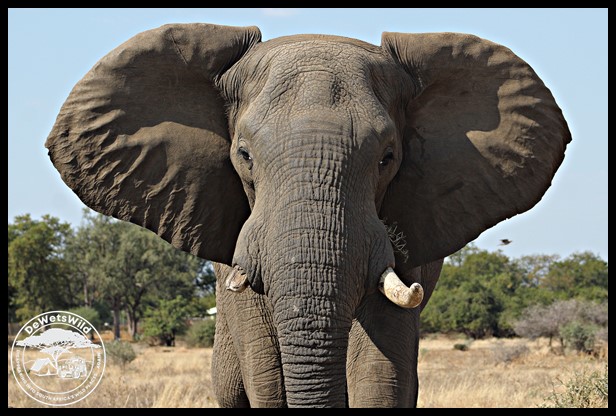
… as much as we do, then the Kruger National Park with its large population of African Elephants really is a must visit destination! This is just a few of the hundreds of elephant photos we took during our visit to the Park in June 2023, with a short video as bonus (and don’t miss the cute little baby trying to drink from the river alongside his mom around the middle of the video!).
Elephant family
Elephant family
Elephant cow in profile
Elephant bulls gathering at a self-dug waterhole in the dry Timbavati River
Elephant hogging Malopenyana Waterhole for himself (photo by Joubert)
Big old Elephant bull
Elephant family (photo by Joubert)
Smiling baby elephant (photo by Joubert)
Bull elephant in a hurry
Elephants (and a buffalo to the side) making their way to the waterhole at Babalala
Elephant warning (photo by Joubert)
Elephant Cow and baby
The Elephant’s Tail
Elephant youngster (photo by Joubert)
Elephants drinking from the Pioneer Dam at Mopani Rest Camp
A huge bull Elephant on his way to the Mooiplaas Waterhole
African Buffaloes are social animals that may congregate in herds many hundreds strong. Several such exceptionally large herds roam the Kruger National Park and we were fortunate to encounter some of them during our visit in June ’23. We also came across many lone bulls with their very intimidating attitudes – usually older ones that have been evicted from the breeding herds.
Big Buffalo Bull
Buffalo herd in the Nwaswitsontso River
Two young Buffalo bulls currying favour with a very commanding mature bull
Buffalo bull (photo by Joubert)
Buffalo cow
Buffalo cow with stunted horns accompanied by a bull (photo by Joubert)
Buffaloes (photo by Joubert)
Young but very imposing Buffalo bull
They might be at the water, but they’re not Water Buffalo – these are African, or Cape, Buffaloes
Old loner
Lopsided Buffalo cow
Death stare from a buffalo bull (photo by Joubert)
Buffalo Bull
Buffalo portrait
Buffalo close-up
This short video will give you a sense of the immenseness of these special buffalo herds:
Buffalo lend themselves beautifully to monochrome photography, and the slow passing of the huge herds gave us ample opportunity to play around with our cameras.
Of all the “Big 5” animals none are as difficult to find as the Leopard. Seeing one is usually the highlight of a visit to a nature reserve in South Africa. Having six sightings of these beautiful cats – of which four were on one day! – will mean our latest visit to the Kruger National Park will not soon be forgotten!
Our first sighting, near Lower Sabie late afternoon just minutes before the gates closed, was not very awe-inspiring, even by Leopard standards. Being as lazy as only cats can be this individual did not even deign to show us its face.
Lazy Leopard near Lower Sabie
Early one morning while travelling along the S56 Mphongolo Loop north of Shingwedzi we came across a pair of Leopards in a tall tree – a smaller individual very high up in the tree and visually afraid of the bigger one below guarding the remains of a kill. Visitors who were on the scene before us later shared how the male stole the female’s kill and chased her to the top of the tree where he was too heavy to get to her.
Lofty Leopard (Photo by Joubert)
The male at the lowest fork of the tree, with the kill well hidden (photo by Joubert)
The arrow indicates how high the female climbed into the tree to escape the male. By the way, parking into the veld and hanging out of your vehicle like the visitors in the Land Cruiser is not only bad etiquette but also dangerous.
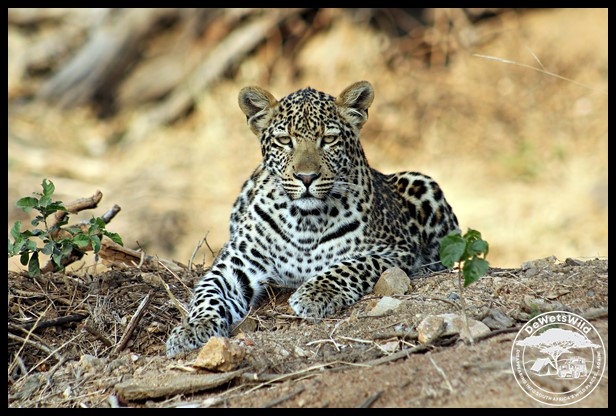
After spending quite some time at the Leopards in the tree we decided to move on to breakfast at Babalala Picnic Spot when, only 4km further along the same road, we found a young and curiously calm Leopard next to the road at the turnoff to Sirheni Bushveld Camp. She posed beautifully for all the photographers in the car, not fazed in the least by our proximity! Having been treated with such grace by the young princess we slowly backed away from her so that she could repose in tranquility.
Young Leopard at the Sirheni turnoff (photo by Joubert)
Young Leopard at the Sirheni turnoff(Photo by Joubert)
Young Leopard at the Sirheni turnoff (photo by Joubert)
Young Leopard at the Sirheni turnoff
Young Leopard at the Sirheni turnoff (photo by Erlo van Aswegen)
Young Leopard at the Sirheni turnoff (photo by Joubert)
Mere minutes later, still sauntering along the S56 towards Babalala, we found our third Leopard encounter for the morning where it was using a small outcrop of rocks as a vantage point and being particularly interested in a huge kudu bull lying nearby. The kudu soon saw the Leopard and did not even think the cat enough of a threat to stand up. Knowing it was outgunned, the Leopard gave the kudu a wide berth and disappeared into the dense shrubbery next to the Shisha stream.
Leopard looking out for prey from a rocky outcrop (Photo by Joubert)
Leopard looking out for prey from a rocky outcrop
Leopard descending from the rocks to try its luck with a kudu bull
Stealthily moving closer (photo by Erlo van Aswegen)
Keeping cover (photo by Joubert)
Leopard posing beautifully (photo by Joubert)
That same afternoon, still extremely excited about our morning, which by then also included sightings of other charismatic or rare species of wildlife including lions, roan antelope, tsessebes, buffaloes and elephants we found our fourth Leopard sighting of the day along the S50 Kanniedood Road southeast of Shingwedzi. The apparently heavily pregnant female was in a hunting mood and stalking a mixed herd of impala, kudu and waterbuck mingling on the bank of the river. She was soon discovered however and slinked back across the road and out of sight.
Leopard along the Shingwedzi River (Photo by Joubert)
Leopard walking over the S50 to stalk a mixed herd of antelope (photo by Joubert)
Leopard walking over the S50 to stalk a mixed herd of antelope (photo by Joubert)
Leopard slinking away after being discovered by her prey
Leopard rushing away after being discovered by her prey (photo by Joubert)
Our final Leopard sighting of the trip (and I am sure we missed more than we saw thanks to their exceptional camouflage!) was before sunrise as we left Shingwedzi for a morning drive. This was a shy individual, trying to hide behind a palm frond for a minute or two and then deciding to retreat into the riverine vegetation lining the Shingwedzi.
Shy Leopard in the early morning (photo by Joubert)
Shy Leopard in the early morning (photo by Joubert)
I made a little compilation video of some of the Leopard encounters I told you about.
During the hours of darkness visitors to the Kruger National Park are not permitted to drive themselves around the reserve, both for their own safety and that of the Park’s wildlife. Nighttime in wild Africa is a fascinating time, however, with nocturnal creatures roaming the dark, and for this reason the Park offers visitors night drives of two to three hours in duration and under the guidance of skilled guides, with spotlights being used to seek out animals and birds that might otherwise be hard to see during daylight. We undertook one such excursion from Lower Sabie Rest Camp during our visit to the Kruger Park last week.
Hippopotamus (photo by Joubert)
Spotted Hyena (photo by Joubert)
Spotted Hyena (photo by Joubert)
Elephant (photo by Erlo van Aswegen)
Lion (photo by Joubert)
Lion (photo by Erlo van Aswegen)
With Joubert and his friend Erlo manning the cameras I could take a few video snippets of our drive. Hop on and come along!
Remember that DeWetsWild can also assist you with bookings for guided activities, like night drives, in the Kruger National Park when you make use of our reservation services for your holiday accommodation.
Yesterday I lamented the fact that we’d be leaving the Kruger National Park today and heading back home to Pretoria. Well, as is often the case, the Kruger still had one present in store for us before we left. This morning, just a kilometer from Shingwedzi Rest Camp, that gift took the form of a buffalo carcass, two bloody lionesses and the smallest pair of lion cubs we’ve seen in a long time!
Lioness feeding on the buffalo carcass
Second lioness walking along the road, having fetched her cubs to join the feast (phot by Joubert)
Cutest, tiniest cubs (phot by Joubert)
Second lioness walking along the road, having fetched her cubs to join the feast (phot by Joubert)
Second lioness walking along the road, having fetched her cubs to join the feast (phot by Joubert)
Cutest, tiniest cubs (phot by Joubert)
The cubs playing on the sandy riverbed
The cubs playing on the sandy riverbed
The two lionesses reuniting
The cubs joining their mom and aunt
The cubs joining their mom and aunt
The first female, very bloodied, walks away for a drink of water
Here’s a little video compilation of the cubs as they walked along the road with their mother:
We had a feast of leopards around Shingwedzi today – no less than 4 separate encounters with these spotted beauties! These photos by Joubert are just a little teaser; we will share more when we get back home.
Lofty Leopard (Photo by Joubert)
Young Leopard at the Sirheni turnoff(Photo by Joubert)
Leopard looking out for prey from a rocky outcrop (Photo by Joubert)
Leopard along the Shingwedzi River (Photo by Joubert)










 DeWetsWild