This week’s WordPress Photo Challenge theme, Orange, seems the perfect excuse to show off another glorious Kruger Park sunrise!


This week’s WordPress Photo Challenge theme, Orange, seems the perfect excuse to show off another glorious Kruger Park sunrise!
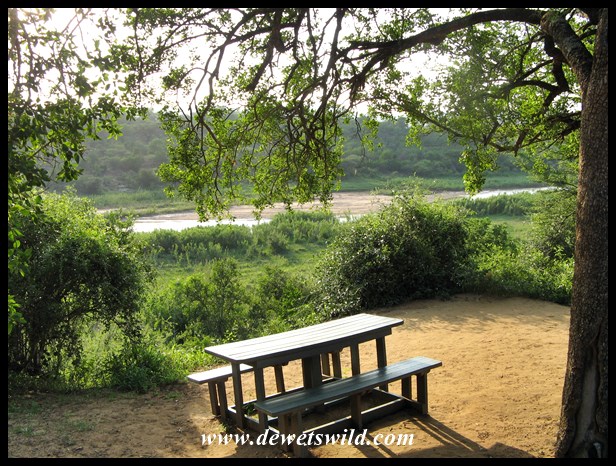
Over the last couple of weeks we’ve shared with you several exciting sightings we enjoyed at Hluhluwe-Imfolozi Park, during our December holidays in the bush. Time to wrap up that part of our trip now.
We left the cheese farm near Mtubatuba very early in the morning of the 24th of December, and made it to the Memorial Gate just in time for it opening at 05:00AM (it’s a drive of about 75km only). We used Memorial Gate so that we could explore the Hluhluwe-section of the reserve on our way south to Mpila Camp, where we could check in 14:00 in the afternoon.


Mpila is a favourite camp of ours. It is unfenced, except for a single strand of electric wire strung high enough to only keep out elephants and giraffes. Other wildlife, including large predators, regularly roam among the accommodation units. Visitors should keep a special eye open for raids by vervet monkeys during the day, and for hyenas at night while preparing their evening meals on the barbeque fires.


That afternoon, we went for a quick drive and had some fun with a cute white rhino calf. Hluhluwe-Imfolozi is renowned as a rhinoceros haven, and we pray that the hard work and dedication of the rangers protecting them against a terrible onslaught from armed poachers will not be in vain.


When we made our December 2014 plans a year before, we specifically wanted to spend Christmas at Mpila. A special day at a special place. We set out for a quick drive on a glorious morning, then went back to camp to prepare and enjoy Christmas lunch. In the afternoon the Park was inundated by a quick cloud burst, luckily the gravel roads are in good condition and we could continue to explore the Park soon after.


Boxing Day brought us our memorable encounter with lions in trees, but Hluhluwe-Imfolozi has much more to offer and our sightings this day was particularly varied. Our day ended with our best ever sighting of a wild African Rock Python, almost as long as the road was wide!


Every day at Hluhluwe-Imfolozi brings something special and exciting, and the 27th of December was no different. Our day started with a thrilling wild dog pack on the hunt, but that wasn’t where it ended!


Our last full day at Hluhluwe-Imfolozi Park seemed to belong to the elephants, with a number of really close-up encounters, but we also had a good laugh at a hyena that bit off more than she could chew.


All too soon our five night stay at Mpila came to an end. We had collected so many memories, and can’t wait to return. Driving to Nyalazi Gate we tried to postpone our departure as long as we could, even spending half-an-hour looking for a distant pride of lions reported by fellow spotters in the kznsightings group (a group set up so that visitors to the game reserves in Kwazulu-Natal can share what they find while exploring with other visitors).


We found the lions and then departed for Midmar in the KZN Midlands.
While exploring Hluhluwe-Imfolozi Park just after Christmas, we encountered a spotted hyena in the west of the reserve. In typical hyena fashion she was walking determinedly and at some speed along the road, and so we followed in the hope that we might see her hunt.
Not long after, she picked up a herd of zebra standing in the road ahead, and made a run at them. The tables were quickly turned however, as the dominant stallion of the zebra family sent our over-ambitious hyena running for cover…
(Click on any of the photos to enjoy the sighting with us in a carousel gallery)


Early one morning during our December visit to Hluhluwe-Imfolozi Park, we were travelling slowly along one of our favourite game viewing drives, the Sontuli Loop, on our way to a picnic breakfast.
Around a corner, we encountered a pack of African Wild Dogs running down the road in the opposite direction, passing our vehicle at speed. There was at least thirteen dogs in the pack (it is very difficult trying to count them as they duck and dive through the bush and into and out of the road). We made a U-turn and followed them; it is not every day you get to see wild dogs on the hunt! Every now and then they’d stop and scan the area around them for prey, giving us an opportunity to take some photos, before setting of again.
(Click on any of the photos to enjoy the sighting with us in a carousel gallery)


The kill was over in a blur. My eye caught a flash of dogs chasing an impala lamb into a thicket. In between the excited yelping of the dogs the impala lamb gave one of two feeble bleats, and then it went quiet. Suddenly the dogs burst out of the thicket, scattering in every direction, each with a small morsel of impala in their jaws to enjoy away from the rest of their hungry pack mates. A baby impala does not go far when it has to be shared between so many mouths.


Just as unexpectedly as they first appeared, the dogs were up again, heading towards the Black Umfolozi River and out of sight. All that remained on the scene was a lonely hyena lucky enough to have found some entrails, and a bunch of vultures descending from above…

Hyena cleaning up after the wild dog kill
The reward for a long day in the bush; a tranquil sunset scene.
This photo was taken near Berg-en-Dal, in the Kruger National Park.
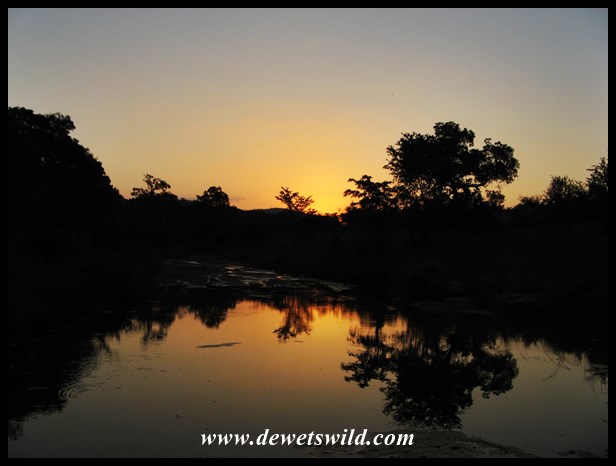
“Reward” is the theme for this week’s WordPress Photo Challenge
We encountered these two love-struck plains zebras this past weekend while walking in our local Moreletakloof Nature Reserve. What a contrast to the fighting, kicking and biting zebras from Ithala Game Reserve we showed you a couple of weeks ago!

This is our final entry for the 5 Day Black-and-White Challenge, and it gives us great pleasure to invite our dear friends, Joey and Marks Culver, to join in the challenge. They are experts at black-and-white photography, and showcase their talents on their blog, mjculverphotography, which you really should visit if you’re at all interested to see exactly how black-and-white should be done! Marks & Joey, it’s no problem if you decide not to join in, as long as you know how much we enjoy your blog and appreciate your friendship!
There are only two rules for this challenge:
1. On 5 consecutive days, create a post using either a past or recent photo in B&W.
2. Each day invite another blog friend to join in the fun.
This herd of African buffalo, making their way out of the dry, dusty bed of the Mphongolo River in the Kruger National Park, during a visit in September 2014, is another sighting we’ll not forget in a hurry.

This is our fourth entry into the 5 Day Black-and-White Photo Challenge. There are only two rules for this challenge:
1. On 5 consecutive days, create a post using either a past or recent photo in B&W.
2. Each day invite another blog friend to join in the fun.
Today we’re inviting Sreejith Nair, author of “Santiago the Shepherd” and another long-standing friend of de Wets Wild, to join the 5 Day Black and White Photo Challenge. Sreejith, you’ve shared some amazing photos of India’s people and places and we hope you’ll consider joining in!
Isilo was, towards the end of his life, the biggest tusker in South Africa, and our encounter with him at Tembe Elephant Park in May 2013 will forever be one of our most memorable wildlife experiences.
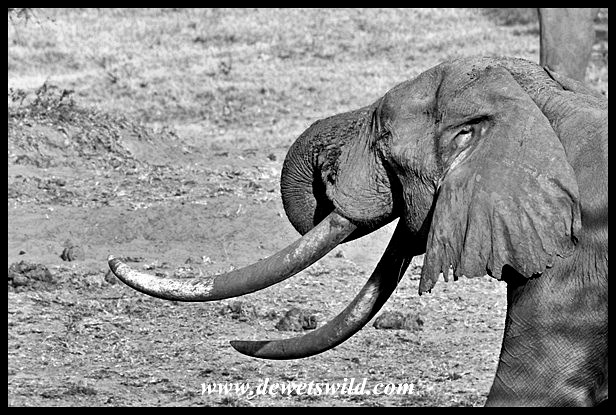
This is our third installment for the 5 Day Black-and-White Photo Challenge. Today we’d like to invite Dina of Perdebytjie se Nes, to join the challenge. She blogs in Afrikaans, our mother tongue, but you’ll need no translation to enjoy the fantastic photographs she shares on her blog! Dina, ons hoop jy sien jou weg oop om deel te neem maar dis geen probleem as jy nie kan nie, solank jy weet hoe baie ons jou blog geniet!
There are only two rules for this challenge:
1. On 5 consecutive days, create a post using either a past or recent photo in B&W.
2. Each day invite another blog friend to join in the fun.
Today, we flash back all the way to July 2012 to remember this spectacular leopard encounter near Skukuza in the Kruger National Park
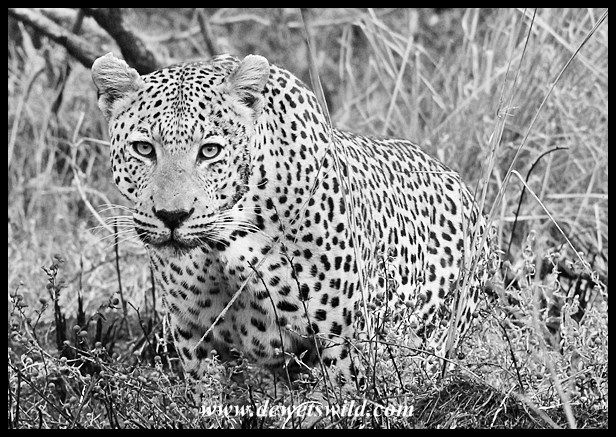
This is our second entry into the 5 Day Black-and-White Photo Challenge. There are only two rules for this challenge:
1. On 5 consecutive days, create a post using either a past or recent photo in B&W.
2. Each day invite another blog friend to join in the fun.
“i AM Safari” is the brilliant blog of another of de Wets Wild’s long standing friends, Maurice Hovens. Like us, Maurice and his family loves exploring earth’s wild places. Maurice, we hope you’ll accept our invitation to join the 5 Day Black-and-White Photo Challenge? If not, at least please see this as a token of how much we appreciate your friendship and support!
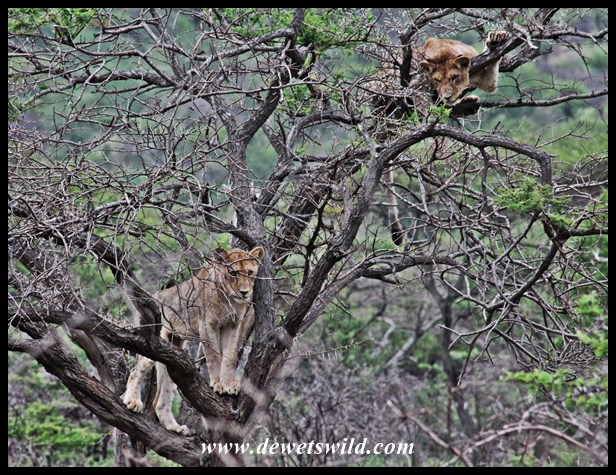
Lions are not generally known for their tree-climbing abilities, and there’s only a handful of prides on the African continent that seem to have this skill and regularly use it. We’ve often heard of Hluhluwe-Imfolozi‘s lions‘ tree-climbing tendencies, but we never saw this for ourselves, despite visiting the Park frequently and enjoying many sightings of these regal cats there.
That is until early morning on Boxing Day 2014, and what an unbelievable sight! We found a lioness (on the ground) with two rather large cubs in a small thorn tree. I did not think that something as big as a lion could get so high up in a flimsy-looking thorn tree, and then be so well camouflaged at that!


