In South Africa, we celebrate the 24th of September as “Heritage Day”, and of course to us de Wets our country’s natural heritage is our biggest pride. What better way then to spend the Heritage Day long weekend than at a place as beautiful as Marakele National Park, accompanied by a group of wonderful friends?
Marakele’s varied landscapes makes for such a diverse experience – from the top of the Waterberg massif to the plains of Kwaggasvlakte below. A few fires passed through the area some days before our visit (a quite natural occurrence in African savannas, to which animal and plant life alike are perfectly adapted) and as soon as the first rains of spring fall Marakele should be transformed into a green paradise again.

Marakele sunrise

Marakele scenery

Marakele stream crossing

Dusty road at sunset

Marakele scenery

Marakele scenery

Marakele scenery

Marakele stream crossing (near Tlopi)

Marakele scenery

Marakele scenery

Bollonoto waterhole near Bontle

Marakele scenery

Milky Way above Marakele

Thutong view
There’s no doubt in our mind that Marakele’s populations of the popular “Big Five” animals must be growing at a good rate. We’ve never seen so many elephants on any of our previous visits to this Park, and this latest visit also delivered us our first encounters with both Marakele’s buffaloes and lions. It is now only the Park’s leopards that still elude us.

Elephant mock-charge

Old buffalo bull

Lioness and mate

Lion

Baby elephant show-off

White Rhinoceros

Old matriarch

Tiny new herd member

Elephant youngster

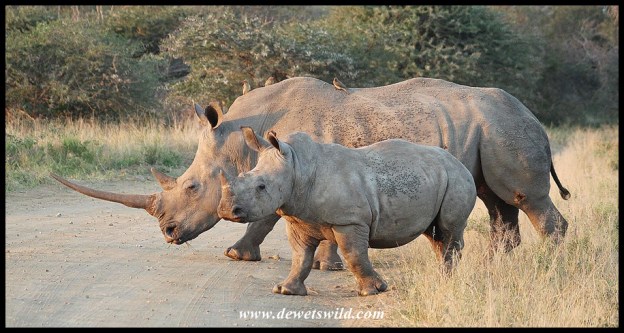
White rhinos

White rhinos

Heavyweights on the run
By now our regular readers will know that we love walking around after dark looking for nocturnal creatures, and in this respect the Thutong Environmental Education Centre where we stayed delivered a range of arachnid species!

Giant spider

Baby scorpion

Solifuge a.k.a. Sun Spider
We’ve already shared with you a series of photos of a wasp dragging a paralysed caterpillar to a nesting tunnel for its young to feed on – have a look here for the complete set.
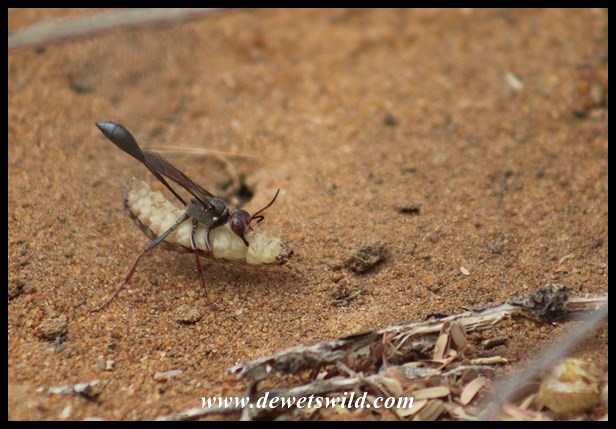
Wasp and prey
Marakele means “a place of sanctuary”, and it is as true for human visitors as it is for the immense collection of wildlife that calls this gem of a place home!

Ostrich at Bollonoto

White-fronted Bee-eater

Little Bee-eater

Golden-tailed Woodpecker

Yellow-throated Bush Sparrow

Southern Black Flycatcher

Female Red-billed Quelea

Red-billed Oxpecker

Kudu cow

Kudu calves

Nyala calf

Bushbuck ewe

Plains Zebra

Plains Zebra

Plains Zebra

Blue Wildebeest

Impala
A big group of people needs a big place to stay. Marakele’s Thutong Environmental Education Centre is a dormitory-style facility built purposely to accommodate visiting school groups, however it is available for private groups when not being used by school children. Provided is six double rooms with en-suite bathrooms for the teachers, with a maximum of 128 children that can be accommodated in 16 seperate rooms with 8 bunk beds in each. Thutong also has a decently equipped kitchen to cook for that many mouths, and a large hall and fireplace. It is securely fenced – the necessity for which we clearly understood when we found lion tracks right outside the gate one morning!

Thutong Environmental Education Centre, Marakele National Park, September 2017

Thutong Environmental Education Centre, Marakele National Park, September 2017
Want to learn more about Marakele National Park? Why not scroll through all our posts about this special place, here.











 DeWetsWild