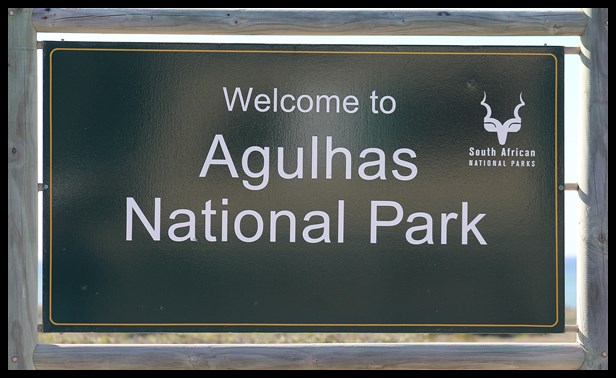
Agulhas National Park

Fifteenth century Portuguese seafarers named Cape Agulhas when they found that magnetic compass needles pointed precisely true north here (“agulhas” being Portuguese for “needles”). It is also the southern-most point of the African mainland, where the Atlantic and Indian Oceans meet, and has been inhabited by humans for over a million years with several sites of archaeological interest. The Agulhas Plain also has an incredible biodiversity and it was realised that what remained of it was worthy of protection, leading to the proclamation of the Agulhas National Park in 1999. Today the park covers almost 230km².

This is one of the world’s most treacherous coastlines. Since 1552, at least 125 ships met their fate around Cape Agulhas. For this reason the lighthouse at Cape Agulhas was commissioned in 1849, and is the second oldest of the 56 working lighthouses along our coast. It was designed as a replica of the Pharos of Alexandria, one of the seven wonders of the ancient world, and at night its beam can be seen up to 60km offshore. One of the most easily seen wrecks is that of the Meishu Maru, a Japanese fishing vessel with a cargo of 240t of tuna, that ran aground in 1982, happily without any loss among the 17 crew members. Today, a fascinating museum and information centre is housed inside the lighthouse.

The vegetation of the Agulhas National Park consists mainly of fynbos, with an estimated 2,000 plant species finding protection within its borders, many of which are rare and occur nowhere else on earth. The vegetation doesn’t grow very tall here due to the extremely windy conditions that prevail throughout the year. The area is rather flat and featureless, with rocky and sandy beaches alternating and stretching for many kilometers. And the sunsets from the main camp, as the sun dips into the Atlantic Ocean (the camp lies west of the southernmost tip of Africa) is a sight to behold!

The Park is still being developed, and as such does not yet contain large terrestrial mammals in any significant numbers. Most of the mammal species that occur here are either marine or small and rarely seen. The Agulhas National Park is however a prime birding spot, both for land and sea birds.

Guests can overnight in the main rest camp, which consists of one or two bedroom cottages and the luxury Lagoon House, built right on the rocks at the ocean’s edge. A few historic farm houses spread throughout the inland portions of the Park has also been renovated to accommodate guests. An extensive network of walking trails have been laid on around the main camp. All modern services and amenities associated with small holiday towns can be found in nearby L’Agulhas and Struisbaai. The nearest big town is Bredasdorp, 35km to the north.

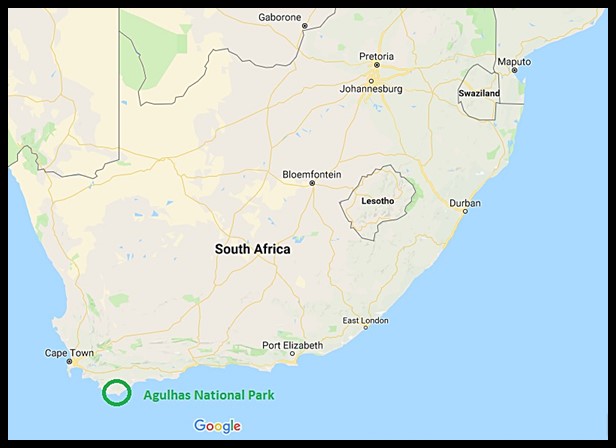
The Agulhas National Park is located about 250km southeast of Cape Town, with the main rest camp a short drive from the small holiday town of L’Agulhas. It was the third destination on our December holiday tour of eight of our country’s national parks.


Cape Grey Mongoose

Galerella pulverulenta

The Cape, or Small, Grey Mongoose is a commonly encountered small carnivore, thanks to its diurnal habits, They occupy a wide variety of habitats, ranging from semi-desert scrub to mountains and coastal thickets, and subsist on a diet of rodents, birds, reptiles, amphibians, invertebrates, carrion and wild fruits.

Weighing in at between 500 and 1,250g, with a length of up to 75cm (excluding the tail), the Cape Grey Mongoose is usually solitary, and moves through their small home range along well used pathways. At night they lie up in thickets, piles of rocks or in tunnels dug by other animals. These sites are also used as dens where females give birth to litters of 1-3 young, mostly between August and December. They have a natural life expectancy of about 8 years.

The Cape Grey Mongoose occurs only in South Africa (Kwazulu-Natal. Free State, Eastern Cape, Northern Cape and Western Cape), and marginally into Lesotho and Namibia. Thanks to a common, stable population the IUCN evaluates it as being of least concern.

Cape Sugarbird

The Cape Sugarbird is endemic to the fynbos regions of the Western and Eastern Cape, where it feeds mainly on nectar, especially of Protea-species (and as such is a major pollinator of these plants), and insects. It is also seen in gardens, especially in the summer. With its long-tail, the male Cape Sugarbird can grow to up to 44cm in length, weighing up to 50g.

Cape Sugarbirds breed mainly in autumn and winter, to coincide with the Protea flowering season. Pairs are monogamous, with the male aggressively defending the nesting site while the female builds the cup-shaped nest of dead leaves and dry grass, usually among the leaves of a Protea-bush. The female incubates the clutch of 1 or 2 eggs alone, for a period of up to 3 weeks. Chicks leave the nest at about 18 days old, and then stay with their parents for only another 3 weeks before attaining independence.

While the IUCN considers the Cape Sugarbird to be of least concern, they are at long term risk due to habitat loss brought on by development and invasion of their habitat by alien plants.

Hartlaub’s Gull

Chroicocephalus hartlaubii

Hartlaub’s Gull is a gregarious species that forages, roosts and nests in large flocks. They occur in coastal areas – inshore waters less than 50m deep, estuaries, lagoons, beaches and harbours, and rarely venture further than 20km from land. Their natural diet relies in a large part on marine invertebrates associated with beached kelp, supplemented with fruits, eggs and small fish.  They also frequent sewerage works, rubbish dumps and abattoirs for easy pickings.

Breeding takes place at anytime of the year, though some localities show distinct peaks in nesting activity at varying times of the year. Breeding colonies are established on flat, rocky islands, coastal pans, in harbours and even on top of buildings, where the nests are small hollows of matted plant material. Pairs are monogamous and aggressively defend a small patch around their nest. Clutches of one to three eggs are incubated by both parents for just short of 4 weeks. Chicks attain adulthood at around two years of age. Hartlaub’s Gull is closely related to the Grey-headed Gull, with which it sometimes interbreeds.

Hartlaub’s Gull occurs only in Namibia and South Africa (Northern, Western and Eastern Cape), where they are considered to be common and increasing their population. With about half of the estimated 30,000 adults in the population occurring in and around the Cape Peninsula, Table Mountain National Park is a good place to look for Hartlaub’s Gull. The IUCN lists the species as being of least concern, despite noting threats to their breeding success rate.

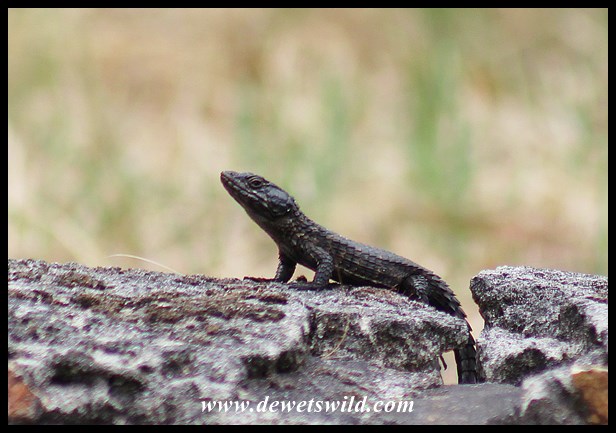
Black Girdled Lizard

Cordylus niger

Black Girdled Lizards occur only on Table Mountain, the Cape Peninsula and around Saldanha Bay, where they inhabit rocky outcrops in the fynbos and shelter in small cracks and crevices. When threatened they will use their prickly tail to cover the rest of their body and inflate themselves so that it should be very difficult to extract them from their hiding place. Black Girdled Lizards grow to between 7 and 9cm in length and are usually seen alone, except when mating. They are diurnal and do not hibernate, although they are much less active in cold weather. Black Girdled Lizards feed primarily on insects. This is an ovoviviparous species, meaning that the female keeps the fertilized eggs inside her body and then gives birth to live young when the eggs hatch inside her. One to three young are born during autumn and must be immediately self-sufficient, as there is no parental care.

The IUCN classifies the Black Girdled Lizard as “Near Threatened” due to their extremely limited distribution and threats from development and the pet trade, despite an apparently numerous population.

African Penguin

Spheniscus demersus

One of our most endearing birds and the only one of its kind resident on the continent, the African Penguin was previously known as the Jackass Penguin, thanks to its donkey-like braying. Adults weigh as much as 3.5kg and stand up to 70cm tall.

Penguins forage in the open ocean, either alone, in pairs or in small groups, and usually within 40km from their colony. When not caring for chicks at the colony, adults can stay out at sea for up to 5 days. They feed primarily on shoaling fish (like sardine and anchovy) and squid. African Penguins swim at speeds of around 7km/h, and can remain submerged for up to 2 minutes at a time.

African Penguins usually breed in tightly packed colonies, often at any time of the year with specific peak periods in different colonies. Pairs are monogamous and form lifelong bonds, with the male advertising and defending their small territory around the nest. Most colonies are on islands well out of reach of mammalian predators, while a handful are in safe and sheltered areas on the mainland. African Penguins prefer to breed in burrows dug in guano (seabird excrement valued as fertilizer) or sand, but as this has become very rare at some nesting colonies authorities have resorted to making artificial structures available for the purpose. When burrows (natural or artificial) is unavailable, they will nest on open ground but usually these attempts are far less successful in raising chicks. Clutches consist of one to three eggs, incubated for around 40 days by both parents. Chicks leave the nest at between 2 and 3 months old, but remain dependent on their parents for another two months or so thereafter. Newly independent juveniles often disperse as far as 2,000km away from the colonies where they hatched, but most return to their natal colonies again when they reach breeding age at about 4 years old. It is estimated that African Penguins can live to about 27 years in the wild.

African Penguins are restricted to the coasts of Namibia and South Africa. The IUCN classifies it as endangered, owing to a plummeting population as a result of depleting fish stocks (through overfishing and warming oceans) and pollution (most notable from oil spills). Scraping of guano, which destroyed the penguins’ nesting sites, and collection of eggs caused major declines in the population at the start of the 20th century. From a population counted in the millions in the early 1900’s, the total estimated population in 2015 stood at around 80,000 mature birds  (probably even fewer now) distributed at 29 breeding colonies (with an estimated 87% of the population breeding at just 8 localities). Boulders Beach, south of Cape Town and managed as part of the Table Mountain National Park, offers probably the most accessible viewing of the species.

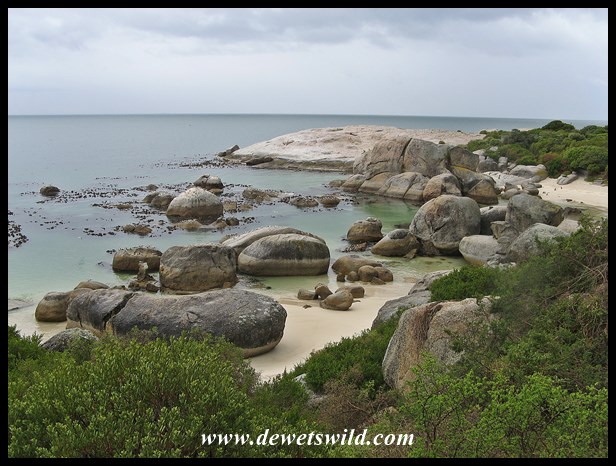
Boulders Beach and Penguin Colony (Table Mountain National Park)

Boulders, a sheltered cove in the naval town of Simon’s Town, comprises a few small bays and beaches protected by enormous granite rocks, 540-million years old, from the pounding surf of the Atlantic Ocean in False Bay. It is one of the most popular attractions in the Table Mountain National Park.

In 1982, two pairs of African Penguins took the unusual step of settling and breeding on the mainland here at Boulders. Today, the colony has grown to number over 2,000 birds and offers probably the most accessible views of penguins to be had anywhere in the world. Visitors are urged not to get too close to the penguins and not to try and touch them, as they’ll not hesitate to nip a finger or nose with their razor sharp beaks if they feel threatened.

While pride of place obviously goes the the penguins, there’s a multitude of other wildlife – birds and mammals especially – that find a safe refuge at Boulders.

Wheelchair-friendly boardwalks erected at Foxy Beach allows visitors to get up close to the penguins, while swimming and sunbathing is popular at Boulders Beach. The two beaches are connected by a lovely walkway through indigenous bush known as Willis’ Walk. There is a curio shop at the visitor centre, and several restaurants, cafes and coffee shops nearby in Simon’s Town.

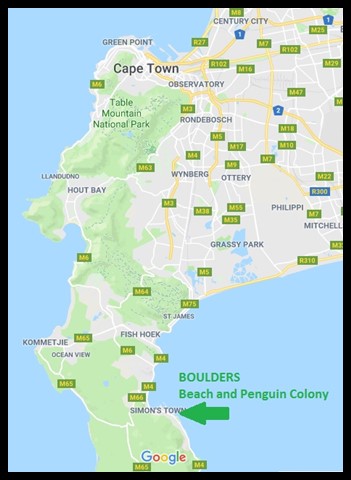
Boulders Beach and Penguin Colony is located in Simon’s Town, base of the South African navy south of Cape Town. Parking is available in Seaforth Road and Bellevue Road, both of which turn off the main Milner’s Point Road (M4) leading through town.

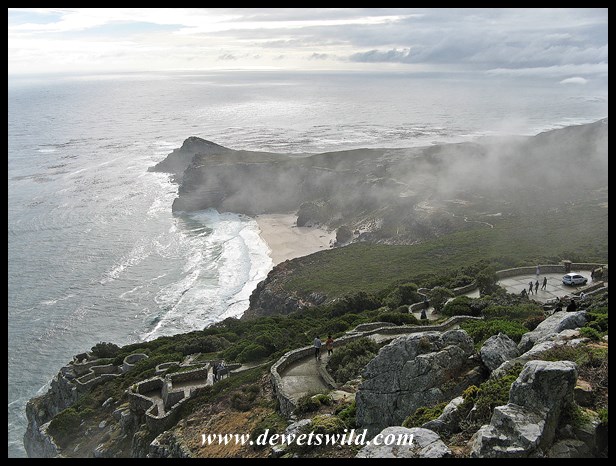
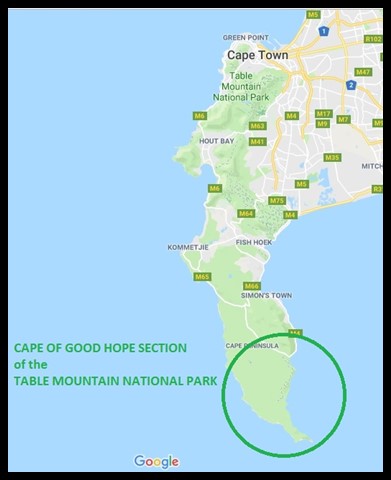
Cape of Good Hope (Table Mountain National Park)

Archaeological investigations indicate that the Cape Peninsula, the mountainous promontory that stretches for over 50km from Table Mountain in the north to Cape Point in the south at Africa’s south-westernmost extremity, has been inhabited intermittently by humans since the Early Stone Age, roughly 600,000 years ago. First described as the “Cape of Storms” by Portuguese explorer Bartolomeu Dias, the first known European to navigate around the southern tip of Africa in March 1488, and then given the moniker “Cape of Good Hope” by King João II of Portugal as Dias’s “discovery” opened the possibility of an oceanic trade route to India and the Far East, the most flattering description for this stretch of rugged coastline came from English Admiral Sir Francis Drake in 1580, when he referred to it as “a most stately thing and the fairest cape we saw in the whole circumference of the earth“. Today, two “padrãos” – replicas of the limestone pillars erected by Portuguese explorers on their voyages to signify Portuguese and Christian sovereignty and erected in 1965, commemorate two of those erstwhile explorers: Dias and Vasco da Gama, the first to reach India from Europe around the African coast.

In 1939, the Cape of Good Hope Nature Reserve was established on the southern tip of the Cape Peninsula. In 1998, the reserve’s 7,750ha was incorporated into the Cape Peninsula National Park, which was renamed the Table Mountain National Park in 2004. The land area of the Park covers a total of almost 300km², with a further 975km² of the ocean protected in a marine reserve. Managing this National Park with Cape Town and its suburbs, a city of 3,7-million people, right on the doorstep must be a daunting task and with over 4-million visitors annually, the Table Mountain National Park is one of South Africa’s top tourist attractions.

Cape Point consists of dramatic sea cliffs, among the highest in the world, jutting into the Atlantic Ocean at the tip of the Peninsula. On a clear day the view from the top is nothing short of spectacular. The “Flying Dutchman” Funicular (named for Captain Hendrick van der Decken’s ghost ship still plying these waters in stormy seas) is available to take visitors up to the old lighthouse and viewpoints and back down, though there’s always the option of hiking the 800m distance.

Commonly described as Fynbos, the natural vegetation of the Table MountaIn National Park is an integral component of the Cape Floral Kingdom, which, with an amazing 9,004 plant species is the smallest of only 6 plant kingdoms recognized in the world and a UNESCO Natural World Heritage Site. There are over 2,285 indigenous flowering plant species on the Cape Peninsula – compare that to fewer than 1,500 species indigenous to the entire British Isles! Inside the Cape of Good Hope section of the Park alone, over 1,200 plant species have been identified.

The Cape Peninsula may be world renowned for its awesome scenery, but it is also home to a wide variety of birds (303 species on land and sea), mammals (58 terrestrial and 36 marine species) , reptiles (64 species), amphibians (17 species) and fish (including the Great White Shark), not to mention countless invertebrates.

Visitors may overnight inside the Cape of Good Hope section of the National Park at one of three cottages (Olifantsbos, Eland & Duiker) or on the Hoerikwaggo Cape of Good Hope Trail. An extensive network of tarred roads lead to several viewpoints and picnic sites, two of which have tidal pools as swimming in the sea at many of the beaches here is considered rather risky, while a restaurant and curio shops can be found at Cape Point.

We spent two nights at Eland Cottage at the Cape of Good Hope during our epic December holidays in eight of South Africa’s national parks.

The Cape of Good Hope section of the Table Mountain National Park lies to the south of the city of Cape Town, and can be approached either from the town of Kommetjie along the Atlantic seaboard (road M65), or through Simon’s Town on the False Bay coast (road M4 / M66).

Another quick nature fix at Rietvlei

Just as we were starting to experience withdrawal symptoms after spending almost a month exploring eight of our country’s beautiful national parks we were saved from the agony by a good friend who organised his birthday party at our local Rietvlei Nature Reserve yesterday.

Karoo Long-billed Lark

Certhilauda subcoronata

Karoo Long-billed Larks are usually encountered singly or in pairs. As their name suggest, these birds inhabit sparsely vegetated, rocky plains and hill slopes in the arid Karoo, and feed primarily on insects and seeds.

These rather large Larks (weighing 31-55g) breed mostly in spring and summer. Their nests are cups built of roots and twigs in hollows at the bases of shrubs and rocks in which 2-3 eggs are laid.

The Karoo Long-billed Lark occurs commonly in the drier western half of South Africa, specifically in the Northern, Western and Eastern Cape Provinces, extending into Namibia. The Karoo National Park is one of the best places to go looking for this species. With a a large and stable population, the IUCN considers the Karoo Long-billed Lark to be of least concern.