Tag Archives: outdoors

Montagu’s Harrier

Circus pygargus

Montagu’s Harrier is a relatively rare bird of prey that visits South Africa between December and March, when it may be seen coursing the open grasslands and floodplains of the Lowveld, Mpumalanga, Gauteng and Free State (though it is occasionally recorded in our other provinces as well). It is seasonally widely distributed over much of Africa, Europe, Arabia and western Asia and, despite a population declining mainly due to loss of habitat, is still considered to be of least concern by the IUCN. They feed mainly on insects and are particularly fond of locusts. Females are considerably larger than males and weigh about 370g.

Dusky Indigobird

Vidua funerea

The Dusky Indigobird inhabits forest edges and clearings, woodlands, savannas and thickets in grassland in areas with higher rainfall. It feeds mainly on grass seeds supplemented with termites and other small insects. Male Dusky Indigobirds are territorial and will mate with as many females as possible. Being a brood parasite the female Dusky Indigobird will enter the nest of a pair of African Firefinches, destroy any eggs she finds in the nest and then lay a single egg of her own for the host family to incubate and rear.

In South Africa, Dusky Indigobirds are found in all provinces with the exception of the Northern and Western Cape. Their distribution further extends patchily over other African countries south of the equator and while the species is not commonly seen and easily overlooked it is considered to be of least concern.

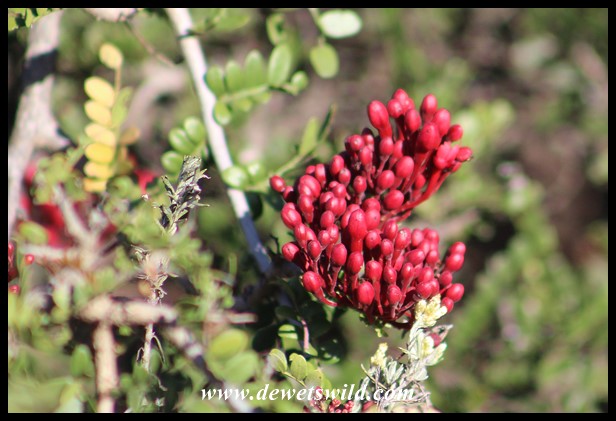
Purple-pod Cluster-leaf

Terminalia prunioides

These attractive seedpods belong to the Purple-pod, or Lowveld, Cluster-leaf, a densely branched shrub or small tree that is found in our Limpopo and Mpumalanga provinces. It proliferates in clay-like soils, often in rocky areas next to large rivers, and is heavily used by browsing animals.


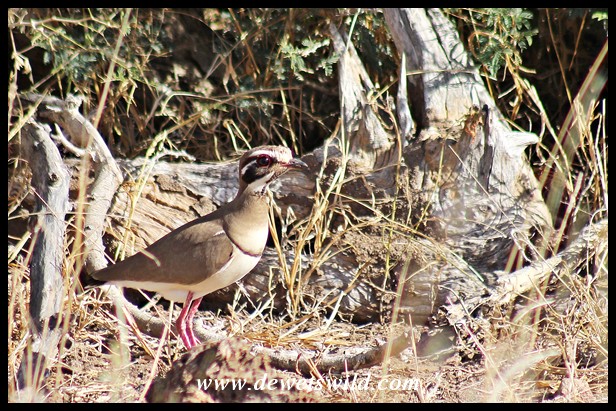
Common (Kurrichane) Buttonquail

Turnix sylvaticus

The Common, or Kurrichane, Buttonquail is a small ground bird inhabiting grasslands and savannas. In South Africa they’re to be found mainly in Kwazulu-Natal, Mpumalanga, Limpopo, Gauteng, North West, the Free State and Kalahari regions of the Northern Cape. Their distribution range further extends over much of the rest of sub-Saharan Africa and through much of Asia from Pakistan to Taiwan, the Philippines and Indonesia. According to the IUCN the Common Buttonquail is of least concern. They live on an omnivorous diet of insects and seeds and are highly nomadic, moving around in response to good rainfall.

Common Buttonquails are usually seen singly or in pairs and breed during the rainy season. They are polyandrous, meaning that the female mates with several males in a season and leaves the incubation of the eggs and rearing of the chicks to them. It takes the male about 2 weeks to hatch the clutch of 2-4 eggs. The chicks leave the nest soon after hatching to wander around with their father, and are fully grown by the time they’re 4 weeks old. Adults weigh about 40g.

Leadwood

Combretum imberbe

The Leadwood is an iconic tree of South Africa’s savanna regions, occurring from northern Kwazulu-Natal through the Lowveld and bushveld regions of Mpumalanga and Limpopo to northern Gauteng and the North West Province. These trees favour alluvial soils in lower-lying areas near rivers and streams.

Leadwoods are slow growing, may reach to over 20m in height with an equally wide-spread canopy and have exceptionally hard, heavy wood – a 1m³ block of dry wood from the Leadwood weighs more than 1,200kg! These trees are long-lived and mature Leadwoods may exceed 1,000 years in age. Even dead trunks may stand for another century, the hard wood being so resistant to rot and termites.


African Skimmer

I know this is a horrid picture, but to me it means very much. It represents the 620th species of bird I’ve seen in South Africa, and it is of a bird that was absent from the country for very many years. The sighting occurred along the Sabie River during a photographic safari and workshop I hosted along with Hannes Rossouw Photography and Kruger Park Game Drives in the Kruger National Park early in February ’26.

A pair of African Skimmers on a sandbank in the Sabie River

Rynchops flavirostris

Skimmers are unique among birds in that their lower mandible is longer than the upper, allowing them to “skim” over the water and snatch up small fish while in flight. They’re found along large rivers and other open water bodies with open banks and sandy islands where they rest, roost and breed. African Skimmers are usually seen in pairs or small flocks.

The IUCN considers the African Skimmer to be of least concern. While they’re found over a large swathe of tropical Africa, stretching from Senegal to Mozambique they disappeared from South Africa as a breeding species in 1944. Only in the last couple of years have they made a return to our country, and specifically to a few spots in the Lowveld of Limpopo and Mpumalanga, and at Lake St. Lucia in Kwazulu Natal – the same places where they used to occur until their local extinction – with a pair successfully hatching a chick at the bridge over the Crocodile River at the Kruger Park’s Malelane Gate late in 2025. This bodes well for the species’ rebound in this part of the world.

Here is a much better image from Wikipedia that shows the African Skimmer beautifully:

Our next nature photography workshops in the Kruger National Park take place early in May 2026 – one at Satara and one at Skukuza. We still have a few spots open, so don’t hesitate to reach out to us if you’d like to take part!


World Wildlife Day 2026

In celebration of World Wildlife Day we take a look back at the 42 species of Southern African wildlife we featured in detail here at DeWetsWild through the past twelve months.

Summer Snapshots from Kruger: Silhouettes

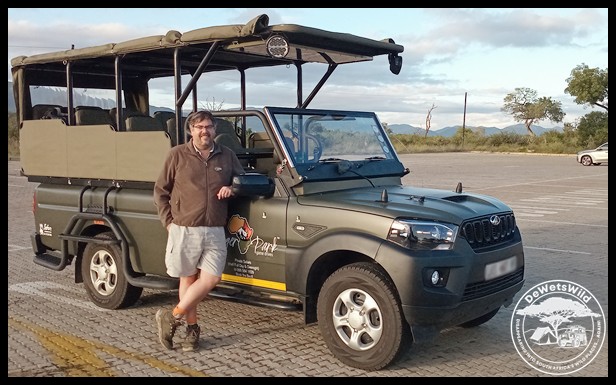
DeWetsWild conducted a two-week tour of the Kruger National Park with altogether nine people to see out 2025 and ring in 2026 and every day for the month of February I’ll be sharing just a few of the many memories our group collected.

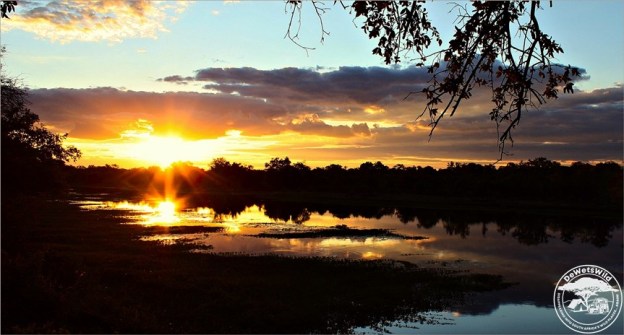
Seems like a few of silhouettes is a good way to bring my recollections of this trip to a close.

If you’d like to join me on a guided tour of South Africa’s wild places, of even if you’d just like a bit of help putting your reservations together, don’t hesitate to reach out!

Summer Snapshots from Kruger: Beautiful Gudzani Dam

DeWetsWild conducted a two-week tour of the Kruger National Park with altogether nine people to see out 2025 and ring in 2026 and every day for the month of February I’ll be sharing just a few of the many memories our group collected.

At the end of the most popular route around Satara, the S100 gravel road, lies the tranquil Gudzani Dam, and man-made impoundment that holds water throughout the year and even during prolonged dry spells. No signs of drought this time around though!
If you’d like to join me on a guided tour of South Africa’s wild places, of even if you’d just like a bit of help putting your reservations together, don’t hesitate to reach out!

Summer Snapshots from Kruger: Bountiful Birds

DeWetsWild conducted a two-week tour of the Kruger National Park with altogether nine people to see out 2025 and ring in 2026 and every day for the month of February I’ll be sharing just a few of the many memories our group collected.

While the Kruger National Park boasts an exceptional number of bird species on its official list even during winter, the summer brings with it an enormous number of migrants, and even more so in a season as wet as the current one. During our tour of two weeks we managed to tick off 187 bird species in the area between the Letaba and Sabie Rivers. These are just a few of them.

If you’d like to join me on a guided tour of South Africa’s wild places, of even if you’d just like a bit of help putting your reservations together, don’t hesitate to reach out!