
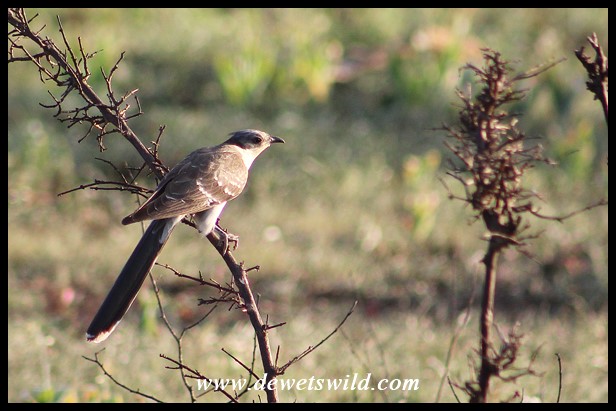
Clamator glandarius
The Great Spotted Cuckoo is another summer visitor to South Africa, with birds arriving here from the Mediterranean and equatorial Africa in September and staying until April or May. While here they have a rather patchy distribution, with concentrations in the Lowveld and northern Gauteng.
Great Spotted Cuckoos live in grasslands, savannas and open woodlands. They feed mainly on a wide range of invertebrates, especially caterpillars.
Like others of their kind, Great Spotted Cuckoos are brood parasites, with this species targeting crows and starlings for the raising of their chicks. Females lay between 1 and 4 eggs, usually 2, in the host nest, and as many as 23 eggs in a season. The chicks don’t usually kill their adoptive siblings but will peck at them. The chicks leave the nest between 3 and 4 weeks after hatching. They grow to 39cm in length and weigh about 130g.


 DeWetsWild
A most impressive cuckoo!
Deserving of its “great” moniker!
Hei Dries, het jou liewe vrou vandag vir my saam met Joshua ‘n present gestuur??
Net n klein dankie sê vir sy Ouma se heerlike lemoenkoekresep wat Joshua haar van vertel het, Tannie Frannie!
Sy het my hart so bly gemaak❣
Ek weet dit is hier ook die geval!
Ek het ook gewonder oor daardie eerste foto waar die koekoek ‘n wurm in sy mond het … op die klein fototjie het dit soos ‘n voel met ‘n baie lang en skewe snawel gelyk! Maar van naderby, kon ek eintlik sien hoe ‘n goeie foto dit is!
Wat my verstom is hoe hulle die brandwurms gesluk kry!!!
Siesa!
Another cuckoo I have not had the pleasure of seeing and so have enjoyed your photographs.
Some summers they’re quite numerous here up north, Anne, and other years there seem to be none around!
I had to laugh at the photo with the cuckoo holding the worm because it first appeared that the bird had a very unusually curved beak! 🙂 I was relieved to find out it was actually a worm. 🙂
Love, love, love the new logo/gravatar!
You are very kind, Janet! I also loved the design the moment I saw the first draft. It is just so “us”.
I suppose it is the same in North America, that hairy caterpillars give a nasty sting? It baffles me that this bird is able to swallow it!
It is “you.” I believe that’s true of at least some caterpillars here. Fortunately I’ve never been stung by one!!
I picked one of them up when I was little and it was a lesson well learned!
Yikes! The sort of lesson you never forget!
Brood Parasitic birds are not well received in other nests by many species. Thanks, D. 🙂
Very true, H.J, and the tactics the cuckoos use to get their eggs into the host nest is often very fascinating!
‘don’t kill them but will peck at them.’ Good gosh! It is a fine-looking bird, though.
Some (most?) cuckoos will kill their nest mates quickly after hatching, Lois. Sounds like a difficult philosophical debate: which is the lesser evil? Murder or abuse? Murky waters…
Oh my goodness…murky waters, indeed, Dries.
Population of least concern is good for this Great Spotted Cuckoo. Great photos as usual!
You’re as kind as always, Hien. Thank you very much.