
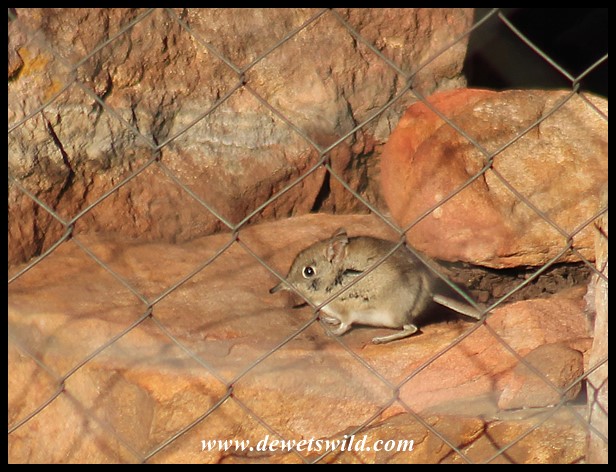
During our recent visit to Marakele National Park, while enjoying the magnificent view from the Lenong Viewpoint, we spied a little Eastern Rock Sengi basking in the early morning sun – a habit they are particularly fond of – behind a fence surrounding one of the communication towers also built atop the mountain. While the fence is a rather irritating obtrusion in these photo’s of ours, it is probably because of it that the Sengi felt comfortable enough to be out and about, safe in the knowledge that neither us humans nor any other predator could reach it!


Elephantulus myurus
The Sengis, or Elephant Shrews, (order Macroscelidea) are a family of 20 small, insectivorous mammal species occurring only in Africa. While they’re superficially very shrew-like they are in fact not related to shrews at all (and they are in fact more closely related to elephants, even if their “trunks” aren’t nearly as long and prehensile), which is why the scientific community is trying to move away from the old moniker in favour of Sengi, a name based in indigenous African languages.
The Eastern Rock Elephant Shrew, or Sengi then, occurs widely in South Africa’s northern and eastern provinces and throughout Zimbabwe, extending into portions of Lesotho, Eswatini, Botswana and Mozambique south of the Zambezi. The IUCN considers it to be of least concern.
As suggested by its name, the Eastern Rock Sengi is always found in close association with rocky areas where they hide in cracks and tiny caves among the boulders. Here they subsist on a diet that consist of insects (mainly ants and termites) and other invertebrates, though they will also eat seeds. They are diurnal, very rarely venturing out in the dark. They are also very alert and nervous, usually dashing for cover at the slightest disturbance.
Eastern Rock Sengi’s are mainly solitary and seen in pairs only while they breed during spring and summer. Females usually give birth to twins after a two-month long gestation. The young are very well developed and can move around with their mother soon after birth. Fully grown, Eastern Rock Sengi’s measure about 26cm long (of which the tail is more than half) and weigh approximately 60g. They have a very short lifespan and may live to only around 18 months of age in the wild.
 DeWetsWild
Kyk die spits neusie (of is dit nou klein slurpie)! Soos Aletta, het ek ook nie geweet daar’s so ‘n diertjie nie … dankie dat jy ons aan soveel diere van Afrika voorstel!
Ek is bly dat ons dit kom doen!
Lovely little creature
It really is the cutest little thing, Sue. Pity that the photo’s can’t show that tiny trunk moving around.
Awww
Trunk! You mean snout, surely!😳😂
Well, an elephant shrew should have a trunk, shouldn’t it?
😄😄😄😂
Dis so ‘n oulike diertjie Dries! Weereens is jou en Joubert se foto’s so pragtig! Ek het nie eens geweet daar is sulke diere nie!
Baie dankie, Aletta. Suid-Afrika het so n ryke verskeidenheid van lewe – ons het ook nog baie om te sien!
Dis waar☺️ dankie dat jy dit na ons toe bring met al julle pragtige fotos en inligting.
I love the way you highlight the little creatures too.
I know you have an appreciation for the less famous animals too, Anne – big or small, we love them all!
Dis te dierbaar. Baie interessante dirtjie en dat jul hom so mooi kon sien is iets besonders. Die heining maak juis dat die fokus baie duidelik is. Nogmaals dankie vir jul pragtige bydraes.
Jy is altyd so gaaf, Ineke. Baie dankie.
Jul is self baie gaaf en baie, baie spesiaal. Ek het gister ‘n Bellbird hier by my Camelia gehad. Was mannetjie wat helderder kleure het, besig om heuninkies uit blomme te drink.Hul is baie skaam en skaars, en mens sien hul nie sommer nie. https://www.doc.govt.nz/nature/native-animals/birds/birds-a-z/bellbird-korimako/
Opreg baie dankie, Ineke.
Die Bellbird is pragtig! Lyk heeltemal anders as enige voel wat ons hier het.
Hier is nogal ‘n groot verskeidenheid anderste voëls as mens dit met SA vergelyk. Ek moet nou weer van vooraf nakyk wat elkeen is en dit dan nog in Engels ook, sug. Hou my aan die gang.
Dis lekker om iets nuuts te ontdek!
Dit is beslis so. Ek kon vandag weer ‘n pukeko wat doodgery is van naby bekyk. Vreemde voël vir my omdat ek hul nie gewoond is nie.
How lucky you were, Dries. The photos are lovely despite the fence.
Thank you very much, Tracy
Thank you for this information on this interesting little creature. It reminded me of the tiny marsupial mice in Australia that we saw there.
Paying attention to the little things is often handsomely rewarded, Anne. Marsupial mice sounds equally interesting!
Cute little mammal! 🙂
It really is, H.J!
What a lovely little creature, great capture through the wire.
Thanks a lot, Maamej!