
Mapungubwe Hill and the valleys around it, today part of the Mapungubwe National Park and World Heritage Site, was the seat of a powerful African Kingdom that ruled between 1,100 and 700 years ago. Mapungubwe Hill is by far South Africa’s most important iron age archeological site and can be visited on guided tours.


The Interpretive Centre at Mapungubwe, itself an award-winning architectural marvel, provides a fascinating glimpse into the daily lives of the people who lived in the Kingdom of Mapungubwe. Royalty ruled from atop the hill, with their subjects living below. The Kingdom’s riches were based on gold and ivory, traded with cultures from as far afield as Persia and China through a trade route leading through the east coast of Africa. Mapungubwe means “Place where rock turns into liquid” in reference to the smelting of gold practiced by the country’s citizens.


The rich archeological treasures of Mapungubwe were re-discovered in 1933. Having been recognised formally as a National Monument in 1984, the Mapungubwe Cultural Landscape was inscribed as a Unesco World Heritage Site in 2003.
 DeWetsWild
Pingback: Mapungubwe National Park | de Wets Wild
Baie interessant Dries!
Ons stem geheel-en-al saam, Aletta!
An interesting array of pictures, Dries.
Mapungubwe’s Interpretive Centre really is a must-see attraction, Anne.
This is fascinating, Dries. A gold and ivory trading kingdom a few centuries older than Great Zimbabwe but serving similar overseas markets. Also intrigued to see the ancient board game. It’s still played throughout East Africa, called Mbao or Bao: https://en.wikipedia.org/wiki/Bao_(game) I tried to fathom the mechanics of the moves once, but was utterly confounded by the intricacies.
The thinking is actually that the people of Mapungubwe were the forebears of those who were responsible for Great Zimbabwe. Amazing to think that such a rich, influential and powerful dynasty once existed on a continent so often regarded as “dark”!
Absolutely agree with your last sentence, Dries. So much of Africa’s history is ‘lost’ or ignored by the outside world. Especially that some of the continent’s kingdoms and empires (e.g Mali) were in many ways far more culturally advanced in the early medieval period than much of Europe.
Fascinating, Dries. The countryside looks fairly inhospitable. Perhaps that reflects the Kingdom of Mapungubwe? The Interpretative Centre looks rather like termite mounds. They must be cool inside.
The centre blends beautifully with its surroundings, Tracy. Really deserving of the accolades it received.
The floodplain of the Limpopo is actually quite fertile. Outside the Park there are large fruit and cotton farms benefitting from the river’s flow.
Ah, thanks for the info, Dries. It did look spectacular.
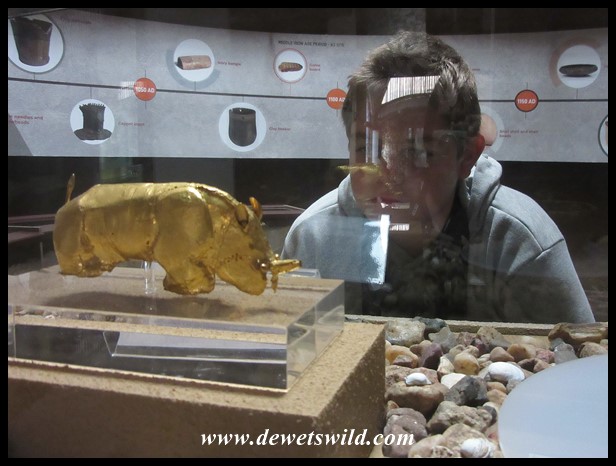
Interesting place, and I, too, love the gold rhino
We thought it is really fascinating to think what was happening here so very long ago, before European influence in Africa’s affairs.
Indeed, history can be most informative, not to say fascinating
Ek het die goue renoster al voorheen gesien. Baie bekend😍
En nie om dowe neute nie, ne!?
Omtrent
That looks fascinating. ❤
And it truly is, Janet. Amazing to think what went on here so long ago.
Dankie weereens vir ‘n uitstaande stuk geskiedenis/inligting en fotos.
Die geskiedenis van Mapungubwe is so fassinerend!
Ek stem saam en mens leer telkens weer iets by.
The golden rhino is beautiful.
It is an amazing relic, Lois