
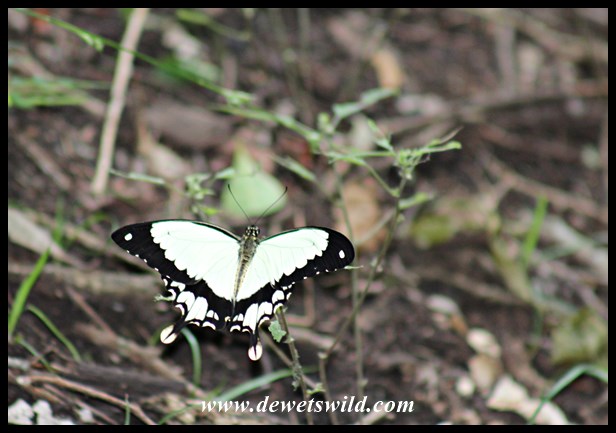
Papilio dardanus
Not only is the Mocker Swallowtail one of the biggest and most beautiful butterflies to be found in South Africa, but it can also be one of the most confusing! The males, also known as Flying Handkerchiefs, boast extravagantly shaped wings with striking black and cream-white markings, while the females are excellent at mimicking at least 14 other species of foul-tasting or poisonous butterfly across their sub-Saharan African distribution, with their comparably larger size usually the best clue to their true identity. Adults have a wingspan measuring up to 11cm and fly throughout the year, though much less numerous in the cooler months.
The Mocker Swallowtail inhabits riverine, montane and coastal forests. In South Africa it is commonly found from the Garden Route, through Kwazulu-Natal and along the escarpment of Mpumalanga and Limpopo to the Soutpansberg range.
Larvae feed on a wide range of food plants from the Rutaceae family which includes citrus plants. The feminine progeny of a single female can metamorphose into a variety of mimic forms and don’t necessarily all look like their mother. Larvae grow quickly and complete their transformation within a few weeks.


 DeWetsWild
I did not know that about the female mimicry – I assume that is where the name ‘mocker’ comes from? I fairly often see butterflies with the male colouration here in our garden but they flit about so fast seldom resting so that they are very difficult to photograph. I will try to look out for larger butterflies that might be females in some of their various forms!
The females appear much more relaxed than the males – perhaps because they mostly resemble other butterflies that aren’t readily included in the menu of their enemies. Getting the males to sit still for a photograph proved very tricky – seemed the cool of early morning with a damp in the air was the best time to get them to co-operate.
what a beauty
Absolutely!
Fascinating – love the nickname too. It made me think of the tree, the handkerchief tree, Davidia involucrata.
I had to google the Davidia involucrata, and I’m so glad I did – what a beautiful and unusual bloom that is, Ann-Christine!
Isn’t it? I had a good friend who managed to grow one in his own garden – unfortunately he sold his house, and I don’t know if the tree is still there. Otherwise we have it in some of our botanical gardens.
What an interesting adaptation. I don’t quite understand how they mimic. do they see another and take on its shape and color, or is it somehow genetic?
It’s genetic, John and typically the species the females “impersonate” are either unpalatable or poisonous, so it probably evolved through natural selection over countless generations. Interestingly females of several forms may come from the same batch of eggs, the daughters don’t even have to imitate the same species their mother does, so until they emerge from the pupae it’s anyone’s guess what mimic will appear!
Fascinating!!
Agreed!
Beautiful and well named!
They’re so special. Thanks for visiting with us again, Montucky!
What a stunner, one I’ve not heard of before. The simplicity of black & white can make for the most beautiful of butterflies. Nice post👍
I think of these as being butterfly royalty. Thanks, Brian.
We are beginning to see more butterflies in our garden. Until my eyes come right after my operations and I get new spectacles in May I am enjoying them without trying to photograph them. Your photographs are lovely to look at – I can take time over them 🙂
I wish I could raise a few of these in my garden, but that wouldn’t be fair to them.
So beautiful and quite confusing with its many different guises. I love the nickname.
They’re a delight to behold, Sylvia!
Fascinating! 11cm wingspan is a pretty big butterfly.
I stand to be corrected, Ally, but I think they’re the 2nd largest butterfly in the country – only the Emperor Swallowtail is larger as far as I know.
The Flying Handkerchief… a good name; but, just don’t get too close to someone in tears or with a cold!
Seriously, fascinating facts. I’m surprised by ability to find them year-long, their size, and quick time for transformation! ~Jane
🙂
Getting this handkerchief to play along when you need it for the sniffles will be rather difficult!
Amazing! Butterfly disguise!
And perfected at that!
Pretty butterfly with a weird name. Thank you, D. 🙂
Thanks, H.J. – Seen in real life the name would make perfect sense to you!
Even if it weren’t an attractive butterfly, the name The Flying Handkerchief would make it beautiful in my eyes. It’s like something Inspector Clouseau would say in a Pink Panther movie. 🙂
janet
A fanciful name for a fanciful creature!
True.
The Flying Handkerchief?! That is the cutest name! And a very pretty butterfly, indeed.
If you see the male flying through the forest the name really comes into its own!