
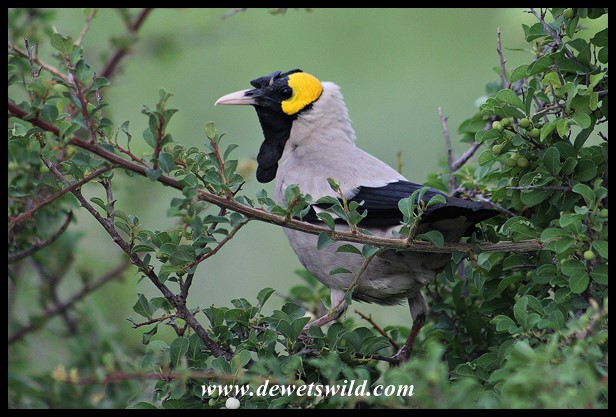
Creatophora cinerea
Certainly one of our most social and numerous starlings, the Wattled Starling is also a nomadic bird that moves around in large flocks, following surges in insect numbers and seeding grasses, their principal foodstuffs, that often follow on good rains. They’re well known for following large grazing herbivores, eagerly pecking up insects disturbed by the movement of the large animals through the vegetation. Wattled Starlings are mostly found in open habitats with short grasscover, ranging from semi-deserts to savannas and open woodland.
Wattled Starlings nest colonially, with monogamous pairs building their untidy ball-shaped stick-nests in close vicinity to one another in thorny trees, with their breeding season spanning most of spring and summer. The parents take turns to incubate the clutch of 2-5 eggs over a period of only 11 days and co-operate to feed the chicks, which leave the nest about two weeks after hatching without being able to fly yet. As a result the nesting colonies are often heavily predated on by birds of prey and other meat-eaters for these easy pickings. Fully grown adults weigh in at about 70g and measure around 21cm in length. The pronounced wattles and brightly coloured facial features of the males are seen only during the breeding season, with older males having the most impressive appearance.
Wattled Starlings are commonly recorded in all South Africa’s provinces, with its wider distribution stretching throughout southern, central and eastern Africa to Ethiopia and Somalia. The IUCN considers the Wattled Starling to be of least concern.


 DeWetsWild
Noticed the wattled starling during the winter and spring. Once the wattles grew they no longer visited our garden. Now in June they are back in full force. Benoni 2023
Several kinds of birds are more common in our suburbs during winter than in summer and I think that might be because it is easier to find food there during that time, Barbara. Wattled Starlings are interesting birds and how lucky you are to have them visit your garden!
Very interesting birds to see. I wonder if, in addition to the parasites in the nests in close proximity, predators are also attracted to the nesting colonies?
It seems the predators have an especially easy time in that period between the chicks leaving the nest and learning to fly, Carol, which makes their eagerness to leave the nest even more baffling.
Such an informative post as always, Dries. Those poor babies must be terrified when they get thrown out of the nest before they can fly. Sink or swim. 😳The mating plumage is irresistible. 😍
Having seen how the youngsters behave around the adults I bet the parents can’t wait for them to get out! 😀
Thanks for the kind words, Sylvia!
I am always in awe of your wildlife photos. You must spend many hours chasing birds to build galleries like you share in your posts. Interesting how they leave the nests before being able to fly. That seems an unusual natural adaptation.
You’re being as kind and generous with your commentary as ever, John, and I really appreciate it.
There must be a very good reason for them to leave the nest prior to fledging and risk predation; as I said to Lois my guess would be that the communal nesting trees quickly become overrun by parasites and therefore the need to abandon the nests as quickly as possible. But it’s just my guess. Perhaps I should (I definitely should!) quit my day job and start studying the breeding behaviour of the Wattled Starling for a few seasons and get us a definitive answer for such strange (to us anyway) behaviour.
I wonder if they went after those locusts that migrated from Africa and are now invading China.
For China’s sake I hope there’s native wildlife left there to help keep the locusts under control – swarms as large as those that’s currently raiding eastern Africa are absolutely devastating to a country’s food security, especially so those already impoverished.
Very interesting – and a lovely variety of photographs. I find these birds fascinating.
Thanks very much, Anne. They’re quite frustrating to watch, being so constantly on the move, and quickly too, so that it’s difficult to keep one bird in the eye and see what it gets up to.
The breeding colors are great.
Like a child coloured it with her brightest pencils!
Life is tough in the savannas of Africa. However, they manage well and thrive/ Great post, D. Thank you. 🙂
Tough and beautiful here in Africa, H.J. That’s for sure.
How and why do the babies leave the nest unable to fly? Poor things.
That’s a very interesting question, Lois, and I don’t have a definite answer. But if I were to hazard a guess I’d say that the massive numbers and close proximity of their nests in the breeding colonies probably causes a massive increase in parasites (fleas, lice, mites) to the point where staying in the nest becomes unbearable.
Oh, dear. That would be a good enough reason to leave. Thanks, Dries.