
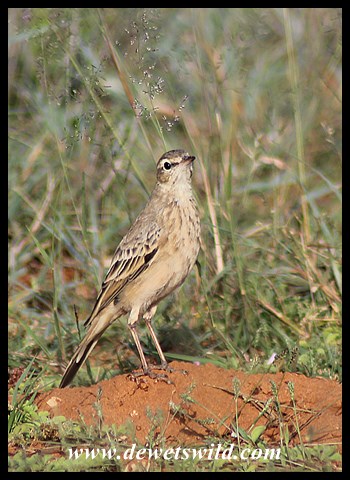
Anthus vaalensis
An inconspicuous inhabitant of dry, grassy plains with patches of bare ground as well as open pastures and recently burnt fields, the Buffy Pipit subsists on a diet of insects and seeds. They are usually encountered singly or in pairs, occasionally forming flocks in winter.
The breeding season in Buffy Pipits stretches from late winter to the summer months, peaking from September to December. Pairs are monogamous and build a rough, cup-shaped nest usually hidden in a grass tussock. Clutches of 2 or 3 eggs are incubated for two weeks, and the chicks leave the nest by the time they’re 14 days old. Adults measure about 18cm in length and weigh around 30g.
The Buffy Pipit has a wide, if patchy, distribution across Africa south of the equator. In South Africa it is to be found throughout the central, eastern and northern parts of the country. With an increasing population due mainly to stock-farming and associated heavy grazing of otherwise long grass, the IUCN considers the Buffy Pipit to be of least concern.


 DeWetsWild
Looks like we have found one advantage of overgrazing! Happy LBS’s!😁😁
Die een se dood is die ander se brood ne!
Very good photos of one of the trickier birds to capture – they always seem to be walking away, half hidden by stones and grass tufts – well done!
Thanks very much, Don! And please, if I happened to miss identify some of these, feel free to put me on the right track – pipits can be very difficult to ID, especially to the colour-blind… 😀
Yes, very difficult indeed! I would be hesitant to identify these birds from photos, especially where the back is not visible – they are known to have caused fist fights between serious birders with differing opinions! However the one thing to look out for in the field is the tail-wagging – Buffy and Plain-backed Pipits both wag their tails in a certain way which can help ID them and separate them from African Pipits which are the dominant species in SA by far
Thanks very much for the pointers, Don.
I’d hate to have a run in with one of those serious birders while identifying LBJ’s – they’ll certainly blow a fuse at my efforts! 😀
Wat van so Afrikaanse naampie vir ons oningeligtes? Ek ken net duiwe, mossies, vinke en volstruise?
Sy Afrikaanse naam is die Vaalkoester, Tina. Jy kan by die “tags” onder aan die post kyk, ek sit altyd die Afrikaanse name daar in.
Oepsie… sug ek word oud. Baie dankie!
Glad nie, Tina!
Well captured and I agree about the charming name.
Very kind of you, thank you Carol
This bird reminds of the Peruvian Thick Knee, that easily can blend with the grasses and practically disappear from sight. Thank you for the post, D. Very interesting, 🙂
Indeed H.J, these pipits can be hidden in plain sight – at least being much smaller than a thick-knee it should be easier for them.
“Buffy pipit” it is such a charming name for a very charming bird! 🙂
Thank you Takami! Buffy is a demure beauty.
they leave the nest at 14 days?! They’re hardly grown!
Life’s tough in Africa, Lois. Why, when I was fourteen days old…
Funny, Dries! 😀
I agree with Janet. He/she has a very posh name. I think that first photo is very flattering, Dries. 🙂
Thanks very much, Sylvia! I think in this case the name’s more flattering than the plumage should allow. It sounds like the name of a Bond girl, but James might be disappointed when Buffy Pipit eventually peeps around the corner. 😉
☺️😂
It may be a more ordinary looking bird but it has a great name! 🙂 Sounds a bit like something an English aristocrat ala Bertie Wooster might say, “I say, Jeeves, that girl is buffy pipit!”
janet
😀
I am never going to be able to look at a Buffy Pipit the same way now, Janet!
😀
😂😂😂