Well, if you ask us what makes the Kruger National Park “THE KRUGER”, our answer wouldn’t be the prolific game or birdlife, awesome as that might be. To us, what makes the Kruger National Park special is the wide variety of habitats and scenery where all this life finds a niche to flourish. At almost 20,000km² in size, the Kruger National Park is bigger than some countries, and naturally a piece of land that enormous would encompass many different landscapes and habitats; in fact there are pronounced differences in the scenery as one travels from south to north through Kruger’s 350km length.
This first gallery of images were taken during my solo visit at the end of May to Pretoriuskop and Skukuza in the south of the Park.

Scenery near Pretoriuskop, complete with a giraffe

Beautiful Blue Water Lily

Impala Lily

Growing Sausage-Tree fruit

The reed-grown bed of the Sabie River

A Sycomore Fig Tree in a dry stream bed near Phabeni Gate

Sunrise over the Sabie River

Sunset Dam at Lower Sabie

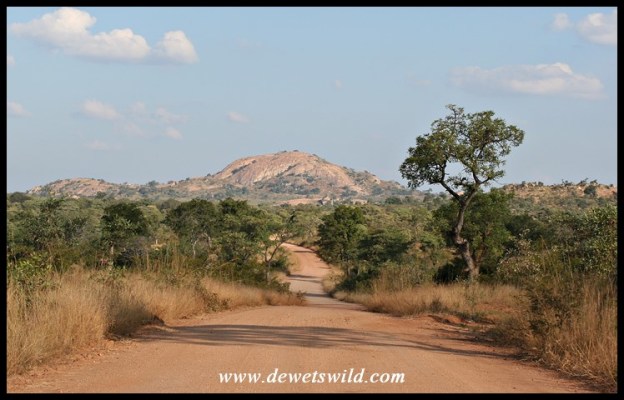
Rocky outcrops are a feature of the Pretoriuskop area

Animals congregating at Transport Dam

Animals congregating at Transport Dam

The Mountains of Malelane

Rocky outcrops are a feature of the Pretoriuskop area

Rocky outcrops are a feature of the Pretoriuskop area

Rocky outcrops are a feature of the Pretoriuskop area – this hill is called Shabeni

Rocky outcrops are a feature of the Pretoriuskop area

Kruger sunset

Rocky outcrops are a feature of the Pretoriuskop area

Sunset near Pretoriuskop
The north of Kruger has a quite different character to the southern parts. Here, the Mopane and Baobab trees dominate the landscape, by virtue of their numbers and size, respectively.
This gallery of images were taken during our visit from 15 to 24 June to the northern reaches of the Park (based at Shingwedzi Rest Camp)

Animals congregating at a waterhole to the north of Babalala

A wide bend in the Shingwedzi River

Giraffe crossing the dry bed of the Shingwedzi

A pool at Red Rocks

A dry Shingwedzi River near Tshange viewpoint

A seemingly serene pool of water at Red Rocks

Baobab with Buffalo Weaver nests

Impala Lily

Impala Lily (Photo by Joubert)

Mopane leaves are uniquely butterfly- or spoor-shaped

Large Jackalberry tree on the Mphongolo Road

Baobab in a see of mopane, on the way to Bateleur

Sunset at the Mphongolo-Shingwedzi confluence

Mopane shrubs

Mopane tree

Sunset elephants in the Shingwedzi (Photo by Joubert)

The last photo taken today – sunset over the dry bed of the Shingwedzi River

Red Rocks from the viewpoint

 DeWetsWild
Most inspirational! Thank you.
So glad you liked this post, thank you Carol!
Whatever one may say about Oom Paul, he deserves the utmost credit for proclaiming this great asset. Magical, indeed.
Absolutely, Leslie – we couldn’t agree more.
Lekker positiewe artikel
Baie dankie, Tina!
Wow, I really didn’t know it was such a vast area!
Thank goodness we still have such large tracts of land where nature can flourish relatively unhindered!
Indeed…
Daar’s ‘n paar landskappe wat ek herken en ook foto’s van het. Die rocky outcrops by Pretoriuskop. Die groot ronde een is pure graniet – sê mense my.
‘n Fantastiese gallery van fotos van die KNP Dries. Wil nog eendag die noorde besoek.
Jy sal beslis nie spyt wees as jy bietjie noord van die Letaba gaan verken nie, Petru.
Amazing pictures.
Thank you, and welcome here!
Asemrowende foto’s – van die landskap met die kameelperd wat so diep dink tot by die pragtige mopanieblare…
Baie dankie Tannie Frannie!
Kruger, oh Kruger … if only we did not live so far away! I have Kruger in my blood, having visited it since I was about four years old. Now I experience such heimwee when I see your photographs! A day spent at Addo yesterday assuaged that – a little!
Addo has a much different “sense of place” to it compared with Kruger, and that makes it a worthwhile destination all its own. The recent expansions to Addo, from the Karoo beyond the Zuurberge to the Indian Ocean, really puts Addo in a class of its own as well there simply isn’t any reserve anywhere on earth that can compare to Addo in its current state, and that gets me really excited!
(And not forgetting the relaxed ellies!)
Weereens ongelooflike mooi foto’s van die Kruger Wildtuin. So lekker om dit deur jou oe te sien. Was so lanklaas daar.
Heerlik om jou saam met ons Wildtuin toe te vat, Aletta, en jy moet net roep as jy wil he ons moet help beplan aan jul volgende besoek!
Sal beslis so maaj
Beautiful photos of both animals and plants!😊 It’s a dream to go to the Kruger Park! My sister and her husband have been there on safari.The Kruger Park is the most famous and well-known in the world. I watch Nat Geo Wild, on that channel they show a lot from Kruger Park.
It really is deserving of all the accolades, John, and when you come to see Kruger for yourself we’ll meet you there!
Joubert–I am going to pretend you took the elephant photos for me. 😀 I did not realize how huge Kruger is!
Thank you, Lois!
Places like THE KRUGER, where nature still rules supreme over large tracts of land for the most part, are so precious. There are very few such places remaining.
Thank you, Lois!
Places like THE KRUGER, where nature still rules supreme over large tracts of land for the most part, are so precious. There are very few such places remaining.
Beautiful images!
Thank you very much, Shikha. It is easy to come away from such a beautiful place with beautiful pictures.
No doubt, it’s so beautiful! 🙂
There really is only a few places that compare to Kruger remaining on the planet.
There really is only a few places that compare to Kruger remaining on the planet.