
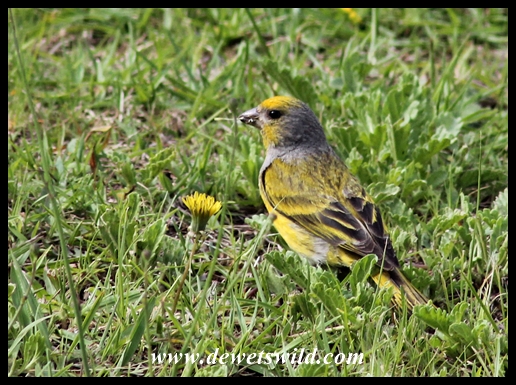
Serinus canicollis
The Cape Canary inhabits arid scrub, fynbos, grassland, dune vegetation, agricultural fields, parks and gardens, even at high elevations. They’re usually encountered in small flocks, though these occasionally swell to number 500 or more birds, and subsist on a diet comprised chiefly of grass and weed seeds.
Breeding in the Cape Canary has been recorded throughout most of the year, with a peak in the spring and early summer. Their cup-shaped nests are built in tall trees using soft plant material. Clutches of up to 5 eggs are incubated for about two weeks, with the chicks leaving the nest when they’re about 3 weeks old. Adults measure about 12cm in length and weigh around 17g.
Naturally, the Cape Canary occurs only in the highlands on the border of Mozambique and Zimbabwe, in Swaziland, Lesotho and South Africa (parts of all provinces except North West). Apparently they have also been introduced to Mauritius and Reunion in the Indian Ocean. The IUCN lists the Cape Canary as being of least concern. though trapping for the illegal caged bird trade should be of concern.


 DeWetsWild
we are privileged to have some in our garden in PE….breading in the back in a big tree…just bought their 3 babies to come and eat and bath in our fountain….
How wonderfully fortunate you are to have these beautiful birds feel safe enough in your yard to nest and raise their family!
Ons het sommer baie van hulle hier in die tuin!
Wat n groot voorreg, Aletta!
It really is a beautiful little bird. Last time I saw one was in the village of Rhodes were it was surprisingly tame, foraging on the ground nearby.
That’s a very lucky encounter, Carol – they’re normally so shy and retiring!
Are they really canaries or is it just a name? Or, are all canaries just not finches?
This is a true canary, AJ – very close family of the domesticated variety.
Lovely!
Aren’t they!?
Pretty little fellow!
Definitely – pity they so seldom let you come close enough to appreciate their prettiness to the full.
Very pretty. I do like yellow on a bird. 🙂
janet
Many of our canaries are rather drab, so this is one of the nice exceptions!