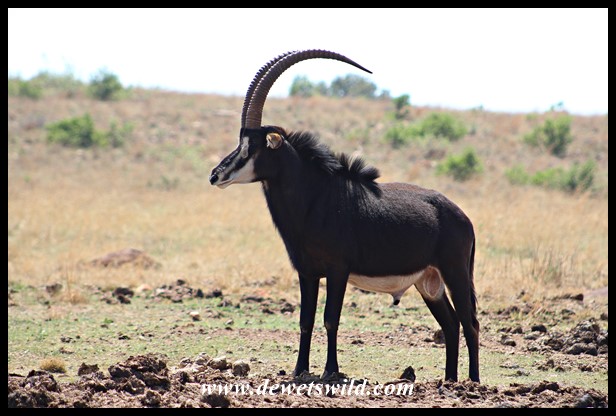
Hippotragus niger
To us, the Sable is the most majestic of all the antelope – the proud bulls with their gracefully curved horns, pitch-black bodies and contrasting white stomachs make a sight to behold! The Sable is a large antelope, weighing from 180 to 270 kg and standing up to 1.4m high at the shoulder. Bulls are only slightly larger than the cows.
The Sable Antelope inhabits open woodland and savannas, with medium to long grass, large trees and few shrubs. They are seldom far from water as they need to drink daily. They are almost exclusively grazers, consuming only small quantities of leaves and herbs, especially in the dry season.


Adult bulls maintain territories through ritual display and serious fights, and attempt to keep passing herds of cows and their calves in their area so that they can mate with receptive females. Breeding herds number about 20 animals, though larger, temporary groups of up to 200 may form in areas of good grazing. Males that aren’t able to hold territories come together in small bachelor herds. A strict hierarchy applies in both the bachelor and breeding herds, and appears to be based on age – the older the animal the higher its rank. Sable Antelope are most active in the early mornings and evenings, sometimes into the night, and rest in the shade during the heat of the day. Sable can be very dangerous and defend themselves valiantly against predator attacks – when cornered they will back into a thorny bush and face the attacker head-on with powerful swipes of those magnificent horns – even lions have been killed by Sable!
Most Sable calves are born in the rainy season, after a gestation of about 9 months. Cows leave their herds a few days before their calves are born and the calf then stays hidden for 2 to 4 weeks, during which time the mother nurses it twice daily, before joining up with the herd again. Young bulls are expelled from the herds at about three years of age to join bachelor groups, until they can establish their own territory at 5 – 6 years of age. Females remain in their maternal herds. Lions and crocodiles are the only natural threat to adult Sable Antelope, but leopards, cheetahs, spotted hyenas and wild dogs take a heavy toll on calves, especially while they are kept hidden those first few weeks of life. Sable have a life expectancy in the wild of between 10 and 18 years.
With a relatively stable population of 75,000 distributed from southern Kenya to northern South Africa, the IUCN considers the Sable Antelope as being of least concern overall, with at least half of this population occurring in protected areas. Outside of formal conservation areas they are becoming increasingly rare due to hunting and loss of habitat. An isolated population in Angola, known as the Giant Sable (H.n.variani) numbers only between 200 and 400 and is considered critically endangered. In South Africa, Namibia and Zimbabwe the Sable is regarded a valuable game ranching animal (mostly for trophy hunting) and as a result has been introduced widely onto private land, also outside their historical distribution range, representing the only sub-populations that are actually increasing in number and now make up about a quarter of the total population. South Africa’s biggest natural population occurs in the Kruger National Park, where their numbers have dropped significantly over the years due to competition from other herbivores. They can also be seen, amongst others, at Marakele, Mokala and Pilanesberg National Parks, at Loskop Dam and Willem Pretorius Game Reserves and in the Kgaswane Mountain Reserve.


 DeWetsWild
Pingback: A memorable encounter with Sable Antelope | de Wets Wild
You do get just the most amazing wildlife photos! 🙂
You’re very kind, thanks Linda. I wish we could see sable antelope more often so that I can get more photos of them – to be honest, I don’t think these images really do these majestic animals justice.
Nog net een in die wildtuin gesien baie jare terug. Was ook net geluk gewees want mens sien hul nie sommer nie. Pragitge dier.
Vir ons is hulle regtig die mooiste boksoort, en sou hulle regtig ook meer dikwels wou sien!
Beautiful Animal.
We’re 100% in agreement!
Very beautiful antelope.😊
We think they’re the most beautiful there is!
Hi guys. Stunning photos of these beautiful antelope. I have seen Sable bachelor herds on the grassy plains just west of Satara camp in Kruger and females with young further north, close to Shingwedzi. I get angy when a population of 75 000 is considered ‘of least concern’ when a hundred years ago there were millions of these magnificent antelope in Africa!
Once seen they’re never forgotten, these beautiful antelope. How wonderful it must have been when they still roamed our continent in their numbers! I guess there’s hope to be had in the fact that the remaining populations are taken relatively good care of.
It is always a privilege to see a Sable.
Just wish we had the honour more regularly!
Dis darem een van die mooiste bokke! Pragtige foto’s, Dries!
Vir ons is hulle die heel mooiste, Dina. Jammer ons sien hulle so selde.
Ja hulle is maar skaars! Ons het reuse troppe gesien in Mahangu wildreservaat, op die grens tussen Botswana en Namibië. Fantastiese klein reservaat, ‘n besoek werd.
Wonderlik om te hoor dat daar nog plekke is waar swartwitpense floreer – dankie Dina!
Wow they are just beautiful 😍 thanks for sharing their pics. Loved it 😊
Glad to know you liked our post about our favourite antelope so much!
They are so beautiful. On our South African safari we saw only 1 lone bull but he was extraordinary! Wonderful captures. You are blessed to be among them!
Thanks very much, Tina! We’d love to see the Sable more often, for they really are magnificent.
They are very handsome!
Agreed, Montucky!
Really striking antelope, with such graceful lines and colors! It is a fighter too if it can kill a lion when cornered. Thank you Dries for a marvelous post and photos!
They’re really remarkable animals, Hien! Thanks for visiting and the very kind comment!
A beautiful animal, thank you for sharing
What a pleasure!