Connochaetes taurinus taurinus
The Blue (or Common) Wildebeest must be one of Africa’s most familiar antelope, although it will probably never be included in a list of the continent’s most elegant creatures. Bulls stand around 1.5m high at the shoulder, and weigh about 240kg, while cows are more lightly built at around 180kg.

Blue Wildebeest bull close-up

Blue Wildebeest calf close-up

Blue Wildebeest cow close-up

Blue Wildebeest

Blue wildebeest

Blue wildebeest

Blue wildebeest

Blue wildebeest

Large concentration of blue wildebeest at Langklaas waterhole

Blue Wildebeest having a rest in the shade

Blue Wildebeest with an unusual chevron mark on its muzzle

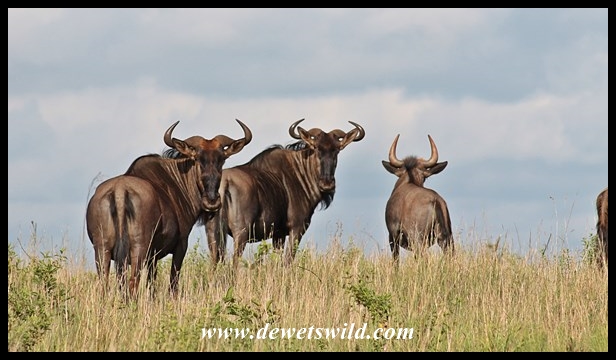
Blue Wildebeest herd
Blue wildebeest inhabit open grasslands, savannas and semi-deserts, where they subsists almost exclusively on short grasses and require a reliable supply of water, even in arid regions.

Blue wildebeest are curious creatures

Blue wildebeest graze on short grass

Vigilant blue wildebeest bull

Blue wildebeest require regular access to drinking water

Always on the move

Blue wildebeest like open terrain

Blue wildebeest too nervous to drink

Blue wildebeest on the move

Wildebeest herd kicking up dust at Makhadzi

Big herd of blue wildebeest at the water

Blue wildebeest

Blue wildebeest

Even Blue Wildebeest appreciate a beautiful spot, like Bhekapanzi Pan

Blue Wildebeest

Blue Wildebeest

Blue Wildebeest

Blue Wildebeest in the rain

Blue wildebeest

Blue Wildebeest

Blue Wildebeest (photo by Joubert)

Blue Wildebeest

Blue Wildebeest

Blue Wildebeest calf

Blue Wildebeest

Blue Wildebeest

Blue Wildebeest

Blue Wildebeest

Blue Wildebeest

Blue Wildebeest in Mapungubwe National Park

Blue Wildebeest in Mapungubwe National Park

Blue Wildebeest in Mapungubwe National Park

Blue Wildebeest at Mooiplaas

Blue Wildebeest
These diurnal herbivores congregate in herds of up to 10,000 (but mostly much smaller – a few dozen or so), consisting mostly of cows and calves traversing the territories of mature bulls. Smaller bachelor herds made up of bulls unable to maintain a territory of their own also occur. They will cover enormous distances trekking after fresh grazing and water. Blue wildebeest are commonly found associating with other game species, especially impala, giraffes and plains zebras, and have a curious love for rolling in mud and dung!

Blue wildebeest at rest after a stormy night

Blue wildebeest cow

Blue wildebeest often associate with other animals

Blue wildebeest “teenagers”

Blue wildebeest love rolling in mud or dung

Blue wildebeest “teenager”

Blue wildebeest

Blue wildebeest

Blue wildebeest

Blue wildebeest

Curious Wildebeest Calf

Blue Wildebeest

Blue Wildebeest

Blue Wildebeest

Blue Wildebeest

Blue Wildebeest

Blue Wildebeest

Blue Wildebeest

Blue Wildebeest

Blue Wildebeest

Blue Wildebeest

Blue Wildebeest (photo by Joubert)

Blue Wildebeest

Blue Wildebeest herd drinking from the Transport Dam
Calves are born in the herd at the onset of the rainy season and can walk within 10 minutes of birth. Blue wildebeest have an expected life span of around 15 years, fall prey to all Africa’s large predators and also suffer from several parasites and sicknesses.

Whispering sweet nothings?

Blue wildebeest calf

Blue wildebeest youngsters

Blue wildebeest twins

Blue wildebeest calf staying close to mom

Blue wildebeest calf staying close to mom

Blue Wildebeest

Blue wildebeest cows

Juvenile Blue Wildebeest

Blue wildebeest

Blue wildebeest cousins

Blue wildebeest herd

Blue wildebeest

Blue Wildebeest

Blue Wildebeest

Blue Wildebeest

Blue Wildebeest

Blue Wildebeest
In South Africa, Blue Wildebeest can be found in all of the northern provinces, though mostly confined to national parks, nature reserves and game ranches. Large populations can be found in Kruger National Park, Hluhluwe-Imfolozi Park, Pilanesberg National Park, Kgalagadi Transfrontier Park, Ithala Game Reserve and uMkhuze Game Reserve. The IUCN considers the Common Wildebeest (C. taurinus) to be of least concern in conservation terms, estimating the total population at around 1,5-million, of which 130,000 belong to the southern subspecies, the Blue Wildebeest (C. t. taurinus).

Wildebeest silhouette

Blue Wildebeest

Blue Wildebeest

Fleeing Blue Wildebeest

Blue Wildebeest creche

Baby Blue Wildebeest with mom

Blue Wildebeest drinking

Newborn Blue Wildebeest

Newborn Blue Wildebeest

Blue Wildebeest

Blue Wildebeests

Newly-born Blue Wildebeest stretching his legs

Blue Wildebeest

Blue Wildebeest

Blue wildebeest

Wildebeest pest (photo by Joubert)

Wildebeest pest (photo by Joubert)

Wildebeest pest (photo by Joubert)

Blue Wildebeest

Blue Wildebeest

Blue Wildebeest

Blue Wildebeest

Blue Wildebeest

Blue Wildebeest

Blue Wildebeest

Blue Wildebeest

Blue Wildebeest

Blue Wildebeest

Blue Wildebeest

Blue Wildebeest cow and calf
A unique colour-variation of the Blue Wildebeest, known as the Golden Wildebeest, is sometimes seen on game ranches.

Golden Wildebeest

Golden Wildebeest

“Golden” Blue Wildebeest

“Golden” Blue Wildebeest
 DeWetsWild
Pingback: Satara Summer 2021 – Mingling with Antelope | de Wets Wild
Pingback: Camping fest at Satara | de Wets Wild
Pingback: Creatures Great and Small at uMkhuze | de Wets Wild
Pingback: Pilanesberg National Park: 10 – 13 May 2012 | de Wets Wild
Pingback: The staple diet… | de Wets Wild
Pingback: Dinokeng Game Reserve | de Wets Wild
Pingback: Lichtenstein’s Hartebeest | de Wets Wild
Pingback: Tsessebe | de Wets Wild
Pingback: Mokala National Park | de Wets Wild
Fantastiese foto’s, Dries!
Baie dankie, Aletta!
Pingback: Black Wildebeest | de Wets Wild
Thanks for the great pics and info. You said, that among other places, some of these animals can be found on game farms. Is their meat marketable or is this just for big game hunters?
Glad you enjoyed our blue wildebeest post, thanks Dan. They are hunted mostly for their venison, which is quite good – especially as biltong, which is a traditional salted, dried meat treat that we South Africans eat in enormous quantities.
At the same time that I find wildebeests very ugly and almost scary-looking, I also find them utterly fascinating. They seem to be from another time and place. Your photos are great!
Thank you very much Lex. They’re such unique creatures and worthy of being fascinating!
Took many photos of these during our safari and love your shots, which stirred some wonderful memories. They may seem unattractive at first glance but they definitely grow on you!
Thanks very much, Tina! Africa’s savannas would have been a much emptier place without the wildebeest!
They look so primeval, especially, in the last B&W pics. I can just imagine them looking and acting the same when the first humans came around….
What a sight Africa, and the world for that matter, must have been then, Annette!
Some wonderful captures as always! I have only seen these guys in Nat Geo – often in an unfortunate situation trying to cross a crocodile infested river:)
Seeing the migration of over a million wildebeest through the Serengeti, and across the Mara or Grumeti rivers, is top of our wildlife bucket list, Inger!
Nou wonder ek, alweer… hoe smaak die biltong? 😉
Baie, baie lekker 😀
Ag sies oom… nou koggel jy my! 😉
Ek belowe wanneer ek oor 2 weke weer in die Wildtuin is sal ek n stukkie eet en aan jou opdra 😛
Mmmmm… klink vir my na suur druiwe!! 😛
Why are they called blue? I didn’t see any blue on them, but I had a Yorkshire Terrier that was “blue” but in reality he was a grayish colour ? Does the same go for the Wilda beasts? T. 🙂
You are spot on, Teresa! “Blue” just sounds so much nicer than “grey” 😀
Weer spesiaal Dankie vir die deel
Baie dankie, Tina!
Op die oop stuk veld voor ons huis, waar daar minder matjarras en akasias groei en die gras in die somer amper soos weiding lyk, hou ‘n eensame (dink ek) bejaarde blouwildebeesbul. Op ‘n Sondagmiddag l^e hy rustig in die skadukol digby die watergat en snags hoor ons hom proes. Jacobus s^e hy is leeukos en ons hou ons harte vas elke oggend. Soms verdwaal hy na ander vlaktes op die plaas en dan verwelkom ons hom soos ‘n ou vriend wanneer hy weer een warm middag skielik langs ons snork terwyl ons met die honde gaan stap
Ek wonder of die ou nie aanvoel dat dit veiliger vir hom is so naby aan die mense nie? Wat n wonderlike voorreg om so naby aan die ongerepte natuur te kan leef!
Great shots, Dries. Love the silhouette and the mom with her calf. 🙂
Thanks very much, Sylvia!
Thanks for this post! I have been fascinated by these curious creatures for some time now. Such a strange face. And horns that look more like the buffalo than an antelope. I’ve heard some say they can go through grass like a lawnmower! 🙂
Glad to know you enjoyed our blue wildebeest post so much, Pat – look out for our black wildebeest post next week. They are very efficient grazers, and unlike cattle (and buffalo) do not pluck the grass out of the ground when grazing on their favourite short shoots, so their favourite fields can start looking like neatly manicured lawns at times.
Ek hou van blouwildebeeste,al sê mense hulle is dom en lelik.Dankie weereens vir pragfoto’s en interessante inligting,Dries!
Ons geniet hulle manewales veral, Dina – hardloop mos dikwels so heen-en-weer of hulle in n slapstick toneel speel!
Ek geniet dit as hulle stofbad en modderbad!
Jong diertjies bly maar mooi – selfs ‘n wildebeeskalfie!
Dis die reine waarheid, Tannie Frannie!
I like the two looking at us photo too-
But also the clarity – such a beautiful place
Thanks very much!
I am not sure why – but I don’t seem to get your posts in my reader – I will have to try and find a better way to visit- peace
Ek dink altyd aan die ou van Groen….hulle kyk altyd rond in stomme verbasing asof hulle alles vir die eerste keer sien.
Dis n wonderlike aanhaling, en so korrek – dankie Boeta!
What a différent Life From me! Thanks for sharing That put everything In perspectives
Wild and free sounds like a very nice way to live, doesn’t it!?
It does. But I was thinking about all the nature around you and these animals! The light and all that surrounds you!
We are blessed to have wild Africa so close, that’s very true!
🙂
You’re on the money, Dries. I think I never took taken one single photo of a wildebeest; they graze, migrate and act as a food source for the more notorious inhabitants of the Savannah, so go kind of unnoticed for me…
Ha Maurice, you may just have taken a photo of one inside the belly of a lion or hyena!
😀
Al is hul nou nie hoog op lys van skoonheid/mooiheid nie het jy hul rerig baie mooi voorgestel in jou fotos. Hul is baie interessante diere vr my. Hul lyk of hul velle so sag soos fluweel voel- veral die gesig en neus deel. Baie mooi man!
Baie dankie Ineke! Ja-Nee, beslis mooi van die lelik, die arme wildebeeste…
y het tog op sy manier n aanneemlike gesig. Hul oë is bv nie so kwaai en dreigend soos n buffel nie.
Ek dink mens sou hul oe eerder as “wild” kon beskryf, hulle lyk altyd so of hulle geskrik het!
Maar hul moet altyd op hul hoede wees vir ingeval. Hul lywe is ook maar nie juis vaartbelynd nie. Arme goed!
Alles oe verblindery, Ineke! Wildebeeste is eintlik baie vinnig met fantastiese stamina!
Wys mens hoe goed die natuur aangepas is. Hul is tog vaartbelynd en dan die dun bene en plan lywe. Nou borduur ek sommer lekker.
I love the two looking directly at you. Are twins unusual?
Thanks Lois! Twins are still unusual among wildebeest, but not as rare as with some other large mammals.