Monthly Archives: February 2015

The exuberance of youth

We had plenty of wonderful sightings during our recent three week long holidays in the bush – we already shared much of it with you, and there’s yet more to come in the next few weeks – but this was probably the biggest highlight of the trip!

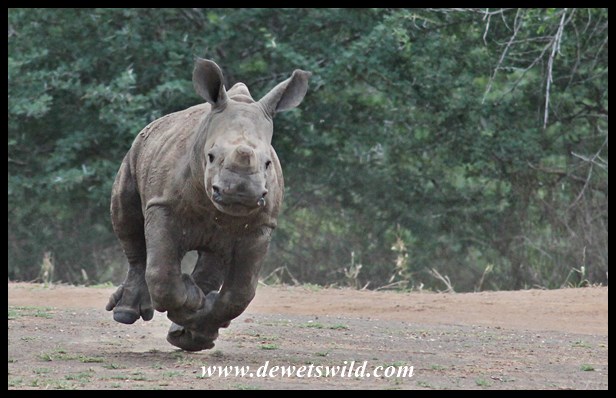
Late in the afternoon of Christmas Eve, in the Hluhluwe-Imfolozi Park, we encountered a white rhino cow and her small calf just where the road goes into and through a thicket of thorny trees. We followed slowly behind as they ambled along, until eventually there was a clearing in the vegetation, just at the spot where there’s also a broad bend in the road. Mom started grazing on the roadside, while her little one decided it was time for some fun. He started running like crazy, at times flying with all four feet off the ground, running circles around his mother and us, then slamming on the brakes in a cloud of dust. Several times he’d charge directly at our vehicle, stopping a meter or two in front of us, only to spin around again, running away at breakneck speed, likely hoping that our silver-grey Jazz was a playmate he could chase and be chased by. Of course, with mom keeping an eye on his antics from close-by, there was no way we could join him for playtime. But inside the car we were laughing out loud in sheer delight.

Eventually he realised that his mom has disappeared around the corner, and he hightailed it to catch up. As we rounded the bend ourselves, we found him next to mom, totally breathless.

We were in awe of the fantastic Christmas present Hluhluwe-Imfolozi had just gifted us.

(you may click on the photos below to view them all in a carousel gallery)

Summer on the Western Shores of Lake Saint Lucia

After uMkhuze, Lake Saint Lucia was the next destination on the itinerary of our December bush holidays. We had only two days available to explore the area, and wanted to pack in as much as we could in that time.

Unfortunately rainy weather brought an early end to our plans of exploring the collection of walking trails around Saint Lucia town. The town is entirely surrounded by the iSimangaliso Wetland Park and it is not unusual to find hippos, antelope, warthog and even leopard roaming the streets from time to time. We had to be content driving on the outskirts of town to the beach and estuary, enjoying a meal at one of the restaurants and buying fresh fruit from the street vendors.

The 23rd of December we set aside to explore the newly opened Western Shores section of the Park, an area we have not visited before. It is accessible from either the Nhlozi Gate in the north, near the town of Hluhluwe and which provided access to the now closed camps at Fani’s Island and Charters Creek, or from the Dukuduku Gate in the south, close to St. Lucia town.

StLucia_Dec2014 (2)

Dukuduku Gate to the Western Shores section


We had hoped to spend the midday hours at Charters Creek, enjoying a picnic lunch and perhaps doing some birdwatching on the lake shore and in the surrounding woodland. Unfortunately the accommodation at Charters Creek had to be closed some years ago due to a terrible drought in the area, and we found the few remaining facilities at the disposal of day visitors in a sad state of disrepair. Not very inviting for picnics, although the wildlife and natural scenery did not disappoint. We certainly hope the Park authorities will consider reopening the camp and revamping the day visitor facilities so that Charters Creek can again become a worthwile destination and base from which to explore the Western Shores section of the Park.

Despite the let down of Charter’s Creek, we found the rest of the newly built facilities on the Western Shores to be in excellent condition, well planned and entirely worth the trip.

The road network provides access to a wide variety of scenery and habitats, as well as the wildlife that lives there; the most commonly encountered animals being reedbuck, waterbuck, kudu, giraffe, blue wildebeest and plains zebra, and we also had good sightings of rare birds like the southern banded snake eagle and osprey.

The uBhejane picnic spot has some shady trees, very welcome in the heat of summer. Just south of the picnic site, the road skirts the Kwelamadoda Pan, which was absolutely alive with a variety of waterbirds and wildlife along the shores.

Although there was little wildlife activity at the pans overlooked by the kuMgadankawu hide at the time we visited, it seems to be a place well worth stopping at during the dry season when water is less widely available elsewhere.

StLucia_Dec2014 (6)

kuMgadankawu hide


From the uMthoma Aerial Boardwalk there’s a great view over the marshes along the lake shore, not to mention the opportunity to explore the forest habitat through which the pathway and boardwalk winds.

We had a lovely day on the Western Shores of Lake Saint Lucia. The area has much to offer, and we’ll certainly be back for more.

————————————————————————————————————————————–

iSimangaliso 21122014

The road to Chane Cheese Farm (iSimangaliso 21/12/2014)

While exploring the area around Lake Saint Lucia during our December 2014 bush holidays, we based ourselves for three comfortable nights at Chane Cheese Farm, a working dairy entirely surrounded by exotic bluegum plantations just a few kilometres outside the town of Mtubatuba. From there, Saint Lucia town and the Dukuduku Gate into the Western Shores section of the iSimangaliso Wetland Park is an easy 20km drive away.

Chane Cheese Farm, December 2014

Chane Cheese Farm, December 2014

Symmetry

The markings on the buttocks and tails of impalas, resembling the logo of a well-known fast food chain, serve both to keep the herd together when they’re fleeing, and to confuse the pursuing predators, preventing them from singling out a specific individual.

symmetry

Symmetry” is the theme for this week’s WordPress Photo Challenge

Southern Reedbuck

Redunca arundinum

As its name suggests, the reedbuck is an antelope with very special habitat requirements; occurring in reedbeds and areas of long, often flooded, grasslands, always within easy reach of a permanent water source.

Reedbuck (8)

Rams are slightly larger than the ewes, standing approximately 90cm high and weighing as much as 80kg. Only the males carry horns, that normally reach lengths of around 38cm.

Reedbuck live alone, in pairs or in small family groups within a territory defended by a mature ram, while the ewes dictate where and when the group moves. They graze mostly from dusk to dawn, preferring to hide in shady reedbeds and patches of long grass during daylight hours. They are not very fast nor agile, and rely heavily on camouflage to evade predators (all of Africa’s large meat-eaters prey on reedbuck). Ewes give birth to single lambs, mostly in the rainy season, and hide them away for two to four months before joining up with the family group again.

In South Africa, the reedbuck occurs mostly in the wetter eastern part of the country. While there’s a small population of reedbuck in the Kruger National Park (sightings there are special treats), the country’s (and probably the continent’s) biggest concentrations can be found along the shores of Lake Saint Lucia, in the iSimangaliso Wetland Park in Kwazulu-Natal Province. We’ll share some photos from our December visit to the Western Shores of Lake St. Lucia with you in our regular Friday post this week.

Reedbuck (2)

Summer at uMkhuze

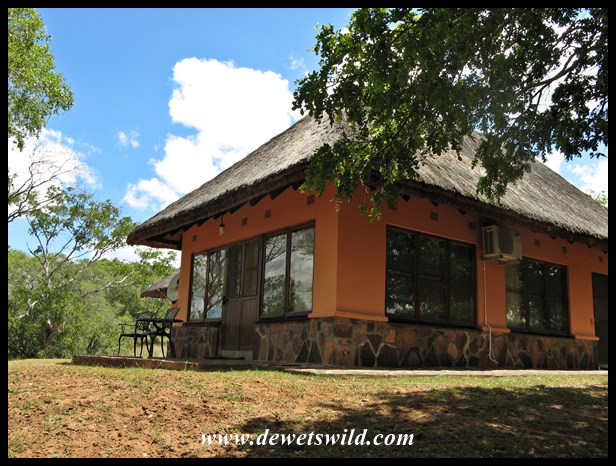
uMkhuze Game Reserve, in the iSimangaliso Wetland Park and World Heritage Site, was the third destination of our epic summer 2014 bush holidays. We arrived at uMkhuze’s western gate, Emshopi, on the 18th of December, after an easy 164km drive from Ithala Game Reserve. Our reservation was for three nights in an extremely spacious cottage at Mantuma Rest Camp. When we say “extremely spacious”, we are not lying; you could have held a dance in the lounge!

Mantuma, uMkhuze, December 2014

Mantuma, uMkhuze, December 2014

We’ve already shared with you our experiences at two of uMkhuze’s biggest attractions, the Nsumo Pan and Kumasinga Hide, and in this post we’ll focus on some of the things we saw in the rest of this unique reserve.

Nsumo magic

Nsumo magic

Zebra reflections

Zebra reflections at Kumasinga

Of the bat, it has to be said that uMkhuze is one of South Africa’s best known birding destinations. The variety of birds is absolutely staggering, thanks to the diversity of habitats the reserve protects, and we were lucky to add a couple of new “lifers” to our birding tick list.

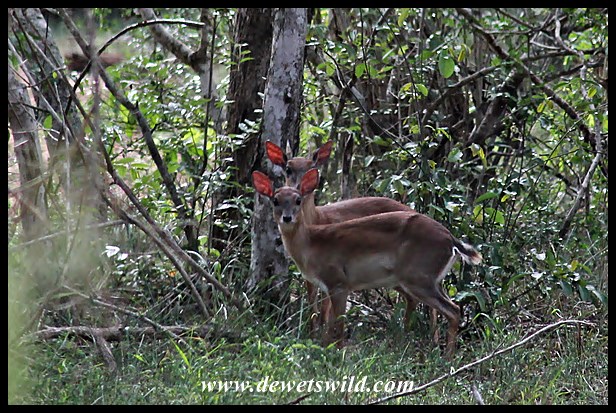
uMkhuze protects a sizable piece of sand forest, a very rare plant community in South Africa. An equally rare little antelope, the suni, lives only within this habitat. We had several sightings of them, but getting even a half-decent photograph of these shy creatures proved very difficult!

A pair of suni in the sand forest

A pair of suni in the sand forest

We also had our first sightings of large predators (on this trip) at uMkhuze. Lions were reintroduced to the reserve a year ago, and we were thrilled to find two females during a guided night drive. On our last afternoon at uMkhuze, we found a very shy spotted hyena lurking in the bush.

uMkhuze protects large populations of other well-known African mammals and they certainly were not shy to show themselves!

uMkhuze has its fair share of creepy-crawlies too!

I’ve already mentioned what a diverse reserve uMkhuze is, and there’s no better place to see this than from the top of the observation tower just a few kilometers south of Mantuma Rest Camp.

uMkhuze really is a gem in the crown of South Africa’s wild places, and we always enjoy visiting here. Leaving through the Ophansi Gate on uMkhuze’s eastern boundary we felt like we should have stayed a bit longer still, thankfully we could console ourselves by thinking about the great destinations that were still waiting for us on our summer trip to the bush!

Driving through the riverine forest at Ophansi Gate

Driving into the riverine forest at Ophansi Gate

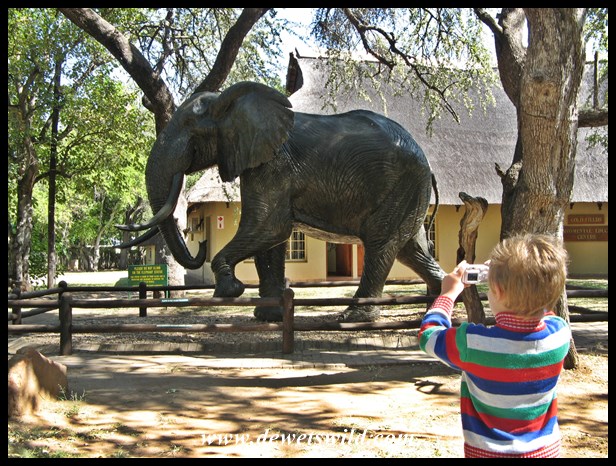
Scale

The Elephant Hall in Letaba Rest Camp, in the Kruger National Park, allows a deeper appreciation of just how big the African elephant really is…

Scale” is the theme for this week’s WordPress Photo Challenge