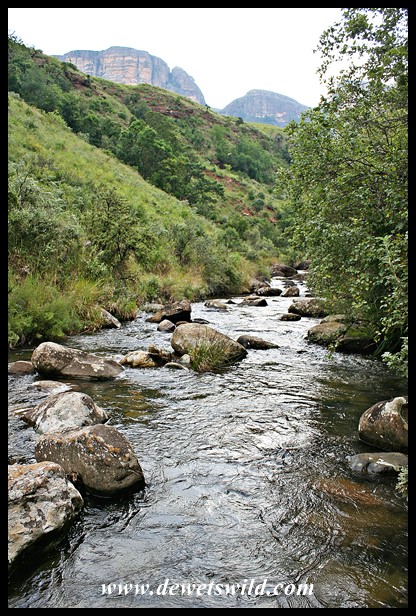
With a massive storm looming over the Drakensberg this evening we can look back on another fun-filled day in the great outdoors at Royal Natal.

Reflections at Mahai
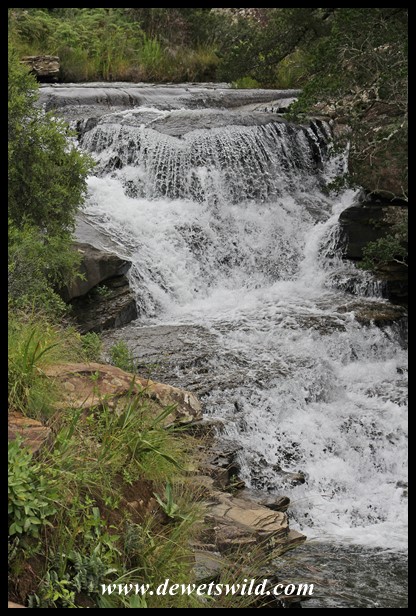
The Cascades in the Mahai stream

With a massive storm looming over the Drakensberg this evening we can look back on another fun-filled day in the great outdoors at Royal Natal.
Reflections at Mahai
The Cascades in the Mahai stream
Well, not really – our bookings were made long before the current health crisis and we opted not to cancel, figuring that it is nice to know that for a while at least we can breathe the fresh mountain air of the Royal Natal National Park again. So here we are.

The Rainbow Skink, or Five-lined Skink, is an active lizard occurring in rocky terrain in savanna habitats from Kwazulu-Natal, through the Lowveld and Limpopo Valley to as far north as Kenya. They feed primarily on insects and other invertebrates. Males are territorial. Females lay one, perhaps two, clutches of 6-10 eggs in summer, with the baby skinks emerging around two months later. Females, adolescents and immature males exhibit the distinct lines and brilliant blue tails associated with this species, while the adult males have an olive base-colouration speckled with tiny white spots. Adults may grow to 20cm in length, including the tail. The IUCN lists the Rainbow Skink as being of least concern.


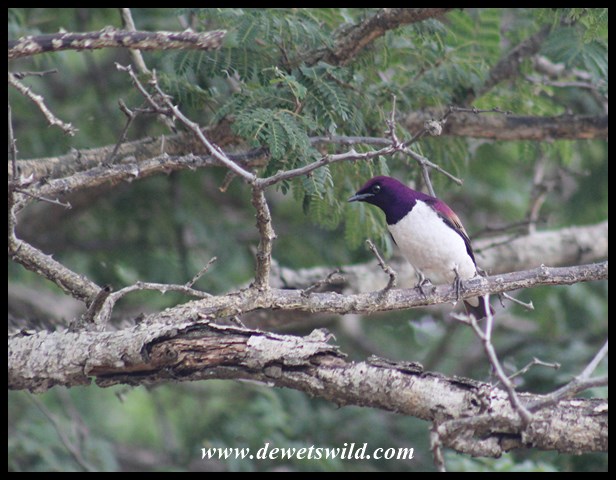
Violet-backed Starlings occur throughout much of sub-Saharan Africa, migrating to South Africa to breed from October to April and they can then be found in Kwazulu Natal, Mpumalanga, Limpopo, Gauteng and North West Province. They inhabit savannas, various kinds of woodland habitats, and gardens, feeding on fruit and insects.
The Violet-backed Starling is one of the smaller members of its family, growing to about 18cm in length and weighing around 45g. The males and females are so dimorphic that they may easily be confused for two different species.
Usually seen in monogamous pairs, or small flocks (fewer than 20 birds) at the end of the breeding season before starting their migration back northwards, Violet-backed Starlings breed in holes in trees or fence posts. The female is singly responsible for the incubation of the clutch of 2-4 eggs over a 2 week period, though the male takes an active role in feeding the chicks until they fledge about 3 weeks after hatching.
The IUCN lists the Violet-backed Starling as being of least concern, though it does note that their populations may be declining due to habitat degradation.


A commonly encountered rodent thanks to its diurnal nature, the Single-striped Grass Mouse is found in a wide range of habitats, from dry scrub to savanna and even the edge of cultivated farmlands wherever good grass cover is available. Grass and seeds make up the bulk of its diet, with other green plant material and a wide range of invertebrates making up the remainder.
Single-striped Grass Mice dig their own burrows at the base of grass tussocks or bushes, from which a network of paths radiate under dense vegetation leading to their favourite foraging grounds. Home burrows may be inhabited by solitary individuals, pairs or family groups. Females give birth to litters of 2-11 babies (usually 4 or 5) during spring and summer after a 4 week gestation. The young are weaned within 3 weeks of birth. In the wild they seldom live longer than a year. Adults grow to a total length of up to 30cm, of which the tail makes up roughly half, and weigh around 60g.
The Single-striped Grass Mouse is considered of least concern and has two centres of distribution: a north-eastern in Kenya and Tanzania, and a southern from Zambia and Malawi to South Africa’s northern provinces (Limpopo, North West, Gauteng, Mpumalanga and Kwazulu-Natal).


Village Weavers are often encountered in large, noisy flocks, inhabiting open savanna and woodland habitats, usually near water, as well as gardens, parks and agricultural fields. They’re omnivores, feeding on seeds, invertebrates, fruit and nectar and often found scavenging for scraps at picnic sites or around houses. They’re also often encountered in mixed flocks with other kinds of weavers and other small seed-eating bird species.
They breed colonially, males weaving their nests in trees, reeds or palms, often hanging over water, and trying to court as many females as possible – males can construct as many as 20 nests in a season! Females will also mate with several different males during the breeding season. There may be as many as 1,000 nests at the breeding colony. Their breeding season stretches from late winter through to autumn. The male plays no role in incubating the clutch of 2-5 eggs or raising the chicks. The eggs hatch about two weeks after being laid, and the chicks leave the nest when they’re about 3 weeks old. Adults measure around 16cm in length and weigh about 37g.
With a wide distribution over sub-Saharan Africa, and with probably the largest population of their genus, the Village Weaver is considered as being of least concern by the IUCN. In South Africa they occur from the Eastern Cape, through Kwazulu-Natal, Mpumalanga and Limpopo to Gauteng and the North West Province.


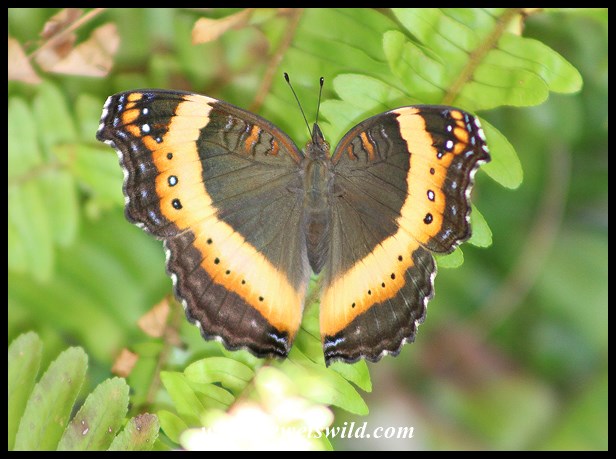
The strikingly beautiful and very active African Leopard butterfly inhabits savanna, woodland, forest edges, parks and gardens and is found over much of South Africa, excluding most of the Eastern, Western and Northern Cape Provinces. It is also known as the Common Leopard and is widely distributed over Africa, Australia, southern Asia and the Indian subcontinent. Eggs are laid singly on a wide range of larval food plants, including exotic poplars and willows. Adults have a wingspan of between 4 and 5.5cm and are on the wing throughout the year.


We can’t think of a better way to celebrate World Wildlife Day than to look back at the 64 species of South African wildlife we gave special attention to here at de Wets Wild over the past year.
Click on the first image, scroll through the gallery and by the end of it you are sure to believe, as we do, that South Africa is a treasure chest of beautiful creatures that you absolutely have to visit!


The Two-pip Policeman butterfly is a denizen of coastal bush and savanna habitats, occurring from Kwazulu-Natal through Mpumalanga, Limpopo, Gauteng and North West to the Free State and eastern portions of the Northern Cape Province. Furthermore it is found widely over the remainder of sub-Saharan Africa in similar habitats. Eggs are laid singly and the larvae feed on a wide range of plants, their development from egg to adult butterfly taking around two months to complete. Adults have a wingspan of 4.5 – 7cm and can be seen throughout the year. They fly fast and erratic and adults of both sexes are frequently seen at flowers or mud puddles, usually in the early morning or late afternoon. Males are territorial.


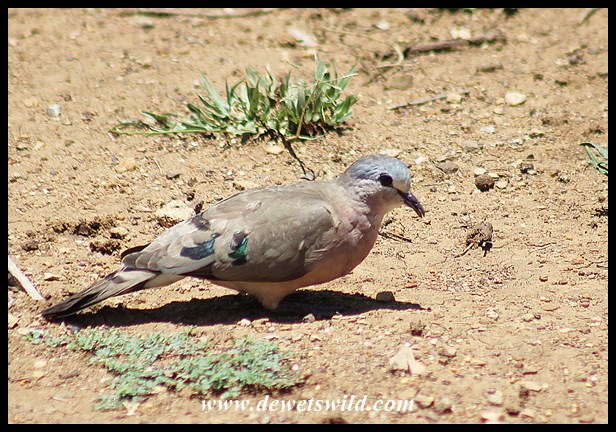
The Emerald-spotted Wood Dove is a well-loved and common resident of many of South Africa’s better known nature reserves and national parks, where its melancholy call is often heard. They occur from the Eastern Cape to the North West Province, through Kwazulu-Natal, Mpumalanga, Limpopo and Gauteng, and widely through central and east Africa. The Emerald-spotted Wood Dove inhabits woodland, thickets and savannas. They feed mainly on grass- and other kinds of seeds, but will also peck at fallen fruit and invertebrates.
Emerald-spotted Wood Doves are usually encountered singly or in monogamous pairs, very rarely forming larger aggregations. Typically, clutches of 2 eggs are incubated by both parents over a 2 week period in a flimsy stick nest built in a tree or tall shrub. The chicks grow quickly and fledge about two weeks after hatching. They breed throughout the year, with a distinct peak in spring and summer. Adults are about 20cm long and weigh around 64g.
The IUCN lists the Emerald-spotted Wood Dove as being of least concern.


 DeWetsWild