There’s more to see here in the West Coast National Park than you can point a lens at!
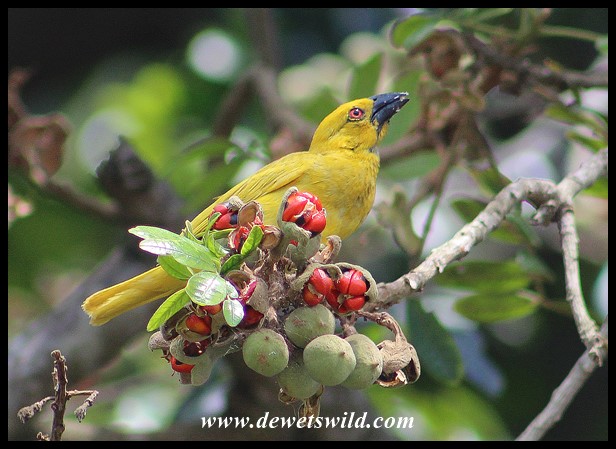
The Yellow Weaver, or Eastern Golden Weaver, is a very social bird closely associated with reedbeds lining coastal rivers, lakes, dams and other permanent waterbodies, venturing into the surrounding savanna to search for the seeds, insects and nectar on which it feeds. Fully grown they weigh approximately 31g and measure 15cm in length.
Yellow Weavers breed colonially during spring and summer and will often occur alongside other weaver species. The males are polygamous, weaving several circular grass nests, often directly over the water, and trying to impress as many females as possible. The female is solely responsible for incubating the clutch of 2-4 eggs and caring for the chicks, which leave the nest at about 3 weeks old.
In South Africa the Yellow Weaver is confined to the coastal plain along the Indian Ocean coastline from the Eastern Cape to far northern Kwazulu-Natal. Beyond our borders their distribution extends as far as central Kenya. According to the IUCN the Yellow Weaver is of least concern.
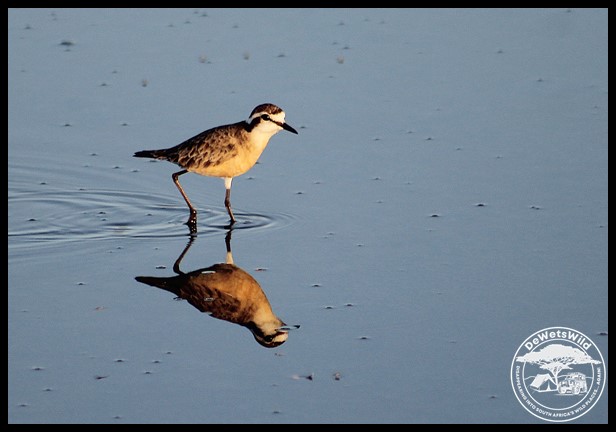
The Collared Pratincole is a migrant to South Africa, usually arriving to breed from about July and departing again by February. They’re found in open habitats – overgrazed grasslands, floodplains, sand banks and so on – near reliable large water sources like dams, lakes and estuaries. They’re most active by dusk and dawn, catching insects in flight and on the ground, and often follow herds of game or stock to catch the invertebrates they flush.
Adult Collared Pratincoles measure about 25cm in length with a weight of around 75g. While they’re usually seen in substantial flocks, often numbering into the thousands, they are monogamous breeders, laying clutches of 2 eggs in shallow depressions (like animal footprints) on the bare ground. Incubation takes a little less than 3 weeks and is shared between the parents. The chicks start flying when they’re about 4 weeks old.
The Collared Pratincole is very widely distributed over Africa, Europe and west and central Asia. and the IUCN lists it to be of least concern overall. In South Africa they are found, mostly during our spring and summer months, in the Lowveld and northern Kwazulu-Natal, and are considered rare and near-threatened.
The Western Shores section of the iSimangaliso Wetland Park was opened to visitors a lot more recently than most other parts of the Park, and in many ways it is still being rehabilitated to its natural state – in fact there are still several exotic eucalyptus plantations in this area that still need to be harvested.
Just about 2km outside of St. Lucia town, on the main road to Mtubatuba, visitors will find the Dukuduku Gate providing quick and easy access to this interesting area. Unfortunately during our visit early in November Charter’s Creek was off limits due to flooding, but there’s other very rewarding areas where visitors can stretch their legs at: uBhejane Picnic Spot, kuMgandankawu Hide and uMthoma Aerial Boardwalk. The road network, while still rather limited, provides access to various interesting habitats and the birds and animals that find refuge there.
If you are interested in visiting St. Lucia and the iSimangaliso Wetland Park, remember that De WetsWild can assist you with reservations in the Eden Park and Sugarloaf Campsites in town or at wonderful Cape Vidal set on the Indian Ocean in the Eastern Shores section of the Park.
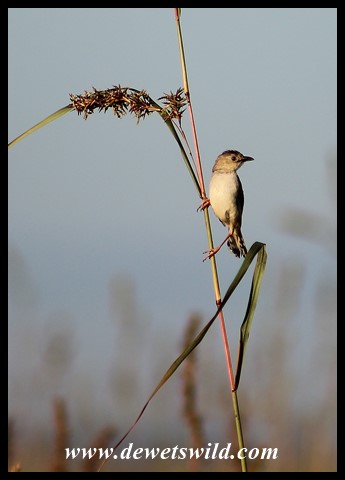
The Rufous-winged Cisticola, also known as the Black-backed Cisticola, occurs only in a rather limited portion of Southern Africa, stretching from southern Malawi and central Mozambique southwards to the Kwazulu-Natal / Eastern Cape border in South Africa. It is very common where it occurs and the IUCN lists it as being of least concern.
As with others of its family the Rufous-winged Cisticola is a small bird, measuring about 13cm long and weighing only about 13g. It inhabits low-lying wetlands, reedbeds, adjacent grassland and sugarcane plantations, living mainly of insects. They are usually seen singly or in pairs. Rufous-winged Cisticolas are monogamous and build their ball-shaped nests just slightly above ground or water level in dense vegetation in marshy areas. Their breeding season spans spring and summer, during which the pair raise a brood of 2-4 chicks. The incubation period lasts about 2 weeks, with the chicks leaving the nest about the same length of time after hatching.
The Southern Banded Snake Eagle inhabits coastal forests and their edges where they feed primarily on reptiles, including venomous snakes, and amphibians. They will also venture into commercial timber plantations that replaced their native forest habitat over much of their local range.
Monogamous and territorial, pairs of Southern Banded Snake Eagles construct their stick-platform nests in the canopies of tall indigenous or plantation trees and usually use these for several consecutive breeding seasons. The female lays a single egg in spring and takes most of the responsibility for its incubation over a 7 week period and for caring for the chick at the nest for its first few weeks after hatching, while the male does most of the hunting to provide food for the female and chick. Fully grown they measure about 58cm long, boast a wingspan of around 1.25m and weigh approximately 1kg.
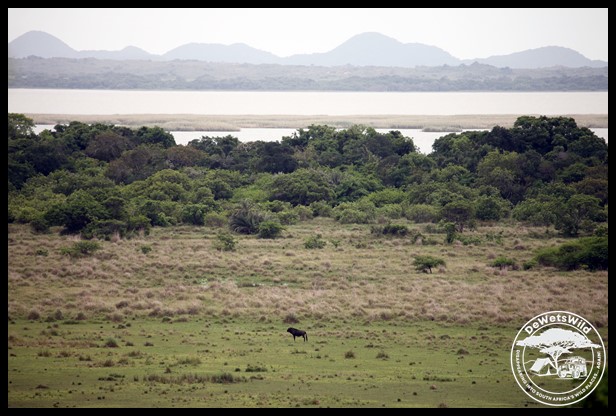
With a very low density population, estimated between 1,000 and 3,000 spreading over a distribution stretching along Africa’s Indian Ocean coast from southern Somalia to the northern corner of Kwazulu-Natal Province in South Africa, the IUCN considers the Southern Banded Snake Eagle to be near-threatened. Most of their very small local population, probably numbering well below 100 individuals and considered vulnerable, is found in the iSimangaliso Wetland Park.
The beautiful little Green Twinspot, a tiny member of the finch family that is only 11cm long and 10g in weight, is easily overlooked in its forest habitat where it feeds mainly on seeds. They’ll also readily venture into plantations and gardens where there are grass seeds to be had. When disturbed they always fly high into the tree canopy to wait there quietly until the threat has passed.
Green Twinspots are often seen in small family groups of up to 10, though they form monogamous pairs in the breeding season (and sometimes for more than one season), which spans the months of spring and summer. Their nest is a rough ball of plant material with a side entrance usually built quite high among dense foliage in which both partners roost together at night. The female lies between 4 and 6 eggs and both parents incubate the clutch for a period of 2 weeks. The chicks fledge at about 3 weeks of age but will keep coming back to the nest for about another week or so before becoming totally independent.
According to the IUCN, the Green Twinspot is of least concern, despite occasionally being trapped for the pet trade. It has a very patchy distribution over much of sub-Saharan Africa, while in our country they’re largely restricted to coastal Kwazulu-Natal and the escarpment of Limpopo and Mpumalanga.
Tailor Ants, or Weaver Ants, naturally inhabit humid forests, which limits their South African distribution to the northern coast of Kwazulu-Natal (where their unique nests are a common sight in the iSimangaliso Wetland Park). Beyond our borders they’re distributed throughout Africa’s equatorial regions.
A single colony of Tailor Ants usually have several nests within their territory, which they fiercely defend by injecting formic acid when biting assailants, be they other ants, birds or animals and even humans. These nests are constructed using silk produced by the larval ants to bind together living leaves. In one nest the queen, which produces about a hundred eggs per day, lives, while the other nests are used by the workers (which measure up to 11mm in length) to care for the young ants or – fascinatingly! – farm with scale insects. The ants subsist on the honeydew these scale insects secrete as well as on other insects they hunt in the trees or on the ground.
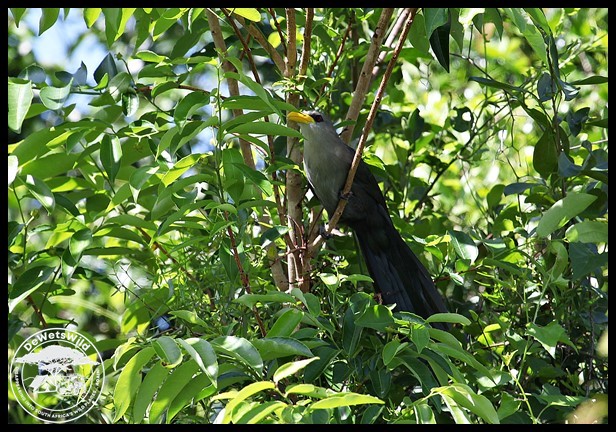
Another very rarely seen bird with a limited distribution in South Africa – only found here along the coast of Kwazulu-Natal – and one that I saw for the first time on my recent trip to the iSimangaliso Wetland Park with my younger brother, is the Green Malkoha (also known as the Green Coucal or Whistling Yellowbill).
The Green Malkoha is a bird of coastal forest habitats and a member of the cuckoo-family. It feeds on a wide range of small vertebrates (with a special fondness for tree-living frogs) and insects, and also a limited selection of fruits. They are usually seen singly or in pairs, preferring to creep through the thick vegetation like a rodent rather than flying.
Green Malkohas form monogamous pairs in the spring breeding season, building rather flimsy platform nests in dense thicket on which clutches of 2-4 eggs are laid – rather unusual in the cuckoo-family, where most species are brood parasites. Aside from the fact that both parents take care of the young after they’ve hatched little else is known of this species’ breeding habits. Fully grown, Green Malkohas weigh about 70g and measure 33cm in length.
The IUCN considers the Green Malkoha to be of Least Concern. Beyond its limited South African occurrence it can be found along the Indian Ocean seaboard and adjacent interior as far north as southern Somalia, with an isolated population on the Ethiopian Highlands.
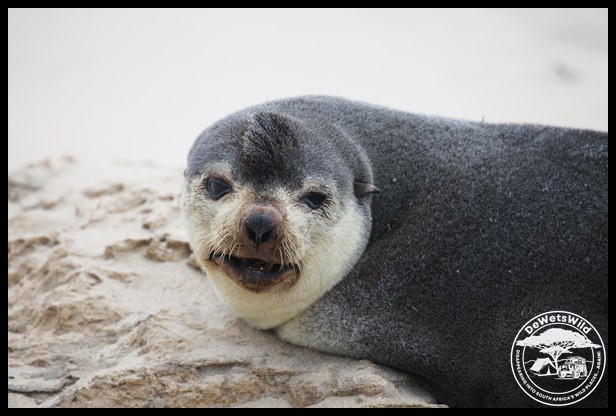
The Subantarctic Fur Seal is a sea living mammal that usually occurs in the chilly waters of the southern Atlantic, Indian and Pacific Oceans. Finding one on the much more tropical beach at Cape Vidal in the iSimangaliso Wetland Park on South Africa’s north-eastern coast, thousands of kilometers from where it belongs, was therefore a very unexpected surprise! Why and how exactly some seals roam so widely outside their usual range still is not really understood, but vagrants of this species has been recorded in South Africa before and even as far north as the Tanzanian coast. When we first noticed this individual it was lying far up the beach, trying its best to stay out of a strong wind, but I later noticed it enjoying the swell at the incoming tide. While to my opinion our visitor looked in good, energetic health I did alert the Park authorities as soon as I had connectivity again just in case they wanted to have a look themselves, as these long distance swimmers are often very tired and underfed by the time they reach our shore and are then looked after at a specialised rehabilitation centre until they can be shipped back to their natural homes.
Subantarctic Fur Seals live and breed around and on tiny islands just north of the Antarctic Polar Front at roughly 60°S latitude, including the South African territory of the Prince Edward islands. Fully grown males, at 1.8m long and 160kg in weight, is much larger than the females, which weigh only about 50kg. They feed mainly on fish and squid. Pups are born in the southern summer (most of them in December). It is estimated that they can live to 25 years of age in the wild.
With a population estimated at around 200,000 adults and considered to be stable, the IUCN lists the Subantarctic Fur Seal as being of least concern. This is a wonderful improvement as they were extensively hunted for their pelts in the 1800’s.