How much can you see in only two days in the Kruger National Park? Well, as this gallery taken over less than 48 hours around Skukuza Rest Camp during March 2017 proves, a whole lot actually!
Shitlave Dam, on the road from Pretoriuskop to Skukuza
One of our favourite activities when out visiting South Africa’s wild places is to search the grounds of the places where we are staying with a flashlight at night, looking for nocturnal wildlife. Skukuza, being the biggest of the camps in the Kruger National Park, is usually especially productive, as most of the wildlife inhabiting the camp is exceptionally used to having humans gawking at them!
It may look like some sort of giant cross between a dragonfly and a moth, but this large insect is actually an adult Blotched Long-horned Antlion!
Grey Duiker
Cape Porcupine
Thick-tailed Bushbaby
The pond in front of Skukuza’s reception is a wonderful place to photograph a variety of amphibians – on our latest visit the reeds and rocks there were alive with the calls of male Painted Reed Frogs and Sharp-nosed Grass Frogs trying their best to impress their female counterparts.
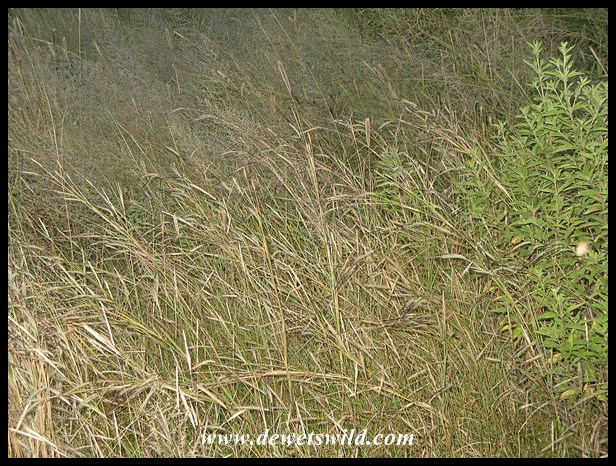
Believe it or not, but in the middle of this picture there’s a leopard hidden in the grass. Don’t worry; If I didn’t see her walk in there I wouldn’t have known it either.
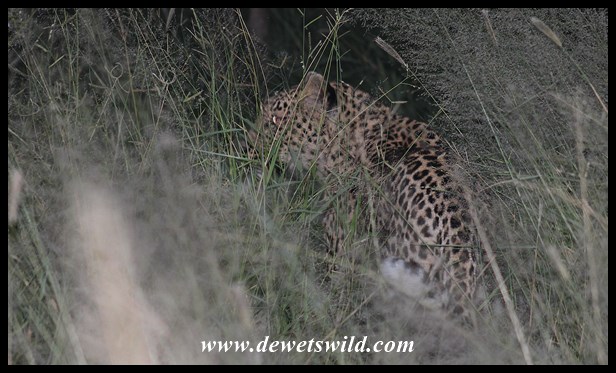
Luckily she grew tired of her hiding spot, got up and walked into even denser vegetation, allowing just one quickly fired shot as proof…
This leopard was lying not two meters from our car and was totally invisible – what wonderful camouflage these cats have!
(Seen along the H3-road just south of Skukuza on Friday last week as we were departing from the Kruger National Park)
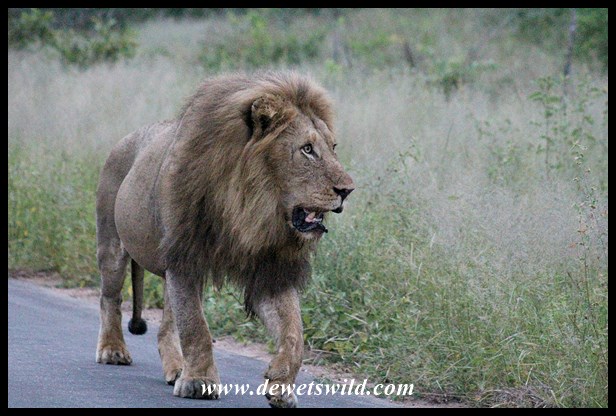
A week ago, on an early morning drive along the Sand River near Skukuza in the Kruger National Park, this magnificent male lion popped out of the thickets to patrol and mark his territory along the road.
Sand River Lion
Sand River Lion
Sand River Lion
Sand River Lion
Sand River Lion
Sand River Lion
Sand River Lion
After spending quite a bit of time with him as he walked at pace along the river road, mostly within arm’s length of the vehicle, another car arrived on the scene, and I drove off in order to allow them the thrill of some alone time with The King as well.
Everyone will quickly recognise the White Stork as the legendary bird responsible for the delivery of newborn babies. These large, strikingly pied birds stand over a metre tall, has a wing span of up to 2 metres and weighs as much as 4kg.
White Storks migrate in enormous flocks (numbering hundreds or even thousands) from Europe, North Africa and Western Asia to Sub-Saharan Africa to spend the summer in our warm weather, the first birds arriving around September and the last departing again by April or May. At those times they are a regular sight in savannas, grasslands and cultivated fields right across South Africa, often close to water, feeding in flocks usually numbering from 10 to 50, though larger groups of several hundred are not uncommon. White Storks are diurnal in habit, roosting communally at night. They feed mainly on insects (but also rodents, reptiles and frogs), and often take advantage of fires to catch prey escaping the flames. Only a handful of pairs breed here, and only in the Western Cape. Nests are constructed of sticks in high trees or on top of buildings or other man-made structures, and often used for several consecutive years, even decades. As the nests are continuously expanded they can become quite huge over time, and are often shared by other kinds of birds. Pairs will build their nests in isolation or in loosely associated small colonies of up to 30 pairs. Up to 7 (more usually 4) eggs are laid and incubated for 33 days or so by both parents. The chicks stay in the nest for about two months after hatching.
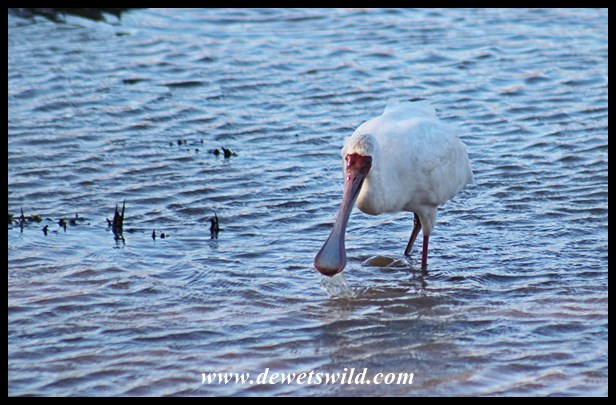
The African Spoonbill is a large wading bird (90cm long, weighing up to 1.8kg) with a characteristic spoon-shaped beak.
They can be found at shallow bodies of freshwater – natural and man-made lakes, pans, rivers, marshes, floodplains, estuaries and even sewerage works – where they feed on small fish and aquatic invertebrates caught by moving their bills sideways through the water. Spoonbills can often be seen close to hippos and crocodiles, hoping that these large animals will flush something edible. Breeding is timed to start just before or during the rains. They nest colonially in trees, reedbeds or on rocky islands and ledges, usually in groups numbering from 5 to 250 or more monogamous pairs and often together with other species of waterbirds as well. The nests are platforms built of sticks and reeds in which 3 to 5 eggs are incubated for around 4 weeks by both parents.
The African Spoonbill has a wide distribution and stable population, and is considered of least concern by the IUCN. They occur over almost all of South Africa with the exception of the arid northwestern corner of the country, and further range over most of Sub-Saharan Africa (except the equatorial forests) and Madagascar.
African Spoonbill
African Spoonbill
African Spoonbill
African Spoonbill
African Spoonbill
African Spoonbill
African Spoonbill
Loskop Hide: sacred ibis, spoonbill and yellow-billed ducks
African Spoonbill
African Spoonbill
African Spoonbill (with a Sacred Ibis just behind)
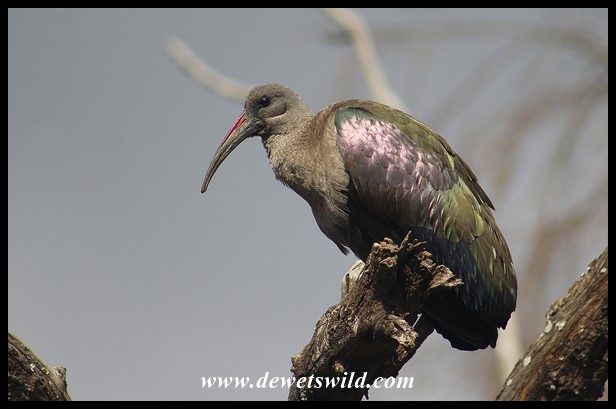
One of South Africa’s best known, most common, and most widely occurring bird species, the Hadeda is a large ibis weighing up to 1.5kg. Few South Africans would not be familiar with their distinctive “ha-ha-ha-de-dah” call.
Hadedas are mostly sedentary, and some have been known to use the same roosts for many years. By day they forage in pairs or small groups along wooded streams and in suitable man-made habitats (like irrigated fields, garden lawns and golf courses) for their invertebrate staple diet (chiefly worms, snails and slugs, endearing them to gardeners), which they locate by probing in the soft earth and leafy detritus with their long, curved bills. Unlike many other ibis species, Hadedas nest in solitary pairs during or just after the rainy season. Three or four eggs are laid in nests usually used for many consecutive breeding seasons and constructed of sticks and twigs on a level tree branch (or similarly suitable man-made structure), often over water. Both adults take turns to incubate the eggs. Traditional healers use the ground-up bones of Hadedas to prepare a potion said to prevent love partners from leaving with someone else, a belief based in the Hadeda’s enduring monogamous associations.
The Hadeda has an expanding population distributed over most of Sub-Saharan Africa, and is considered of “Least Concern” by the IUCN. They are a common sight all over urban South Africa, which has aided their rapid range expansion, and in most nature reserves.
Hadeda Ibis flock in flight
Hadeda Ibis
Hadeda Ibis
Hadeda Ibis
Hadeda Ibis
Hadeda Ibis
Hadeda Ibis
Hadeda Ibis
Hadeda Ibis
Hadeda Ibis chicks in nest
Hadeda
Hadeda Ibis
Hadeda Ibis
Hadeda Ibis
Hadeda
Hadeda
Hadeda
Hadeda
Hadedas
Hadeda Ibisses
Hadeda Ibis nest at Mphafa hide (photo by Joubert)
Hadeda in flight over Pretoria
Hadeda Ibis
Hadeda Ibis
Hadeda
Hadeda Ibis
Hadeda
Hadeda Ibisses
Hadeda Ibis
Hadeda Ibis
Hadeda Ibis
Hadeda nesting in a dead tree in the middle of Tilodi Dam
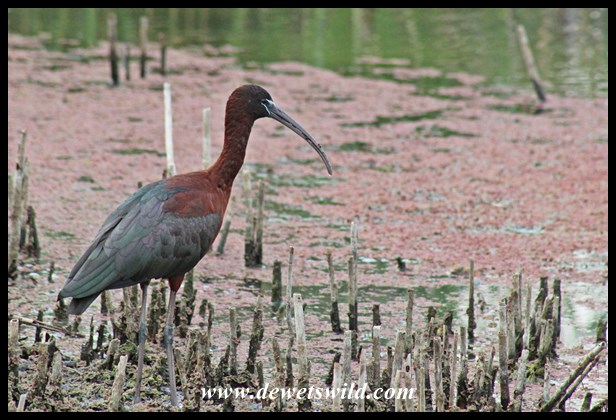
The Glossy Ibis is a rather small ibis (weighing between 500 and 750g with a wingspan of a metre or less), occurring in shallow wetlands, lagoons, estuaries, swamps and flooded meadows, rice paddies and sewerage works. Here they feed mostly on aquatic invertebrates (insects, worms, molluscs, crustaceans, etc) and only occasionally on vertebrates like fish and frogs.
Most breeding takes place just before or during the rainy season. Glossy Ibis nest in colonies, usually consisting of between 5 and 100, but often thousands, of monogamous pairs, and often together with other waterbirds. The nests are platforms constructed from twigs, usually just slightly above the waterline in trees or other emergent vegetation standing in wetlands. Females normally lie three to five eggs that are incubated by both parents for around three weeks. Nestlings fledge a month after hatching but are fed by the parents for up to 2 months. Once the breeding season comes to an end, individuals become nomadic and range widely.
The Glossy Ibis has an enormously wide distribution, and can be found in North and South America, the Caribbean, Europe, Asia, Australia and most of Africa and the Indian Ocean islands, except the driest deserts and equatorial forests. In South Africa they are absent only from the driest portions of the Northern Cape Province. The IUCN estimates that there may be as many as 2.3-million of these birds on earth, and though some populations are declining (due mostly to loss of their wetland habitat) considers them to be of Least Concern in conservation terms.
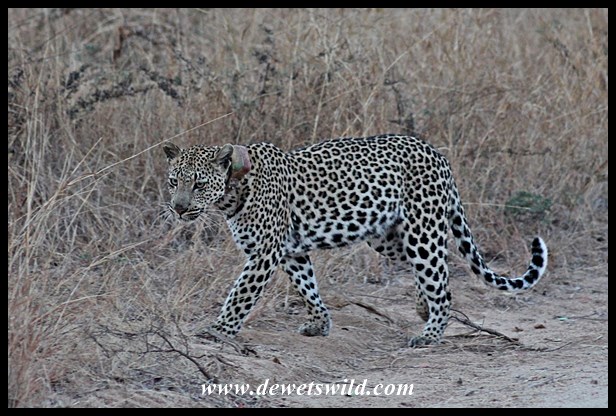
The beautiful Leopard is at the top of the wishlists of many visitors to South Africa’s wild places, and certainly deserves its position among Africa’s “Big Five“. One of the most adaptable of the large carnivores, their build and colouration is supremely attuned to the environment in which they live. Depending on the harshness of the environment and the size of prey available, the weight of adult males can vary between 20 and 90 kilograms (females weigh slightly less), with a shoulder height ranging between 55 and 80cm.
Serene leopard near Punda Maria
Catnapping leopard near Punda Maria
Leopard seen near Olifants
Beautiful leopard encountered near Red Rocks
Leopard male and kill
Leopard and kill (photo by Joubert)
She quickly repositions (photo by Joubert)
Leopardess eyeing an injured wildebeest calf
Her interest peaked by a growl from the male, the leopardess moves to a lower branch
Leopardess in a tree
There’s a leopard hidden in the Sausage Tree
Leopard along the Timbavati
Hidden leopard
Leopard in a tree
Lazy leopard
Leopards have adapted to every habitat on the African continent, from the driest deserts to the tropical rainforest and high mountain ranges. They are just as catholic in their diet, which ranges from insects, fish, amphibians, reptiles, birds and rodents to large mammals and even other predators (including jackals, spotted hyenas and cheetahs) or carrion, though they normally prefer commonly occurring medium-sized antelope and wild pigs. Though they are not dependent on the availability of surface water they will drink regularly if it is available. Their penchant for storing the carcasses of their prey up high in the branches of trees, where it is inaccessible to competing predators, allows them to feed from the same carcass for up to 6 days.
Leopard hunting jackals
Leopard lying in wait at a waterhole
Leopard lying in the bed of the Nwatimhiri near Skukuza in the Kruger Park
Remains of a leopard kill
Leopard on the prowl
Leopard hiding in long grass
Leopard camouflage in a thicket
Lazy Leopard
Leopard up a tree near Phalaborwa Gate
Leopard in a tree on the bank of the Tsendze River south of Mopani
Leopard seen early morning in the Sedudu Valley
Leopard stalking a steenbok in the Kruger National Park
Solitary by nature, Leopards only associate with others of their kind when mating or when cubs accompany their mother. Adults of both sexes hold territories that may cover enormous areas, depending on the availability of prey, are advertised by their rasping call and marked with urine, scat and scrape marks against prominent trees, and defended viciously, sometimes to the death, against interlopers of the same sex. Male territories are larger and can overlap with the areas of up to six females. Leopards are nocturnal, with most activity occurring from dusk to dawn, resting up in the deep shade of tree canopies, thickets and caves. They love basking in the early morning or late afternoon sun. Leopards can reach a speed of up to 60km/h, but can only maintain it for short bursts and rely on their camouflage and expert stalking skills to get within range of their prey.
Leopard at Nwanetsi Bridge, on a night drive from Satara in the Kruger Park
Leopard hunting jackals
Leopard in a tree, S36 (Kruger Park)
Leopard in a tree on the S3 near Skukuza, Kruger Park
Leopard on the Maroela Loop, near Skukuza in the Kruger Park
Leopard on the Maroela Loop, near Skukuza in the Kruger Park
Leopard in tree, at Ximangwaneni Dam (Kruger Park)
Leopard on Ngubhu Loop in Ithala Game Reserve
Leopard trying to hide among the thorns
Leopard sighting on the Grassland Loop on the Eastern Shores of Lake St Lucia – 15th June 2015
Leopard in golden early morning sunshine
Leopard in golden early morning sunshine
Leopard in a tree south of Skukuza
Leopard near Lower Sabie
Leopard
Leopard lounging in a tree
Female Leopards usually give birth to 2 or 3 cubs (range from 1 to 6) after a short 3 month gestation at any time of the year. Newborn cubs are kept hidden in caves, among boulders, in thickets and even burrows while the mother is out hunting, until they start accompanying her at the age of about two to four months. Cubs become independent anywhere between 12 and 24 months of age, though only about half of the cubs born reach that age. Lions and spotted hyenas will attack and kill adult Leopards, while even jackals pose a threat to unguarded cubs.
Leopard female calling for her cubs
Sub-adult leopard cubs
Leopard cub in a rocky outcrop between Tshokwane and Skukuza
Leopards have a wide distribution in Africa and Asia, but their populations have been reduced and become confined to increasingly isolated pockets over most of that range, leading the IUCN to classify it as “vulnerable” due to the persistent threats of illegal hunting and loss of habitat and prey. In South Africa, Leopards can be found in the mountains of the Western and Eastern Cape, along the Namibian and Botswana borders with the Northern Cape, in the Drakensberg range and northern Kwazulu-Natal, and widely in the North-West, Limpopo and Mpumalanga provinces, but their secretive nature makes it virtually impossible to determine their population size, with the EWT estimating the number of leopards occurring in South Africa between 2,800 and 11,600. In our experience, the Kruger National Park, Kgalagadi Transfrontier Park, Mapungubwe National Park, Pilanesberg National Park, Hluhluwe-Imfolozi Park, iSimangaliso Wetland Park (especially the Eastern Shores section) and Ithala Game Reserve presents the best chance of finding these elusive cats on a self-drive safari in South Africa.
We spent the past weekend with good friends in and around the Loskop Dam Nature Reserve, taking in the peaceful atmosphere, spectacular scenery and diverse wildlife. Here’s a gallery showing some of what we saw and experienced – if you’d like to know more about Loskop Dam and the general area, have a read here.
On the trail to the waterfall at Waterfall Safari Lodge
On the trail to the waterfall at Waterfall Safari Lodge
On the trail to the waterfall at Waterfall Safari Lodge
On the trail to the waterfall at Waterfall Safari Lodge
On the trail to the waterfall at Waterfall Safari Lodge
On the trail to the waterfall at Waterfall Safari Lodge
Waterfall at Waterfall Safari Lodge
Waterfall at Waterfall Safari Lodge
On the trail to the waterfall at Waterfall Safari Lodge
On the trail to the waterfall at Waterfall Safari Lodge
View from Waterfall Safari Lodge
Garden Commodore (wet season colouration)
Natal Acraea
Guinea-fowl Butterfly
Foxy Emperor
Spotted Joker
Mixed bag of butterflies at a mud puddle
Poisonous Koppie Foam Grasshopper
Common Stick Grasshopper camouflage
Elegant Grasshopper nymphs
Golden Orb Web Spider – the female is considerably larger than the male














 DeWetsWild