Tag Archives: wildlife

Hardworking Wasp

Just to prove that a visit to a game reserve isn’t all about the “hairies and scaries”, one of the most memorable sightings of the trip we took to Marakele National Park last weekend wasn’t of one of the “Big Five” or another large mammal, bird or reptile. Instead, we watched in awe as a wasp carried (sometimes through the air, but mostly along the ground) a large, paralysed caterpillar to a specially prepared tunnel. In there, the wasp’s young can grow to adulthood by feeding on the hapless immature insect.

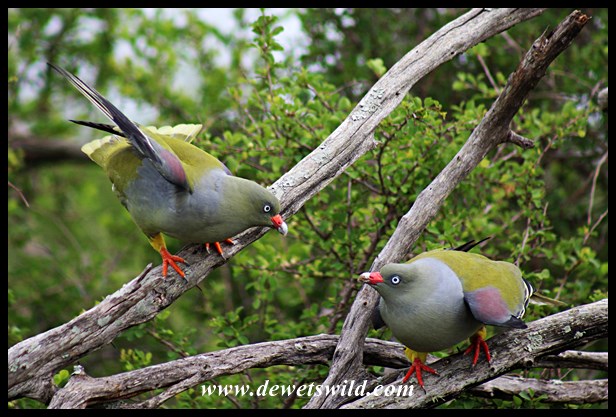
African Green Pigeon

Treron calvus

You’d be forgiven for confusing the African Green Pigeon with a parrot at first glance, especially if you glimpse these colourful birds clambering among the branches or hanging upside down in the canopies of tall trees, foraging for fruit and seeds! African Green Pigeons inhabit forests, woodland, dense savannas (usually along river courses) and well-planted parks and gardens populated by various fruiting trees, showing a special fondness for wild figs (genus Ficus) and jackalberry (Diospyros). Adult African Green Pigeons are between 25 and 29cm long and weigh between 210 and 250g.

African Green Pigeon females build flimsy nests (of twigs and leaves gathered by the male) in the forks of trees at any time of year (with a peak in early summer in South Africa), the female incubating the small clutch (usually only 1 or 2 eggs) for around two weeks. The young pigeons leave the nest around two weeks after hatching. They are gregarious, and occur in small groups or flocks numbering up to 50 or more.

In South Africa, African Green Pigeons are common along the coast in the Eastern Cape, through much of Kwazulu-Natal, and into the bushveld and lowveld regions of Mpumalanga, Limpopo and Gauteng. North of our borders this species occurs widely over tropical Africa south of the Sahara. The IUCN considers them to be of least concern, though noting that loss of habitat and hunting is causing their overall population to decline.

Back from Marakele

If you thought we were a little quiet the last few days, you’d be right. We spent the Heritage Day long weekend enjoying our natural heritage and the company of good friends at Marakele National Park. Here’s just a little sample of some of what we experienced, with a promise of more to come later in the week.

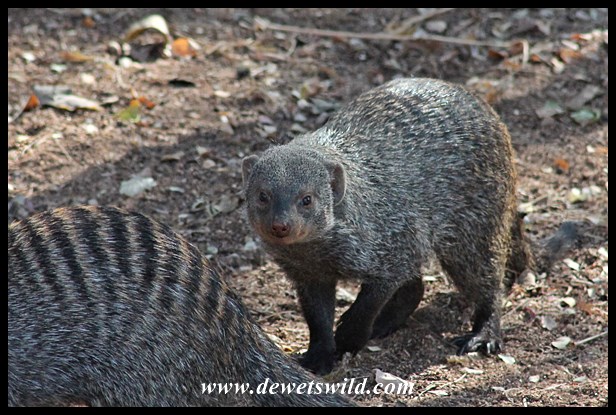
Banded mongoose in Skukuza

Banded Mongoose

Mungos mungo

The diurnal Banded Mongoose inhabits woodland and savanna, showing a strong preference for areas along rivers and marshes with an abundance of logs and termite mounds. These little carnivores prey on insects (especially dung beetles and their larvae), other invertebrates, amphibians, reptiles (including venomous snakes), birds, eggs and rodents, and occasionally also eat fruit. They grow to longer than half a metre, and weigh between 600g and 2kg.

Banded Mongooses live in troops usually numbering from 5 to 30 though exceptionally up to 75, roaming a small home range of up to 4km², within which they have a number of dens used intermittently. These dens are usually holes dug by themselves or other animals, often in termite mounds, or crevices in rocky hills. Though they are not strictly territorial, conflict does sometimes erupt when neighbouring troops meet. Banded Mongooses often associate with warthogs and baboons.

Banded Mongoose pups are born at anytime of the year, though usually in the spring or summer. Most females in the troop get babies at more or less the same time, and the little ones will drink from any lactating female. Litters number from 2 to 8, and the babies tag along with the troop when they go searching for food from about 5 weeks old. Fewer than half of the babies live to 3 months of age, though they can live to between 8 and 13 years. Large raptors and medium-sized mammalian carnivores (jackals, servals, wild dogs, etc.) pose the biggest threat to Banded Mongooses.

The Banded Mongoose has a wide distribution over most of Sub-Saharan Africa, although they are rare in West Africa and absent from the equatorial forests of Central Africa and the arid south-west of the continent. The IUCN regards it as being of least concern, siting its wide distribution, stable and common populations in suitable habitat, presence in major conservation areas and adaptability to human encroachment. In South Africa they are found in the provinces of Kwazulu-Natal, Mpumalanga, Limpopo, Gauteng and North West.

Nylsvley Nature Reserve

Almost 180 years ago, the Voortrekkers on their Great Trek northwards (away from the British colony in the Cape), reached what they thought was the source of the River Nile in what is today South Africa’s Limpopo Province. Of course they were still thousands of miles away from the real Nile, but the name stuck.

Our Nyl River is a minor tributary of the Limpopo, but forms one of South Africa’s largest and most pristine wetland areas – an area 70km long and 7km wide at its widest point. In years of exceptional rainfall (normally about once in ten years) the total inundated area covers as much as 160km². In 1974 the provincial government established the Nylsvley Nature Reserve (39km² in size) to protect a portion of this delicate ecosystem, which was recognised as a wetland of international importance under the Ramsar convention in 1998.

Joubert and I decided to pay the reserve a quick one night visit this past weekend.

Nylsvley’s motto reads “Nylsvley is for the birds” and considering that this relatively small reserve has an impressive list of over 380 recorded bird species, it is certainly most fitting. Nylsvley is an important breeding habitat for over 100 kinds of waterbirds (more than any other wetland in the country), many of which is considered rare or range restricted in South Africa. While the rainy season hasn’t yet started and most summer migrants are yet to arrive, we still managed to identify 79 species of birds in the little over 24 hours we spent at Nylsvley. We’d dearly want to return in late summer, once the wetland has been flooded, in anticipation of the spectacle of a reported 80,000 waterbirds congregating at Nylsvley.

And while pride of place at Nylsvley really does go to the birdlife, the reserve is also home to thousands of invertebrate species (including 55 kinds of dragonflies and 194 kinds of butterflies), 13 kinds of fish, 23 kinds of amphibians, 58 reptile species (including many venomous snakes, so wear sensible shoes when hiking!) and 77 species of mammals (among which sizable populations of rare roan antelope and tsessebe). Vegetation comprises broad-leaved woodlands, thornveld, grassland and of course the floodplains, and over 600 species of plant have been recorded in the reserve.

Nylsvley Nature Reserve falls under the jurisdiction of the Limpopo Department of Economic Development, Environment and Tourism, with the NGO Friends of Nylsvley playing an active role in the protection of the reserve and extended floodplain. Visitors to the reserve can overnight in the rustic camping area (6 shady sites), a dormitory with space for 36 people, or in one of the 5 chalets (4×2 bed, 1×6 bed). Other facilities in the reserve include a picnic area for day visitors, a restaurant, three bird-viewing hides, a limited road network (which can be carefully negotiated in a sedan), and an extensive network of hiking trails. The services of expert guides can be arranged through the reserve’s reception office. Most other services and shops are available in the nearby towns of Modimolle (formerly Nylstroom) and Mookgopong (Naboomspruit).

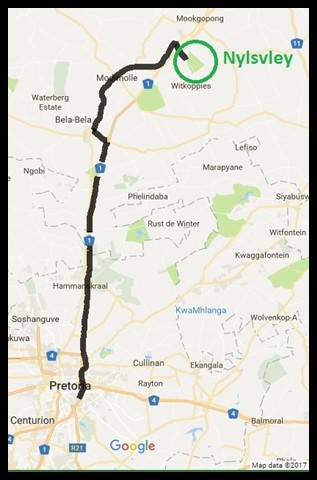
Nylsvley is an easy 170km away from us in Pretoria, along the N1 and R101 highways to the north.

Pretoria to Nylsvley along the N1 and R101

Father & Son Time at Nylsvley

This past weekend Joubert and I took a short camping breakaway to a new destination for us; the Nylsvley Nature Reserve in Limpopo Province.

Father and son time at Nylsvley

Of course we’ll tell you more about our trip, and the reserve, in an upcoming edition of de Wets Wild!

Verreaux’s Eagle

Aquila verreauxii

The Verreaux’s Eagle (or Black Eagle) is a denizen of rocky hills and mountains, often surrounded by savanna, grasslands or arid scrub, from sea level to 5000m high – the favoured habitat of its most common prey species; the rock hyrax (dassie), which makes up between 60% and 90% of their diet. They will also hunt other mammals (up to the size of springbok and baboons), reptiles (especially tortoises, which they drop from on high so that the carapace shatters) and birds, but they have seldom been seen to eat carrion. Verreaux’s Eagle pairs often hunt together; one bird flushing the prey while the other scoops it up, and then sharing their prey. They do most of their hunting in the early morning and late afternoon, when the hyraxes are sunning themselves on exposed rocks.

With a wingspan of up to 2.3 metres and a weight of between 3 and 7kg, the Verreaux’s Eagle is one of the three biggest eagles to be found in South Africa (the others being the Crowned and Martial Eagles). Females are slightly larger than males.

Verreaux’s Eagles pair for life, and pairs are fiercely defensive of their territories. Their massive stick nests are usually built on cliff ledges (sometimes on equally inaccessible trees or man-made structures). In South Africa they usually start breeding during winter. Two eggs are laid and mostly incubated by the female for 44-48 days, while her mate brings food to her on the nest. The stronger (usually oldest) chick invariably kills, and sometimes eat, its weaker sibling within a few days of hatching. The young eagle starts flying at about three months old and becomes independent of its parents about 7 months after hatching. Immature Black Eagles roam widely before settling down with a mate.

Verreaux’s Eagles are distributed over large areas of East, Central and Southern Africa, wherever suitable mountainous habitat and sufficient populations of dassies are found. With a stable population estimated in the tens of thousands, the IUCN considers the species of least concern. In South Africa, where they occur in all provinces, Verreaux’s Eagles are sometimes hunted due to an undeserved reputation as a threat to small stock, though farmers have of late realised the benefit of these eagles keeping dassie populations under control. In traditional African folklore many people regard them as a messenger from the ancestors.

A pair of Black Eagles have been resident at Johannesburg’s Walter Sisulu Botanical Gardens since the 1970’s, offering probably the most easily accessible viewing of this majestic raptor.

Rock Dassie (Hyrax)

Procavia capensis

As their name suggests, Rock Dassies are closely associated with rocky habitats, be it mountains, hills, cliffs, ditches, canyons, gorges or just plain heaps of boulders – as long as there is rocks with caves and crevices to hide in, a sufficient supply of food, and a place where they can soak up the sun, Rock Dassies can be found from deserts to forests and from sea level to mountain tops, and even in city suburbs. Rock Dassies are entirely independent of drinking water, and feed on a wide variety of plantmaterial; grass, leaves, flowers, fruit, bark, twigs, roots, bulbs, herbs, and even poisonous plants that would kill other animals are all included in their diet.

Adult Rock Dassies are about 20 – 30cm high and weigh anywhere from 2 to 5.5kg, males being a little larger than the females. Notwithstanding their relatively small size, hyraxes are the closest living relative of elephants!

Rock Dassies live in colonies, usually numbering around 30 but up to 100 or more under favourable conditions, consisting of a dominant, territorial male and a harem of females and their young. Females also have a strict hierarchy and will fight viciously to maintain their place in the rank. Dassies are diurnal, and start their day basking on an exposed rock in the early morning sun. They’re rather lazy and spend only about two hours a day feeding, mostly in the morning and afternoon. While feeding they sometimes move a few hundred meters from their rocky abodes. At night and during the heat of the day they rest in caves and crevices among the rocks. Rock Dassies are excellent climbers, both of rocks and trees, are rather quarrelsome and downright aggressive amongst themselves, have very keen senses and have the remarkable ability to look straight into the sun without any apparent ill effect – a handy adaptation to detect their biggest natural enemy; the Verreaux’s Eagle. While the colony is feeding, one individual is always on guard for the eagles and other predators like leopard, caracal, jackal and other raptors. They’re also persecuted as a pest by many farmers, especially those with small stock. Rock Dassies seldom live past the age of 8 years in the wild, though they can get up to 15 years old in captivity.

Females give birth to between 1 and 6 babies at the end of the rainy season, after a gestation of almost 8 months – unusually long for such a small animal. The babies are weaned between 3 and 5 months after birth, and young males are driven from the colony when they’re about a year old.

Rock Dassies occur widely, if discontinuously due to its habitat requirements, over Africa (including parts of the Sahara) and much of the Middle East. Owing to its exceptionally wide distribution and overall large, stable populations, many of which in well protected conservation areas, and despite hunting pressure in some parts of its range, the IUCN lists the Rock Hyrax as being of least concern. in South Africa they can be found in all provinces, wherever their preferred habitat is available.

A related species with a more restricted distribution in South Africa, the Yellow-spotted Rock Hyrax, will be discussed in an upcoming post on de Wets Wild
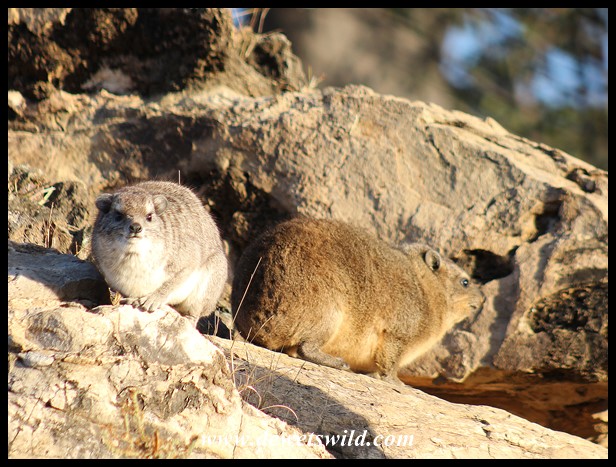
Yellow-spotted Rock Hyrax (left) and Rock Hyrax (right) sharing the sun in Mapungubwe

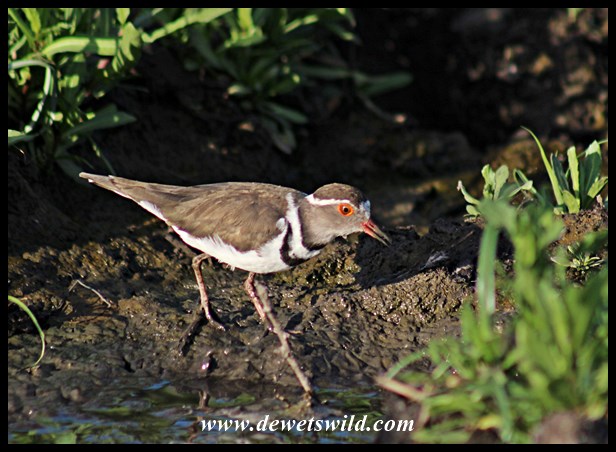
Three-banded Plover

Charadrius tricollaris

Three-banded Plovers inhabit the open, often muddy, shores of freshwater and brackish habitats, natural or man-made, and feed on a wide variety of worms, insects, molluscs, crustaceans and other invertebrates foraged from the water’s edge. They are usually seen singly or in pairs, with small flocks of up to 20 a rare occurrence. Adult Three-banded Plovers weigh between 28 and 45g, with a wingspan of around 46cm.

Nests are little more than well camouflaged scrapes in the ground, placed near the water among gravel, pebbles, rocks or other debris, in which one or two eggs are incubated by both parents for around four weeks. Pairs vigorously defend their territories from other Three-banded Plovers and even other kinds of birds. The chicks fledge about three weeks after hatching, but remain with their parents until they’re about 6 weeks old. This species breeds throughout the year.

The Three-banded Plover occurs all over South Africa, and has expanded its range in recent times thanks to the construction of artificial water bodies in otherwise arid areas. In the rest of Africa it occurs widely over the eastern and central parts of the continent and is considered of least concern by the IUCN, who sites a total population of between 70,000 and 140,000 (of which between 25,000 and 50,000 is estimated to occur south of the Zambezi River).

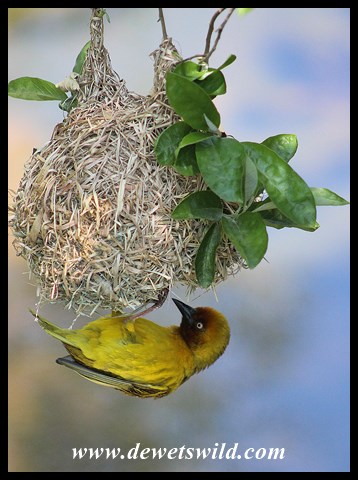
Cape Weaver

Ploceus capensis

The Cape Weaver is common in fynbos, wet highlands, coastal thickets and grasslands with easy access to water and stands of trees. It shows a marked preference for agricultural areas causing some conflict with grain and fruit farmers. It feeds on a wide range of plant material (especially seeds, fruit and nectar) and insects, often in mixed flocks with other weavers, sparrows and canaries. They weigh between 28 and 54 grams.

Cape Weavers are gregarious, nesting colonially in reeds, trees or fences (not necessarily near water) during the spring and summer months, often together with other species of weaver and bishop. Males mate with as many as 7 females in a season and has to weave several nests of grass and reeds to accommodate them – females will often tear apart nests that they find inferior. If accepted, the female will line the nest with soft vegetation and feathers and then, after mating, lies a clutch of 2-5 eggs, which she incubates for two weeks. The chicks fledge at about 17 days of age.

The Cape Weaver is a common to abundant species in South Africa, with a limited distribution outside our borders in Swaziland, Lesotho and the extreme south of Namibia along the lower Orange River, and considered of least concern by the IUCN. They are common along the Atlantic coast and adjacent interior of the Northern Cape, throughout most of the Western and Eastern Cape and Kwazulu-Natal, the eastern Free State, Gauteng and the Highveld of Mpumalanga and Limpopo Province.